


Oxidative Stress and Low-Grade Inflammation in Polycystic Ovary Syndrome: Controversies and New Insights
- PMID: 33562271
- PMCID: PMC7915804
- DOI: 10.3390/ijms22041667
Oxidative Stress and Low-Grade Inflammation in Polycystic Ovary Syndrome: Controversies and New Insights
Abstract
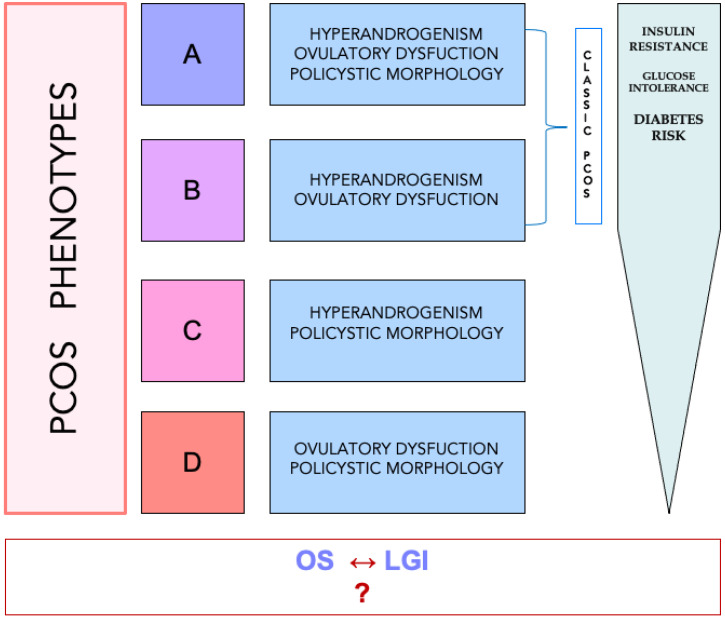
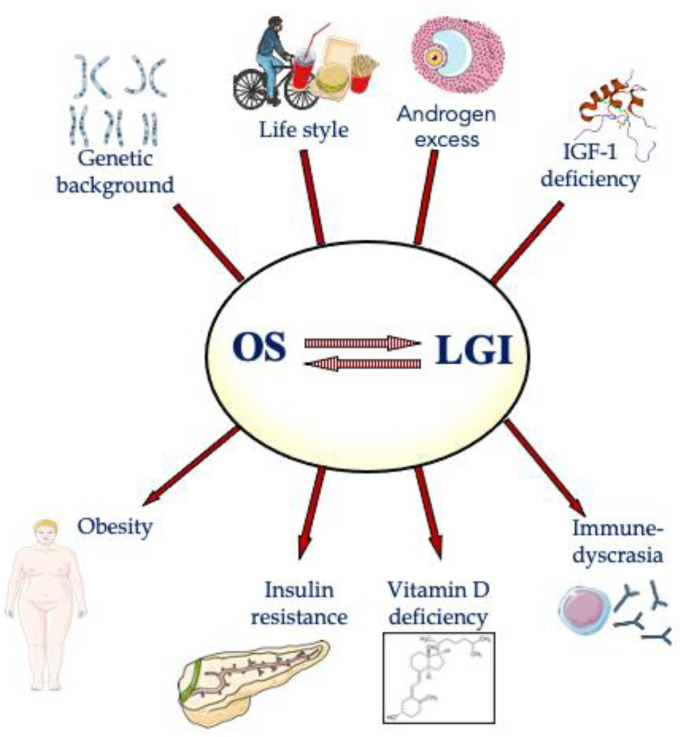
The pathophysiology of Polycystic Ovary Syndrome (PCOS) is quite complex and different mechanisms could contribute to hyperandrogenism and anovulation, which are the main features of the syndrome. Obesity and insulin-resistance are claimed as the principal factors contributing to the clinical presentation; in normal weight PCOS either, increased visceral adipose tissue has been described. However, their role is still debated, as debated are the biochemical markers linked to obesity per se. Oxidative stress (OS) and low-grade inflammation (LGI) have recently been a matter of researcher attention; they can influence each other in a reciprocal vicious cycle. In this review, we summarize the main mechanism of radical generation and the link with LGI. Furthermore, we discuss papers in favor or against the role of obesity as the first pathogenetic factor, and show how OS itself, on the contrary, can induce obesity and insulin resistance; in particular, the role of GH-IGF-1 axis is highlighted. Finally, the possible consequences on vitamin D synthesis and activation on the immune system are briefly discussed. This review intends to underline the key role of oxidative stress and low-grade inflammation in the physiopathology of PCOS, they can cause or worsen obesity, insulin-resistance, vitamin D deficiency, and immune dyscrasia, suggesting an inverse interaction to what is usually considered.
Keywords: antioxidants; hyperandrogenism; insulin-resistance; obesity.
Conflict of interest statement
The authors declare no conflict of interest.
Figures
References
-
- Fauser B.C.J.M. Revised 2003 consensus on diagnostic criteria and long-term health risks related to polycystic ovary syndrome. Fertil. Steril. 2004;81:19–25. - PubMed
-
- Ladrón de Guevara A., Fux-Otta C., Crisosto N., Szafryk de Mereshian P., Echiburú B., Iraci G., Perez-Bravo F., Sir-Petermann T. Metabolic profile of the different phenotypes of polycystic ovary syndrome in two Latin American populations. Fertil. Steril. 2014;101:1732–1739.e92. doi: 10.1016/j.fertnstert.2014.02.020. - DOI - PubMed
-
- Azziz R., Carmina E., Dewailly D., Diamanti-Kandarakis E., Escobar-Morreale H.F., Futterweit W., Janssen O.E., Legro R.S., Norman R.J., Taylor A.E., et al. The Androgen Excess and PCOS Society criteria for the polycystic ovary syndrome: The complete task force report. Fertil. Steril. 2009;91:456–488. doi: 10.1016/j.fertnstert.2008.06.035. - DOI - PubMed
-
- Azziz R., Carmina E., Dewailly D., Diamanti-Kandarakis E., Escobar-Morreale H.F., Futterweit W., Janssen O.E., Legro R.S., Norman R.J., Taylor A.E., et al. Position statement: Criteria for defining polycystic ovary syndrome as a predominantly hyperandrogenic syndrome: An androgen excess society guideline. J. Clin. Endocrinol. Metab. 2006;91:4237–4245. doi: 10.1210/jc.2006-0178. - DOI - PubMed
Publication types
MeSH terms
LinkOut - more resources
Full Text Sources
Other Literature Sources
Medical
