. 2021 Feb 5;10(4):605.
doi: 10.3390/jcm10040605.

COVID-19 in Autoinflammatory Diseases with Immunosuppressive Treatment

Affiliations

COVID-19 in Autoinflammatory Diseases with Immunosuppressive Treatment

Tatjana Welzel et al. J Clin Med. .

Abstract

COVID-19 disease increases interleukin (IL)-1β release. Anti-IL-1-treatment is effective in IL-1-mediated autoinflammatory diseases (AID). This case series presents COVID-19 in patients with IL-1-mediated and unclassified AID with immunosuppressive therapy (IT). Patient 1 is a 34-year-old woman with an unclassified AID and methotrexate. Patients 2 and 3 (14-year-old girl and 12-year-old boy, respectively) have a Cryopyrin-Associated Periodic Syndrome (NLRP3 p.Q703K heterozygous, CAPS) treated with canakinumab 150 mg/month since three and five years, respectively. Patient 4 is a 15-year-old girl who has had familial Mediterranean fever (MEFV p.M694V homozygous) for 3 years treated with canakinumab 150 mg/month and colchicine. All patients had a mild acute COVID-19 course, particularly the adolescent patients. A few weeks after COVID-19 recovery, both CAPS patients developed increased AID activity, necessitating anti-IL-1-treatment intensification in one patient. At day 100, one out of four patients (25%) showed positive antibody response to SARS-CoV-2. This is one of the first reports providing follow-up data about COVID-19 in AID. The risk for severe acute COVID-19 disease was mild/moderate, but increased AID activity post-COVID-19 was detected. Follow-up data and data combination are needed to expand understanding of COVID-19 and SARS-CoV-2 immunity in AID and the role of IT.

Keywords: CAPS; FMF; Interleukin-1; SARS-CoV-2 antibody response; autoinflammatory diseases; coronavirus.


Conflict of interest statement

T.W., S.D.S., R.K. and J.N.v.d.A. declare no conflict of interest. J.B.K.-D. received grant support and speaker’s fees from Novartis and SOBI. No external source had a role in the design of this article; in the collection, analyses, or interpretation of data; in the writing of the manuscript, or in the decision to publish this article.

Figures
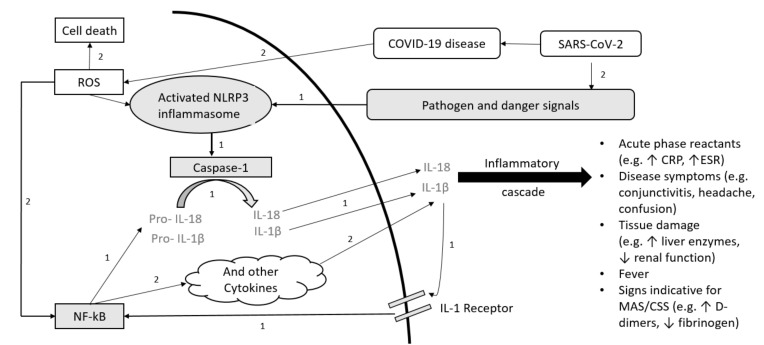
Figure 1
Figure 1
Schematic overview of the pathogenesis for IL-1-mediated autoimmune disease (AID) and COVID-19. (1.) Pathogenesis of NLRP3 Inflammasome associated AID (gray): Inflammasome formation is induced by a variety of triggers. Activated NLRP3 subsequently drives caspase-1 activation. Caspase-1 mediates transformation from pro-IL-1β and pro-IL-18 to active IL-1β and IL-18. The positive feedback loop stimulates NF-kB. (2.) SARS-CoV-2 pathogenesis (white): SARS-CoV-2 can stimulate a hyperinflammatory immune response with epithelial cell-mediated production of reactive oxygen species (ROS). ROS can stimulate NF-kB and NLRP3. Both pathways (1. and 2.) result in increased cytokine levels with laboratory signs and clinical symptoms associated with hypercytokinemia. Abbreviations: SARS-CoV-2: severe acute respiratory syndrome coronavirus 2; COVID-19: coronavirus disease 2019; ROS: reactive oxygen species; NLRP3: (NOD)-like receptor protein 3; NF-kB: nuclear factor kappa B; IL: interleukin; CRP: C-reactive protein, ESR: Erythrocyte sedimentation rate, MAS: macrophage activation syndrome; CSS: cytokine storm syndrome.
Figure 2
Figure 2
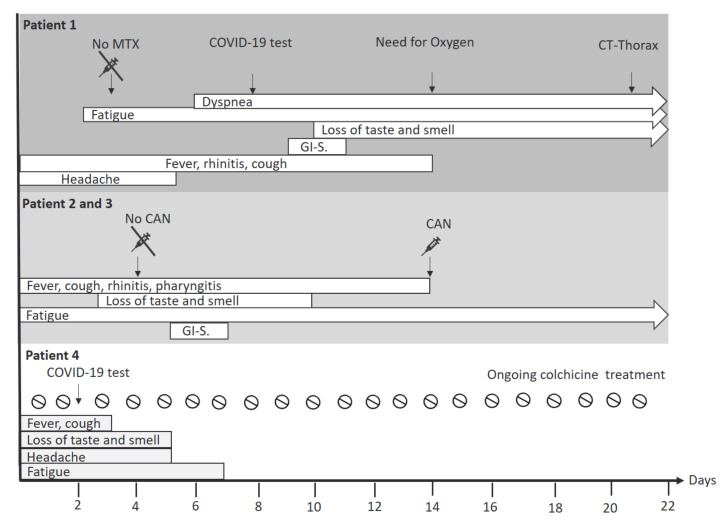
Overview of symptoms of the acute COVID-19 disease course in AID patients. Acute COVID-19 disease course was less severe in the three adolescent AID patients with canakinumab maintenance treatment as compared to the adult patient treated with methotrexate. Particularly patient 4, who was treated with daily colchicine and who had received canakinumab 150 mg s.c. 4 days before COVID-19 was confirmed, had a short and mild disease course. Abbreviations: CAN: Canakinumab; CT: Computed tomography; COVID-19: Coronavirus disease 2019; GI-S.: Gastrointestinal symptoms such as nausea, diarrhea, emesis, abdominal pain; MTX: Methotrexate. Legend: ⇨ ongoing disease symptoms on day 22 after COVID-19 onset.

References

    1. Broderick L., De Nardo D., Franklin B.S., Hoffman H.M., Latz E. The inflammasomes and autoinflammatory syndromes. Annu. Rev. Pathol. 2015;10:395–424. doi: 10.1146/annurev-pathol-012414-040431. - DOI - PubMed
    1. De Torre-Minguela C., Mesa Del Castillo P., Pelegrin P. The NLRP3 and Pyrin Inflammasomes: Implications in the Pathophysiology of Autoinflammatory Diseases. Front. Immunol. 2017;8:43. doi: 10.3389/fimmu.2017.00043. - DOI - PMC - PubMed
    1. Ozen S., Demirkaya E., Erer B., Livneh A., Ben-Chetrit E., Giancane G., Ozdogan H., Abu I., Gattorno M., Hawkins P.N., et al. EULAR recommendations for the management of familial Mediterranean fever. Ann. Rheum. Dis. 2016;75:644–651. doi: 10.1136/annrheumdis-2015-208690. - DOI - PubMed
    1. Ter Haar N.M., Oswald M., Jeyaratnam J., Anton J., Barron K.S., Brogan P.A., Cantarini L., Galeotti C., Grateau G., Hentgen V., et al. Recommendations for the management of autoinflammatory diseases. Ann. Rheum. Dis. 2015;74:1636–1644. doi: 10.1136/annrheumdis-2015-207546. - DOI - PubMed
    1. Henderson L.A., Canna S.W., Schulert G.S., Volpi S., Lee P.Y., Kernan K.F., Caricchio R., Mahmud S., Hazen M.M., Halyabar O., et al. On the alert for cytokine storm: Immunopathology in COVID-19. Arthritis Rheumatol. 2020;72:1059–1063. doi: 10.1002/art.41285. - DOI - PMC - PubMed

LinkOut - more resources