Review
. 2021 Jul;46(7):595-607.
doi: 10.1016/j.tibs.2021.01.003. Epub 2021 Feb 6.

One Ring to Rule them All? Structural and Functional Diversity in the Nuclear Pore Complex

Affiliations
Review

One Ring to Rule them All? Structural and Functional Diversity in the Nuclear Pore Complex

Javier Fernandez-Martinez et al. Trends Biochem Sci. 2021 Jul.

Abstract

The nuclear pore complex (NPC) is the massive protein assembly that regulates the transport of macromolecules between the nucleus and the cytoplasm. Recent breakthroughs have provided major insights into the structure of the NPC in different eukaryotes, revealing a previously unsuspected diversity of NPC architectures. In parallel, the NPC has been shown to be a key player in regulating essential nuclear processes such as chromatin organization, gene expression, and DNA repair. However, our knowledge of the NPC structure has not been able to address the molecular mechanisms underlying its regulatory roles. We discuss potential explanations, including the coexistence of alternative NPC architectures with specific functional roles.

Keywords: NPC; gene regulation; nuclear pore complex; nuclear transport; nucleoporin; structure.


Conflict of interest statement

Declaration of Interests The authors declare no conflicts of interest.

Figures
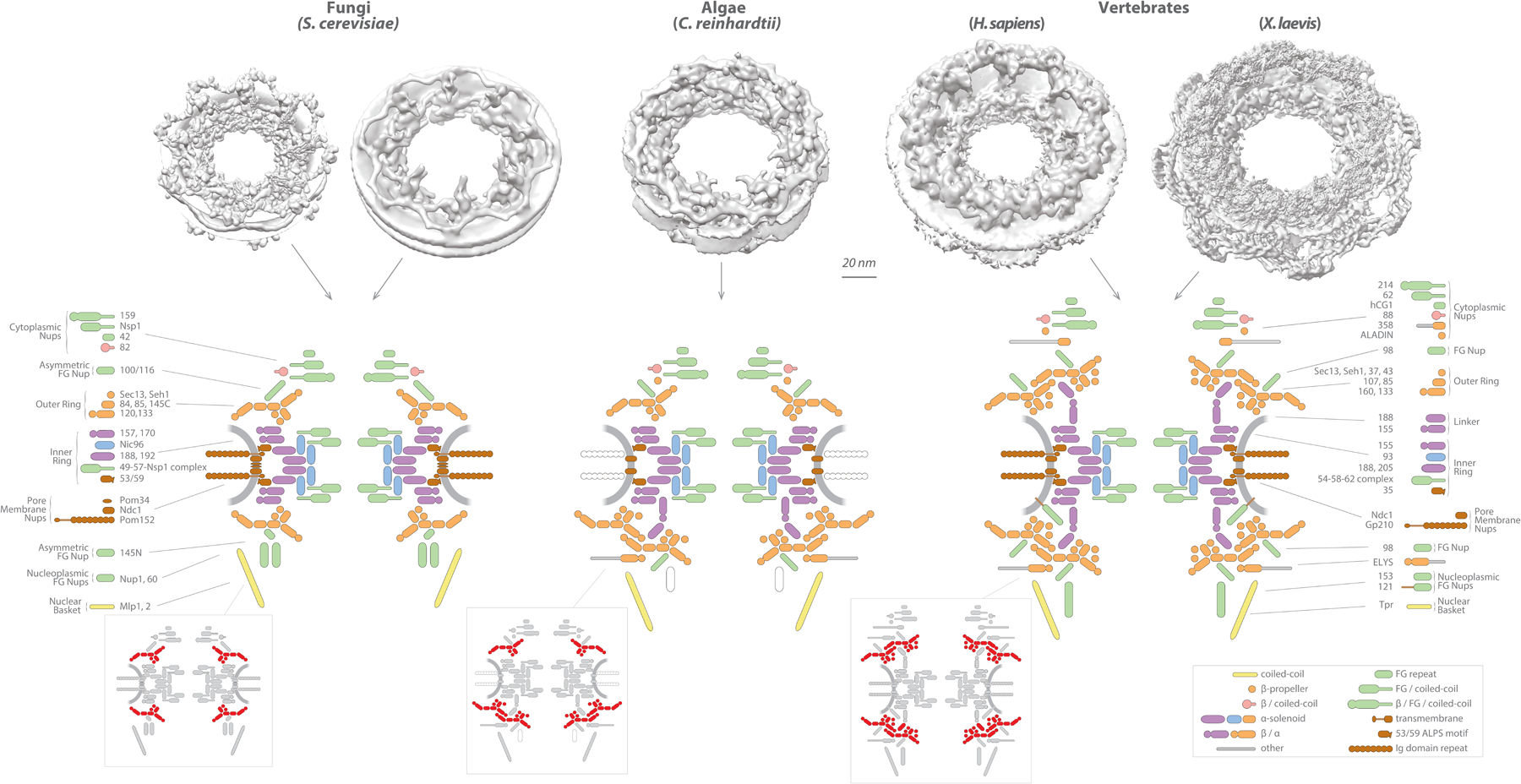
Figure 1.
Figure 1.. Structural diversity of nuclear pore complexes (NPCs) across eukaryotes.
Top row, NPC structures for the indicated organisms solved by integrative methods (left S. cerevisiae PDBDEV_00000010–12 [1]), FIB-cryo-ET (right S. cerevisiae EMD-10198 [31], and C. reinhardtii EMD-4355 [32]), cryo-ET (H. sapiens EMD-3103 [47]), or cryo-ET and single particle analysis (X. laevis, kindly shared by Gaoxingyu Huang and Yigong Xi [57, 80]). Middle row, diagrams reflecting the known composition and arrangement of the different nucleoporins (Nups) and NPC modules in S. cerevisiae (left), C. reindhardtii (middle) and H. sapiens (right). The identity of each Nup is shown to the left in S. cerevisiae or to the right of the H. sapiens diagram. Empty, non-colored shapes indicate a non-identified component. Grey arches: nuclear envelope (NE). Bottom row, NPC diagrams showing the outer ring components in red to highlight their alternative arrangement in the different organisms. Bottom right corner, box depicting the protein folds and domains found in Nups. β / α indicates a β-propeller followed by an α-solenoid.

References

    1. Kim SJ et al. (2018) Integrative structure and functional anatomy of a nuclear pore complex. Nature 555 (7697), 475–482. - PMC - PubMed
    1. Rout MP et al. , The yeast nuclear pore complex: composition, architecture, and transport mechanism, The Journal of Cell Biology, 2000, pp. 635–651. - PMC - PubMed
    1. Ori A et al. (2013) Cell type-specific nuclear pores: a case in point for context-dependent stoichiometry of molecular machines. Mol Syst Biol 9, 648. - PMC - PubMed
    1. Wente SR and Rout MP, The Nuclear Pore Complex and Nuclear Transport, Cold Spring Harbor Perspectives in Biology, 2010, pp. a000562–a000562. - PMC - PubMed
    1. Sakiyama Y et al. (2017) Structural dynamics of the nuclear pore complex. Semin Cell Dev Biol 68, 27–33. - PubMed

Publication types

Substances

LinkOut - more resources
