Case Reports
. 2021 Jan 25:2021:6684254.
doi: 10.1155/2021/6684254. eCollection 2021.

Malignant Transformation of Temporal Bone Schneiderian Papilloma Associated with HPV-6

Affiliations
Case Reports

Malignant Transformation of Temporal Bone Schneiderian Papilloma Associated with HPV-6

O Marzouk et al. Case Rep Otolaryngol. .

Abstract

Introduction: Temporal bone Schneiderian papillomas (TBSPs) rarely present as a primary tumors arising from the middle ear and mastoid process. The clinical findings and imaging of TBSPs are not specific. Therefore, diagnosis can only reliably be definitively established by histopathology.

Objective: To report a novel case of a malignant transformation of TBSP associated with HPV-6 and to present its management. Case Report. A 68-year-old woman presented with conductive hearing loss and recurrent right-sided otorrhoea. Initially, we performed a lateral temporal bone resection and obliteration with abdomen fat. Early histology described TBSP associated with HPV-6. Follow-up detected malignant transformation of the Schneiderian papillomatous variant. Postoperative radiotherapy combined with extended temporal bone resection resulted in a disease-free 17-month period of follow-up. Discussion. TBSPs are not very specific, and the diagnosis can only reliably be established by histopathology. There is a risk of malignant transformation, and due to the absence of reliable prognostic markers, strict postoperative follow-up is mandatory and should consist of regular otoscopy, nasal endoscopy, and imaging. This case also supports the importance of extended temporal bone resections as salvage surgery, combining radical surgery with radiotherapy for improved survival rates.


Conflict of interest statement

The authors declare that there are no conflicts of interest.

Figures
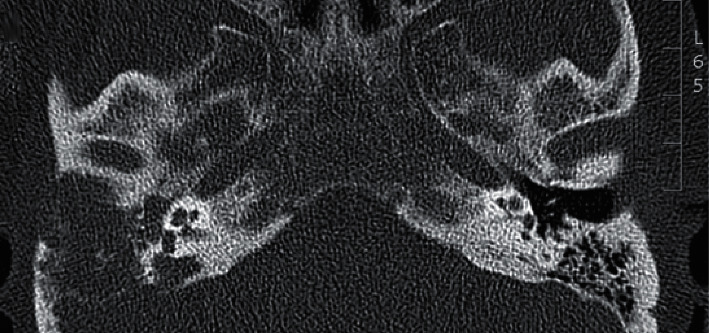
Figure 1
Figure 1
Axial view of the initial temporal CT showed complete opacification of the external auditory canal, middle ear, and mastoid on the right side indicating a soft tissue mass.
Figure 2
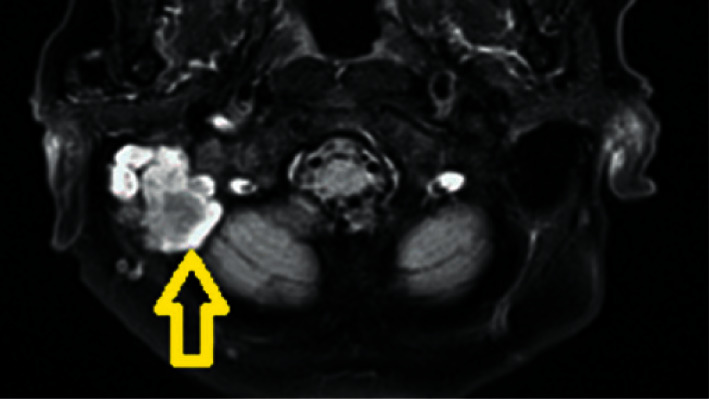
Figure 2
Initial T2-weighted magnetic resonance imaging revealing a mass occupying the right middle ear and mastoid (yellow arrow).
Figure 3
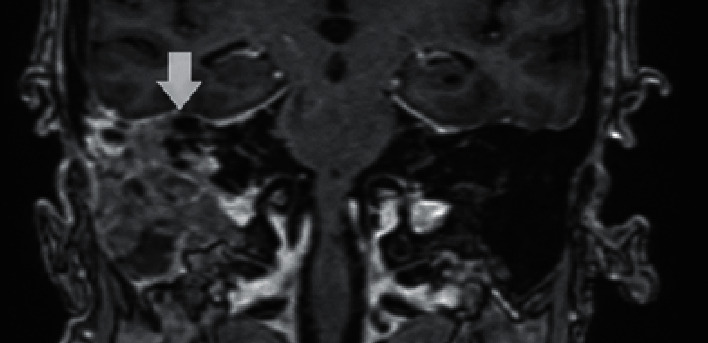
Figure 3
Initial coronal MRI demonstrating a heterogenous tissue mass in the right middle ear mastoid up to the dura of the middle cranial dura (white arrow).
Figure 4
Figure 4
Axial view of temporal CT 5 months after the initial surgery showing complete opacification and massive bone erosion of the middle ear and mastoid on the right side indicating an extended soft tissue mass adjacent to the carotid canal (red arrow) and jugular bulb (blue arrow) and partially obliterating the temporal mandibular joint.
Figure 5
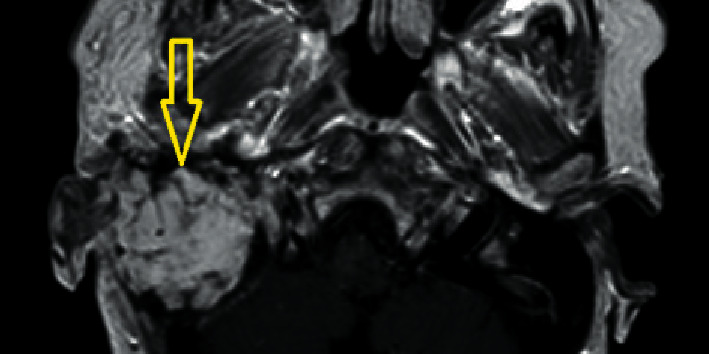
Figure 5
Axial T1-weighted MRI with gadolinium revealed obliteration with abdominal fat (yellow arrow) without any residual tumor 16 months after the extended temporal bone resection.
Figure 6
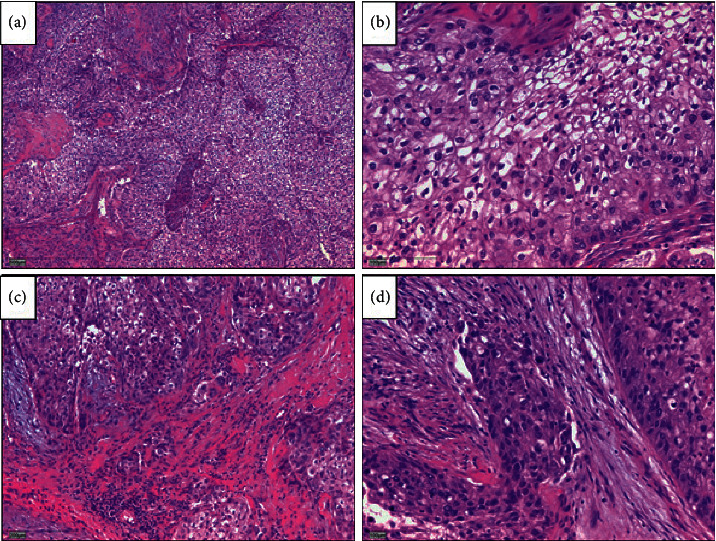
Figure 6
Histopathology revealing parts of the surgical specimen widely occupied by extensions of the temporal bone Schneider papilloma after complete temporal bone resection. Cellular atypia and increased mitoses demonstrate the transition to an invasive, moderately differentiated, nonkeratinizing squamous cell carcinoma.

References

    1. Mirza S., Bradley P. J., Acharya A., Stacey M., Jones N. S. Sinonasal inverted papillomas: recurrence, and synchronous and metachronous malignancy. The Journal of Laryngology & Otology. 2007;121(9):857–664. doi: 10.1017/s002221510700624x. - DOI - PubMed
    1. Ramey S. J., Russo J. K., Condrey J. M., 3rd., Coulter B., Sharma A. K. Synchronous bilateral inverted papilloma of the temporal bone: case report and review of the literature. Head & Neck. 2013;35(8):240–245. doi: 10.1002/hed.23073. - DOI - PubMed
    1. Kaddour H. S., Woodhead C. J. Transitional papilloma of the middle ear. The Journal of Laryngology & Otology. 1992;106(7):628–629. doi: 10.1017/s0022215100120377. - DOI - PubMed
    1. Wenig B. M. Schneiderian-type mucosal papillomas of the middle ear and mastoid. Annals of Otology, Rhinology & Laryngology. 1996;105(3):226–233. doi: 10.1177/000348949610500310. - DOI - PubMed
    1. Schaefer N., Chong J., Griffin A., Little A., Gochee P., Dixon N. Schneiderian-type papilloma of the middle ear: a review of the literature. International Surgery. 2015;100(6):989–993. doi: 10.9738/intsurg-d-14-00242.1. - DOI - PMC - PubMed

Publication types

LinkOut - more resources