


Efficacy-based and normative interventions for facilitating the diffusion of conservation behavior through social networks
- PMID: 33565650
- PMCID: PMC8360073
- DOI: 10.1111/cobi.13717
Efficacy-based and normative interventions for facilitating the diffusion of conservation behavior through social networks
Abstract
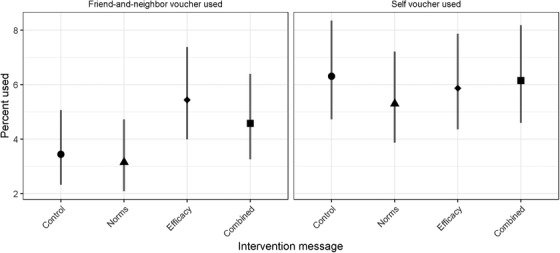
Research suggests that encouraging motivated residents to reach out to others in their social network is an effective strategy for increasing the scale and speed of conservation action adoption. However, little is known about how to effectively encourage large numbers of residents to reach out to others about conservation causes. We examined the influence of normative and efficacy-based messaging at motivating residents to engage in and to encourage others to participate in native plant gardening in their community. To do so, we conducted a field experiment with messages on mailings and tracked native plant vouchers used. Efficacy messages tended to be more effective than normative messages at increasing residents' willingness to reach out to others to encourage conservation action, as indicated by a several percentage point increase in native plant voucher use by residents' friends and neighbors. Messages sometimes had different impacts on residents based on past behaviors and perceptions related to native plant gardening. Among these subgroups, efficacy and combined efficacy and norm messages most effectively encouraged individual and collective actions, as indicated by increased voucher usage. Our findings suggest that interventions that build residents' efficacy for engaging in a conservation behavior and for reaching out to others may be a promising path forward for outreach. However, given our results were significant at a false discovery rate cutoff of 0.25 but not 0.05, more experimental trials are needed to determine the robustness of these trends.
Intervenciones Normativas y Basadas en la Eficiencia para Facilitar la Difusión del Comportamiento de Conservación por Medio de las Redes Sociales Resumen Las investigaciones sugieren que alentar a los residentes motivados para que se comuniquen con otros en sus redes sociales es una estrategia efectiva para incrementar la escala y velocidad de la adopción de las acciones de conservación. Sin embargo, se sabe poco sobre cómo alentar de manera efectiva a un gran número de residentes para que hablen con otros sobre las causas de la conservación. Examinamos la influencia de la mensajería normativa y basada en la eficiencia sobre la motivación de los residentes para ellos mismos participar y alentar a otros a participar en la jardinería de plantas nativas dentro de su comunidad. Para lograr esto, realizamos un experimento de campo con mensajes en los envíos y rastreo de los vales usados para plantas nativas. Los mensajes de eficiencia tendieron a ser más efectivos que los mensajes normativos para incrementar la voluntad de los residentes para alentar a otros a tomar acciones de conservación, como lo indicó el incremento de varios puntos porcentuales en el uso de vales para plantas nativas de los amigos y vecinos de los residentes. Los mensajes a veces tuvieron un impacto diferente sobre los residentes con base en los comportamientos pasados y las percepciones relacionadas con la jardinería de plantas nativas. Entre estos subgrupos, la eficiencia, la eficiencia combinada y los mensajes normativos fueron los factores que alentaron de manera más efectiva las acciones individuales y colectivas, como lo indicó el incremento en el uso de vales. Nuestros hallazgos sugieren que las intervenciones que construyen la eficiencia de los residentes para participar en el comportamiento de conservación y para comunicarse con otros sobre éstas puede ser un camino prometedor para la divulgación. Sin embargo, ya que nuestros resultados fueron significativos a una tasa límite de descubrimientos falsos de 0.25 y no 0.05, se requieren más pruebas experimentales para determinar la fortaleza de estas tendencias.
Keywords: comportamiento de conservación; conservation behavior; conservation psychology; efficacy; eficiencia; encuadre; framing; mensajería; messaging; normas; norms; psicología de la conservación.
© 2021 The Authors. Conservation Biology published by Wiley Periodicals LLC on behalf of Society for Conservation Biology.
Figures
References
-
- Abrahamse, W., & Steg, L. (2013). Social influence approaches to encourage resource conservation: A meta‐analysis. Global Environmental Change, 23: 1773–1785.
-
- Amel, E., Manning, C., Scott, B., & Koger, S. (2017). Beyond the roots of human inaction: Fostering collective effort toward ecosystem conservation. Science, 356: 275–279. - PubMed
-
- Bandura, A. (1998). Personal and collective efficacy in human adaptation and change. Advances in Psychological Science, 1: 51–71.
-
- Belaire, J. A., Whelan, C. J., & Minor, E. S. (2014). Having our yards and sharing them too: The collective effects of yards on native bird species in an urban landscape. Ecological Applications, 24: 2132–2143. - PubMed
-
- Benjamini, Y., & Hochberg, Y. (1995). Controlling the false discovery rate: A practical and powerful approach to multiple testing. Journal of the Royal Statistical Society: Series B (Methodological), 57(1), 289–300.
Publication types
MeSH terms
Grants and funding
LinkOut - more resources
Full Text Sources
Other Literature Sources
Miscellaneous
