


Serum neurofilament light in MS: The first true blood-based biomarker?
- PMID: 33565908
- PMCID: PMC9315170
- DOI: 10.1177/1352458521993066
Serum neurofilament light in MS: The first true blood-based biomarker?
Abstract
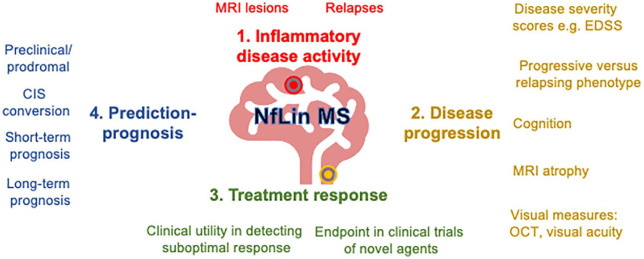
A simple blood-derived biomarker is desirable in the routine management of multiple sclerosis (MS) patients and serum neurofilament light chain (sNfL) is the most promising candidate. Although its utility was first shown in cerebrospinal fluid (CSF), technological advancements have enabled reliable detection in serum and less frequently plasma, obviating the need for repeated lumbar punctures. In this review, after defining the knowledge gap in MS management that many hope sNfL could fill, we summarize salient studies demonstrating associations of sNfL levels with outcomes of interest. We group these outcomes into inflammatory activity, progression, treatment response, and prediction/prognosis. Where possible we focus on data from real-world perspective observational cohorts. While acknowledging the limitations of sNfL and highlighting key areas for ongoing work, we conclude with our opinion of the role for sNfL as an objective, convenient, and cost-effective adjunct to clinical assessment. Paving the way for other promising biomarkers both blood-derived and otherwise, sNfL is an incremental step toward precision medicine for MS patients.
Keywords: Neurofilament light chain; biomarkers; multiple sclerosis.
Conflict of interest statement
Figures
References
-
- Giovannoni G. Disease-modifying treatments for early and advanced multiple sclerosis. Curr Opin Neurol 2018; 31: 233–243. - PubMed
-
- Sartori A, Abdoli M, Freedman MS. Can we predict benign multiple sclerosis? Results of a 20-year long-term follow-up study. J Neurol 2017; 264(6): 1068–1075 - PubMed
-
- Comabella M, Montalban X. Body fluid biomarkers in multiple sclerosis. Lancet Neurol 2014; 13(1): 113–126. - PubMed
-
- Wattjes MP, Rovira Miller ÀD, Yousry TA, et al. Evidence—based guidelines: MAGNIMS consensus guidelines on the use of MRI in multiple sclerosis—Establishing disease prognosis and monitoring patients. Nature Rev Neurol 2015; 11: 597–606. - PubMed
-
- Wattjes MP, Steenwijk MD, Stangel M. MRI in the diagnosis and monitoring of multiple sclerosis: An update. Clin Neuroradiol 2015; 25: 157–165. - PubMed
Publication types
MeSH terms
Substances
LinkOut - more resources
Full Text Sources
Other Literature Sources
Medical
Miscellaneous
