


How Social Media Use at Work Affects Improvement of Older People's Willingness to Delay Retirement During Transfer From Demographic Bonus to Health Bonus: Causal Relationship Empirical Study
- PMID: 33565983
- PMCID: PMC7904398
- DOI: 10.2196/18264
How Social Media Use at Work Affects Improvement of Older People's Willingness to Delay Retirement During Transfer From Demographic Bonus to Health Bonus: Causal Relationship Empirical Study
Abstract
Background: With the increased older population in China and the subsequent reduced labor force, the "demographic bonus" is disappearing. The Chinese government proposed a Healthy China strategy in 2017. The transfer of the demographic bonus to a "health bonus" extended the working life of people and reduced the negative impact of the population's aging on the labor force structure.
Objective: This research focuses on the effect of older workers' social media usage at work on their work ability (related to both physical and mental health) and thus their willingness to delay retirement.
Methods: The questionnaire respondents were older than 55 years, and they obtained the questionnaire from social media, from June to July 2018. A total of 1020 valid questionnaires were collected, and SmartPLS 3.28 (SmartPLS GmbH) was used to analyze the data. Effects were analyzed using 2-tailed t tests.
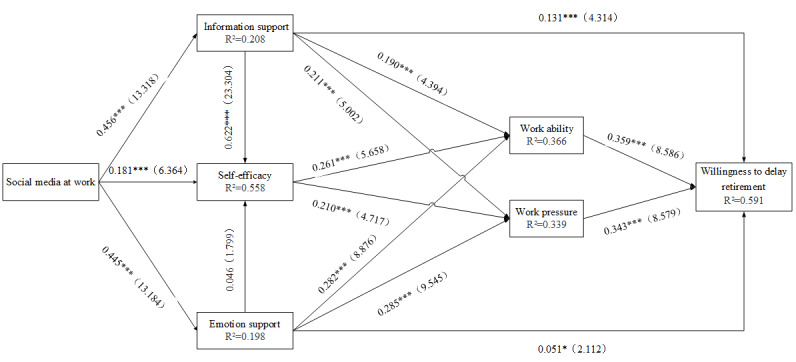
Results: (1) Use of social media at work can improve information support (t14=13.318, P<.001), emotional support (t14=13.184, P<.001), and self-efficacy (t14=6.364, P<.001) for older people; (2) information support is the main factor affecting the self-efficacy of older workers (t14=23.304, P<.001), as compared with emotional support (t14=1.799, P=0.07); (3) the impacts of emotional support on work ability (t14=8.876, P<.001) and work stress (t14=9.545, P<.001) are generally higher than those of information support (t14=4.394, P<.001; t14=5.002, P<.001); (4) self-efficacy has an impact on work ability (t14=5.658, P<.001) and work stress (t14=4.717, P<.001); and (5) the impacts of work ability (t14=8.586, P<.001) and work stress (t14=8.579, P<.001) on retirement willingness are greater than those of emotional support (t14=2.112, P=.04) and information support (t14=4.314, P<.001).
Conclusions: Our study confirms that the use of social media at work has a positive impact on older workers. Based on the findings, we have put forward proposals to extend people's working lives and help governments implement health bonus policies. In the future, we will compare the different values of willingness to delay retirement among older people in different occupations and different cultures.
Keywords: delayed retirement; older workers; social media; social support; work ability.
©Yiming Ma, Changyong Liang, Dongxiao Gu, Shuping Zhao, Xuejie Yang, Xiaoyu Wang. Originally published in the Journal of Medical Internet Research (http://www.jmir.org), 10.02.2021.
Conflict of interest statement
Conflicts of Interest: None declared.
Figures
References
-
- WHO . Mental health of older adults. Geneva: World Health Organization; 2017. [2021-01-15]. http://www.who.int/en/news-room/fact-sheets/detail/mental-health-of-olde....
-
- Bloom DE, Canning D, Fink G, Finlay JE. Fertility, female labor force participation, and the demographic dividend. J Econ Growth. 2009 May 5;14(2):79–101. doi: 10.1007/s10887-009-9039-9. - DOI
-
- WHO . World health statistics 2016: monitoring health for the SDGs sustainable development goals. Geneva: World Health Organization; 2016.
-
- Mason A, Lee R. Reform and support systems for the elderly in developing countries: capturing the second demographic dividend. Genus. 2006;62(2):11–35.
-
- Hongchun Wang. From Demographic Bonus to Health Bonus. Medicine & Philosophy. 2006;(05):21–22. https://kns.cnki.net/kcms/detail/detail.aspx?FileName=YXZX200605009&DbNa...
Publication types
MeSH terms
LinkOut - more resources
Full Text Sources
Other Literature Sources
Medical
Research Materials
