Factors Associated With Real-Life Functioning in Persons With Schizophrenia in a 4-Year Follow-up Study of the Italian Network for Research on Psychoses
- PMID: 33566071
- PMCID: PMC7876615
- DOI: 10.1001/jamapsychiatry.2020.4614
Factors Associated With Real-Life Functioning in Persons With Schizophrenia in a 4-Year Follow-up Study of the Italian Network for Research on Psychoses
Abstract
Importance: The goal of schizophrenia treatment has shifted from symptom reduction and relapse prevention to functional recovery; however, recovery rates remain low. Prospective identification of variables associated with real-life functioning domains is essential for personalized and integrated treatment programs.
Objective: To assess whether baseline illness-related variables, personal resources, and context-related factors are associated with work skills, interpersonal relationships, and everyday life skills at 4-year follow-up.
Design, setting, and participants: This multicenter prospective cohort study was conducted across 24 Italian university psychiatric clinics or mental health departments in which 921 patients enrolled in a cross-sectional study were contacted after 4 years for reassessment. Recruitment of community-dwelling, clinically stable persons with schizophrenia was conducted from March 2016 to December 2017, and data were analyzed from January to May 2020.
Main outcomes and measures: Psychopathology, social and nonsocial cognition, functional capacity, personal resources, and context-related factors were assessed, with real-life functioning as the main outcome. Structural equation modeling, multiple regression analyses, and latent change score modeling were used to identify variables that were associated with real-life functioning domains at follow-up and with changes from baseline in these domains.
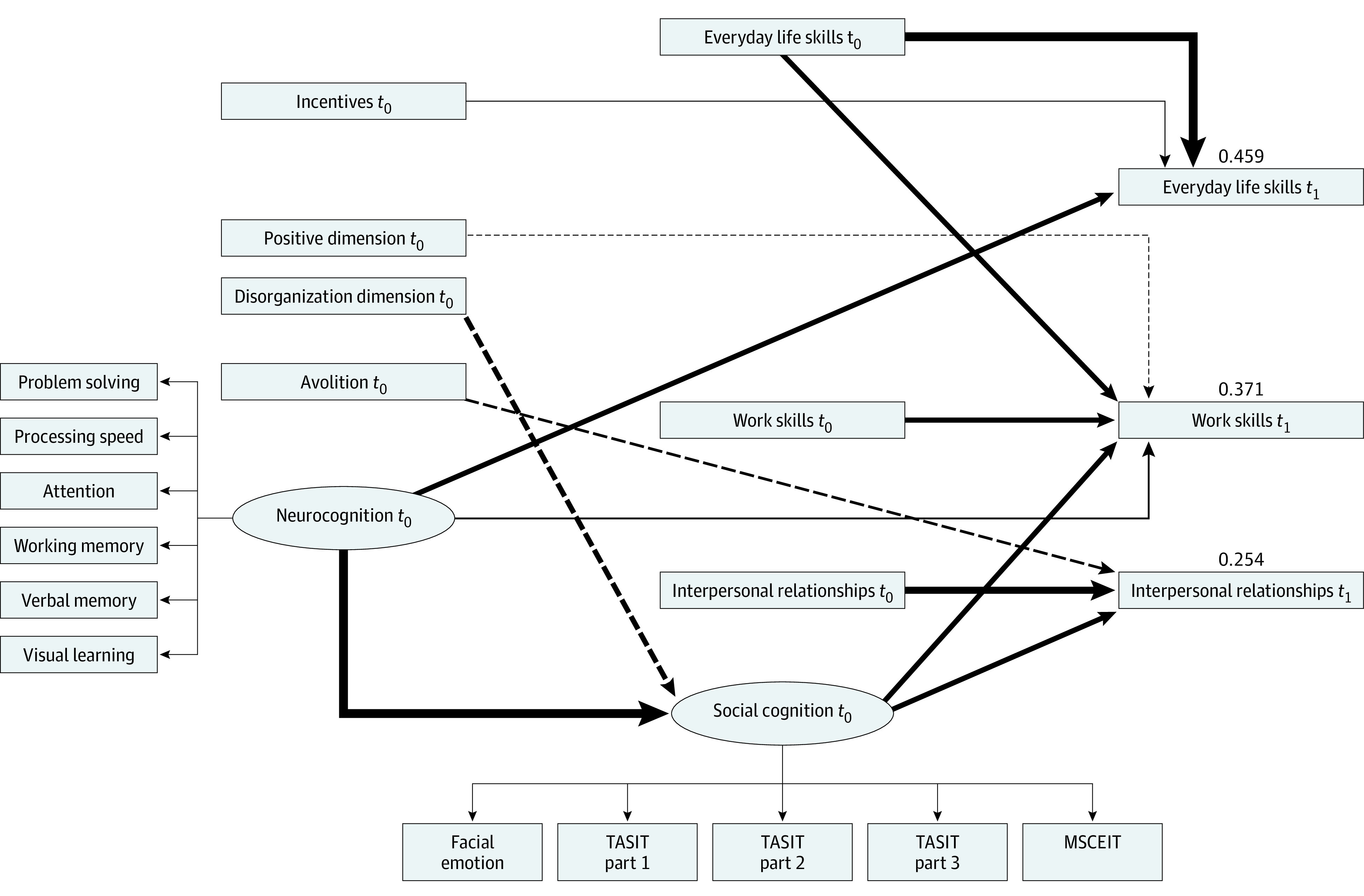
Results: In total, 618 participants (427 male [69.1%]; mean [SD] age, 45.1 [10.5] years) were included. Five baseline variables were directly associated with real-life functioning at follow-up: neurocognition with everyday life (β, 0.274; 95% CI, 0.207-0.341; P < .001) and work (β, 0.101; 95% CI, 0.005-0.196; P = .04) skills; avolition with interpersonal relationships (β, -0.126; 95% CI, -0.190 to -0.062; P < .001); positive symptoms with work skills (β, -0.059; 95% CI, -0.112 to -0.006; P = .03); and social cognition with work skills (β, 0.185; 95% CI, 0.088-0.283; P < .001) and interpersonal functioning (β, 0.194; 95% CI, 0.121-0.268; P < .001). Multiple regression analyses indicated that these variables accounted for the variability of functioning at follow-up after controlling for baseline functioning. In the latent change score model, higher neurocognitive abilities were associated with improvement of everyday life (β, 0.370; 95% CI, 0.253-0.486; P < .001) and work (β, 0.102; 95% CI, 0.016-0.188; P = .02) skills, social cognition (β, 0.133; 95% CI, 0.015-0.250; P = .03), and functional capacity (β, 1.138; 95% CI, 0.807-1.469; P < .001); better baseline social cognition with improvement of work skills (β, 0.168; 95% CI, 0.075-0.261; P < .001) and interpersonal functioning (β, 0.140; 95% CI, 0.069-0.212; P < .001); and better baseline everyday life skills with improvement of work skills (β, 0.121; 95% CI, 0.077-0.166; P < .001).
Conclusions and relevance: Findings of this large prospective study suggested that baseline variables associated with functional outcome at follow-up included domains not routinely assessed and targeted by intervention programs in community mental health services. The key roles of social and nonsocial cognition and of baseline everyday life skills support the adoption in routine mental health care of cognitive training programs combined with personalized psychosocial interventions aimed to promote independent living.
Conflict of interest statement
Figures
References
-
- Galderisi S, Rossi A, Rocca P, et al. ; Italian Network For Research on Psychoses . The influence of illness-related variables, personal resources and context-related factors on real-life functioning of people with schizophrenia. World Psychiatry. 2014;13(3):275-287. doi: 10.1002/wps.20167 - DOI - PMC - PubMed
Publication types
MeSH terms
LinkOut - more resources
Full Text Sources
Other Literature Sources
Medical