Randomized Trial of a Vaccine Regimen to Prevent Chronic HCV Infection
- PMID: 33567193
- PMCID: PMC8367093
- DOI: 10.1056/NEJMoa2023345
Randomized Trial of a Vaccine Regimen to Prevent Chronic HCV Infection
Abstract
Background: A safe and effective vaccine to prevent chronic hepatitis C virus (HCV) infection is a critical component of efforts to eliminate the disease.
Methods: In this phase 1-2 randomized, double-blind, placebo-controlled trial, we evaluated a recombinant chimpanzee adenovirus 3 vector priming vaccination followed by a recombinant modified vaccinia Ankara boost; both vaccines encode HCV nonstructural proteins. Adults who were considered to be at risk for HCV infection on the basis of a history of recent injection drug use were randomly assigned (in a 1:1 ratio) to receive vaccine or placebo on days 0 and 56. Vaccine-related serious adverse events, severe local or systemic adverse events, and laboratory adverse events were the primary safety end points. The primary efficacy end point was chronic HCV infection, defined as persistent viremia for 6 months.
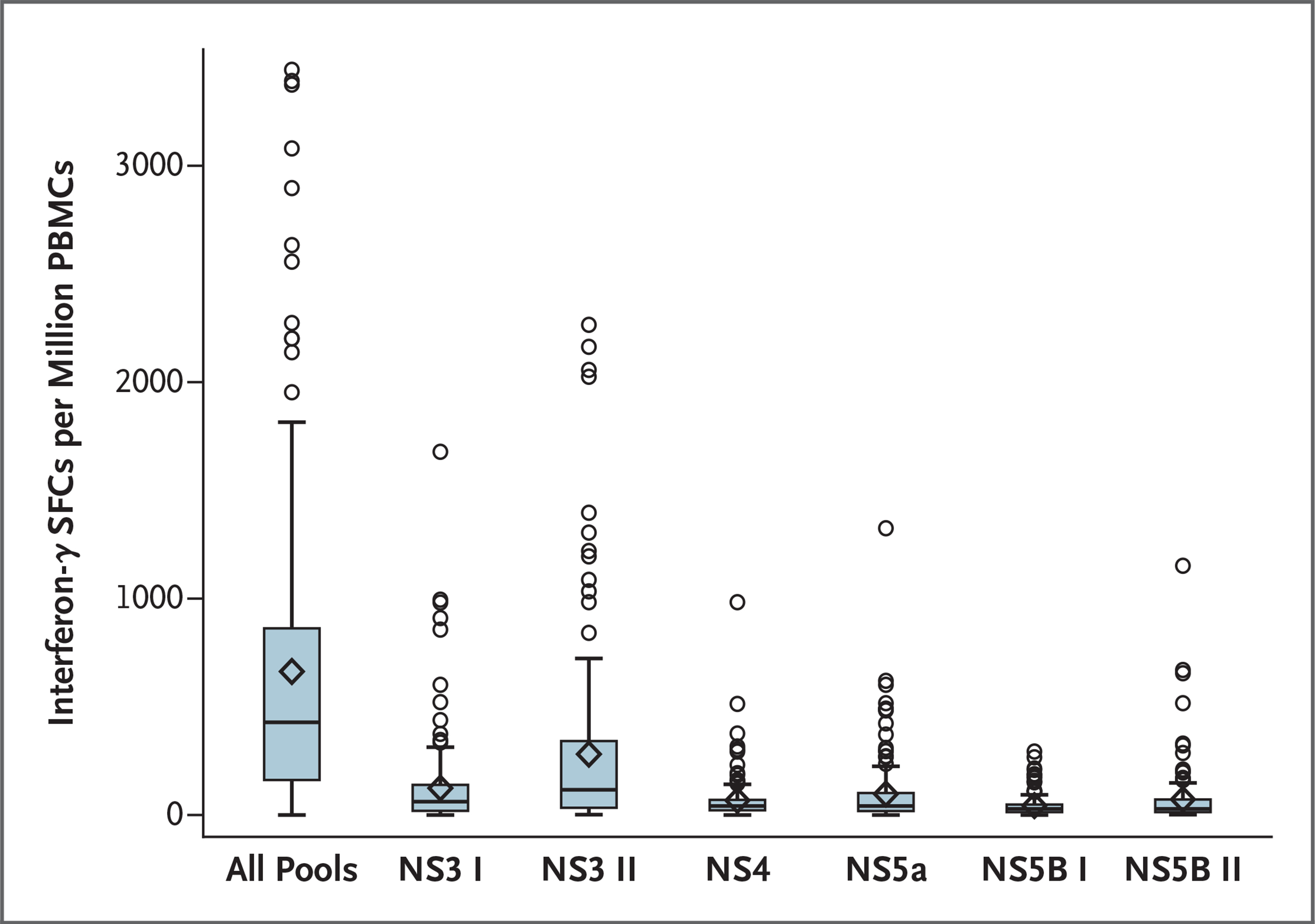
Results: A total of 548 participants underwent randomization, with 274 assigned to each group. There was no significant difference in the incidence of chronic HCV infection between the groups. In the per-protocol population, chronic HCV infection developed in 14 participants in each group (hazard ratio [vaccine vs. placebo], 1.53; 95% confidence interval [CI], 0.66 to 3.55; vaccine efficacy, -53%; 95% CI, -255 to 34). In the modified intention-to-treat population, chronic HCV infection developed in 19 participants in the vaccine group and 17 in placebo group (hazard ratio, 1.66; 95% CI, 0.79 to 3.50; vaccine efficacy, -66%; 95% CI, -250 to 21). The geometric mean peak HCV RNA level after infection differed between the vaccine group and the placebo group (152.51×10³ IU per milliliter and 1804.93×103 IU per milliliter, respectively). T-cell responses to HCV were detected in 78% of the participants in the vaccine group. The percentages of participants with serious adverse events were similar in the two groups.
Conclusions: In this trial, the HCV vaccine regimen did not cause serious adverse events, produced HCV-specific T-cell responses, and lowered the peak HCV RNA level, but it did not prevent chronic HCV infection. (Funded by the National Institute of Allergy and Infectious Diseases; ClinicalTrials.gov number, NCT01436357.).
Copyright © 2021 Massachusetts Medical Society.
Figures
References
-
- World Health Organization. Global hepatitis report, 2017. (https://www.who.int/hepatitis/publications/global-hepatitis-report2017/en/).
-
- Razavi H, Waked I, Sarrazin C, et al. The present and future disease burden of hepatitis C virus (HCV) infection with today’s treatment paradigm. J Viral Hepat 2014;21:Suppl 1:34–59. - PubMed
Publication types
MeSH terms
Substances
Associated data
Grants and funding
LinkOut - more resources
Full Text Sources
Other Literature Sources
Medical