Review
. 2021 Jul;12(4):e1641.
doi: 10.1002/wrna.1641. Epub 2021 Feb 10.

Therapeutic promise of engineered nonsense suppressor tRNAs

Affiliations
Review

Therapeutic promise of engineered nonsense suppressor tRNAs

Joseph J Porter et al. Wiley Interdiscip Rev RNA. 2021 Jul.

Abstract

Nonsense mutations change an amino acid codon to a premature termination codon (PTC) generally through a single-nucleotide substitution. The generation of a PTC results in a defective truncated protein and often in severe forms of disease. Because of the exceedingly high prevalence of nonsense-associated diseases and a unifying mechanism, there has been a concerted effort to identify PTC therapeutics. Most clinical trials for PTC therapeutics have been conducted with small molecules that promote PTC read through and incorporation of a near-cognate amino acid. However, there is a need for PTC suppression agents that recode PTCs with the correct amino acid while being applicable to PTC mutations in many different genomic landscapes. With these characteristics, a single therapeutic will be able to treat several disease-causing PTCs. In this review, we will focus on the use of nonsense suppression technologies, in particular, suppressor tRNAs (sup-tRNAs), as possible therapeutics for correcting PTCs. Sup-tRNAs have many attractive qualities as possible therapeutic agents although there are knowledge gaps on their function in mammalian cells and technical hurdles that need to be overcome before their promise is realized. This article is categorized under: RNA Processing > tRNA Processing Translation > Translation Regulation.

Keywords: gene expression; nonsense mutation; nonsense suppression therapy; nonsense suppressor tRNA; premature termination codon mutations; readthrough; translation.


Conflict of interest statement

The authors have declared no conflicts of interest for this article.

Figures
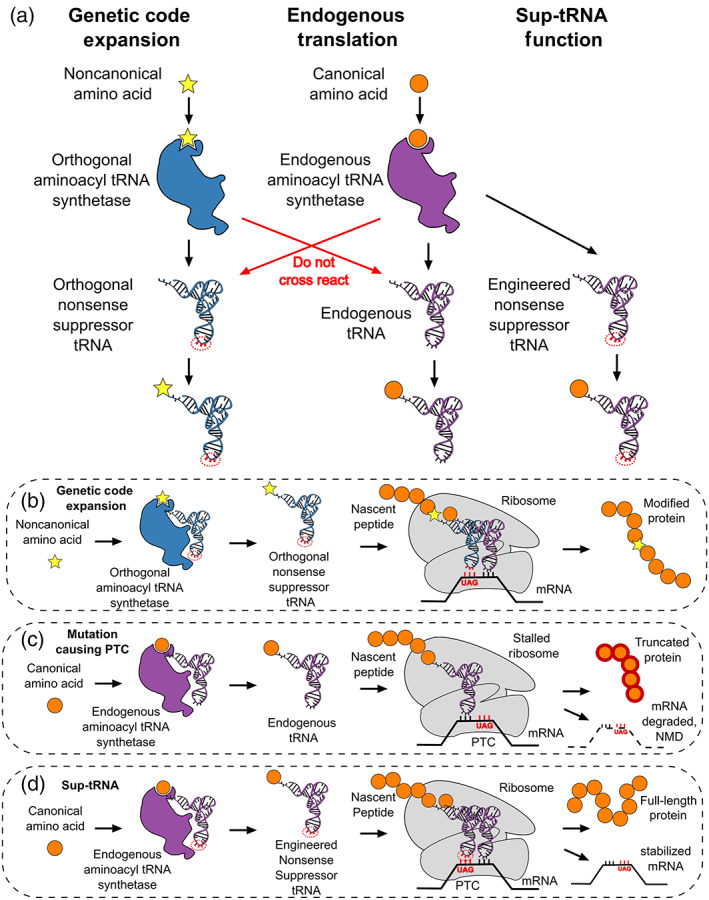
FIGURE 1
FIGURE 1
The applications of sup‐tRNAs and their function in translation. (a) Genetic code expansion involves the codon specific incorporation of a noncanonical amino acid (ncAA) into proteins in vivo. This is accomplished by introducing an orthogonal aminoacyl‐tRNA synthetase (o‐aaRS) specific for both the ncAA and its cognate orthogonal tRNA (o‐tRNA). This newly introduced pair is “orthogonal” as it does not cross‐react with any of the endogenous tRNAs or aaRSs. For genetic code expansion, the o‐tRNA most often is engineered as an amber sup‐tRNA to ensure site‐specific ncAA incorporation. In contrast, ACE‐tRNAs for therapeutic suppression of PTCs are designed to cross‐react with endogenous aaRSs while altering the anticodon to suppress a nonsense codon. (b) Genetic code expansion enables site‐specific incorporation of an ncAA by employing an o‐aaRS/amber nonsense suppressor o‐tRNA pair to suppress an amber stop codon in the mRNA of a gene of interest using cellular translation. (c) Premature termination codons (PTCs) arise from single nucleotide mutations that convert a canonical triplet nucleotide codon into a stop codon. The generation of a PTC in an mRNA causes the translating ribosome to stop, resulting in the release of a truncated protein and mRNA degradation by nonsense‐mediated decay (NMD). (d) in a manner analogous to genetic code expansion, sup‐tRNAs are charged by an endogenous aaRS leading to PTC suppression on the ribosome, seamless rescue of full‐length protein expression, and stabilization of mRNA by inhibiting NMD
FIGURE 2
FIGURE 2
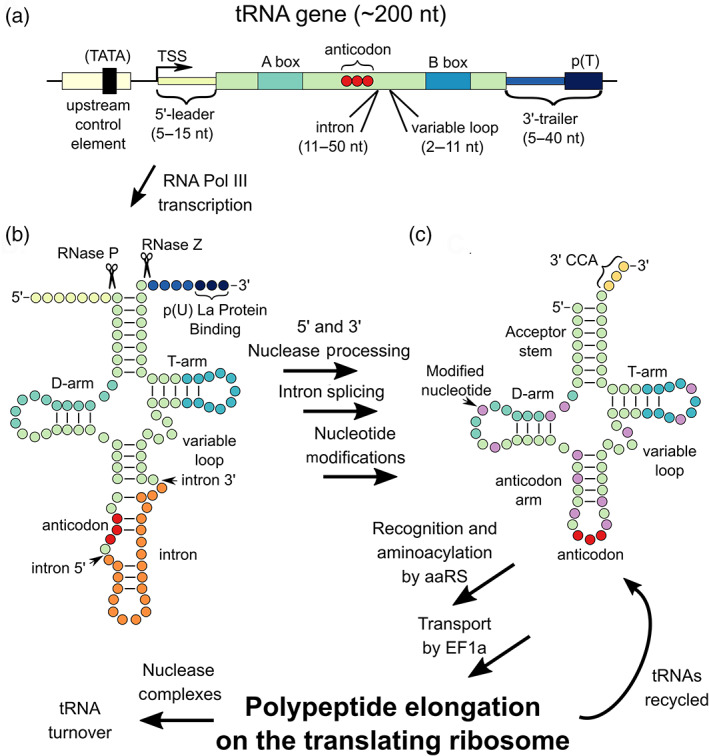
Diagram of structural and functional elements of a mammalian tRNA gene, processes involved with mammalian tRNA biogenesis, and tRNA function in translation. (a) Diagram of a typical tRNA gene containing an upstream control element containing a TATA‐box, transcription start site (TSS), 5′‐leader sequence, tRNA sequence containing internal A‐ and B‐box promoter elements, the location of the anticodon, intron, and variable loop, 3′‐trailer, and poly‐thymidine transcriptional terminator (p[T]). (b) Mammalian tRNAs are synthesized as a primary RNA transcript containing 5′‐leaders removed by RNase P, introns spliced out by the SEN complex, and 3′‐trailer removed by RNase Z or other exonucleases. The RNA chaperone La protein binds the poly‐uridine tracts at the 3′ ends of the primary transcript to stabilize the transcript and direct processing. The 3′‐terminal CCA trinucleotide common to all tRNAs is ligated to the pre‐tRNA during processing. Throughout the tRNA maturation process, 10–15 nucleotides are chemically modified by specific modification enzymes. (c) Following processing, tRNAs are aminoacylated by their cognate aminoacyl‐tRNA synthetase (aaRS), transported to the ribosome by EF1a, and finally participate in translation on the ribosome
FIGURE 3
FIGURE 3
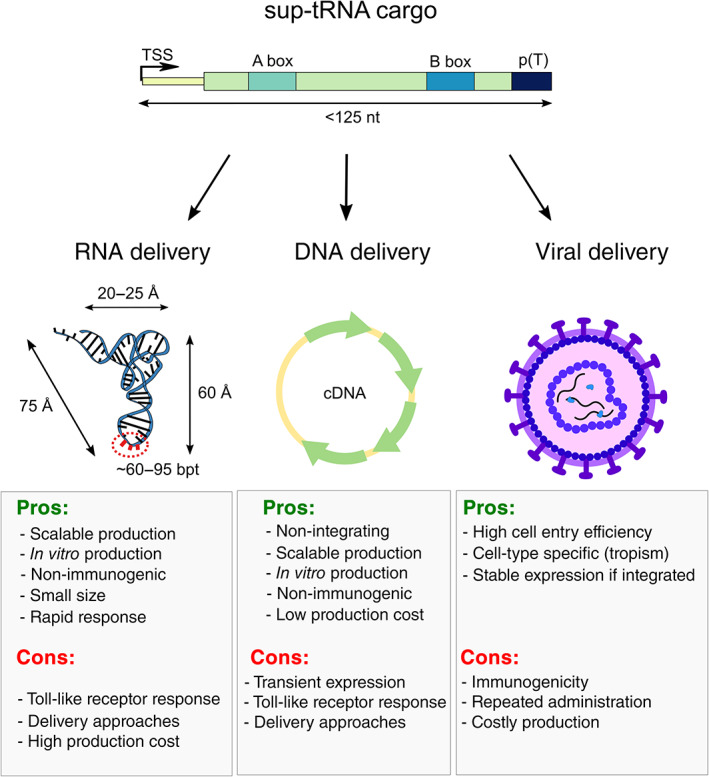
Pros and cons of sup‐tRNA delivery options. For specific elements necessary for sup‐tRNA expression from DNA or virus see Figure 2(a) or Lueck et al. (2019)

References

    1. Adachi, M. , & Cavalcanti, A. R. (2009). Tandem stop codons in ciliates that reassign stop codons. Journal of Molecular Evolution, 68(4), 424–431. 10.1007/s00239-009-9220-y - DOI - PubMed
    1. Amrani, N. , Ganesan, R. , Kervestin, S. , Mangus, D. A. , Ghosh, S. , & Jacobson, A. (2004). A faux 3'‐UTR promotes aberrant termination and triggers nonsense‐mediated mRNA decay. Nature, 432(7013), 112–118. 10.1038/nature03060 - DOI - PubMed
    1. Anderson, J. C. , Wu, N. , Santoro, S. W. , Lakshman, V. , King, D. S. , & Schultz, P. G. (2004). An expanded genetic code with a functional quadruplet codon. Proceedings of the National Academy of Sciences of the United States of America, 101(20), 7566–7571. 10.1073/pnas.0401517101 - DOI - PMC - PubMed
    1. Anderson, W. F. , Gorini, L. , & Breckenridge, L. (1965). Role of ribosomes in streptomycin‐activated suppression. Proceedings of the National Academy of Sciences of the United States of America, 54(4), 1076–1083. 10.1073/pnas.54.4.1076 - DOI - PMC - PubMed
    1. Ashton, L. J. , Brooks, D. A. , McCourt, P. A. , Muller, V. J. , Clements, P. R. , & Hopwood, J. J. (1992). Immunoquantification and enzyme kinetics of alpha‐L‐iduronidase in cultured fibroblasts from normal controls and mucopolysaccharidosis type I patients. American Journal of Human Genetics, 50(4), 787–794. - PMC - PubMed

Publication types