Review
. 2021 Feb 8;22(4):1701.
doi: 10.3390/ijms22041701.

Glutamine Synthetase as a Therapeutic Target for Cancer Treatment

Affiliations
Review

Glutamine Synthetase as a Therapeutic Target for Cancer Treatment

Go Woon Kim et al. Int J Mol Sci. .

Abstract

The significance of glutamine in cancer metabolism has been extensively studied. Cancer cells consume an excessive amount of glutamine to facilitate rapid proliferation. Thus, glutamine depletion occurs in various cancer types, especially in poorly vascularized cancers. This makes glutamine synthetase (GS), the only enzyme responsible for de novo synthesizing glutamine, essential in cancer metabolism. In cancer, GS exhibits pro-tumoral features by synthesizing glutamine, supporting nucleotide synthesis. Furthermore, GS is highly expressed in the tumor microenvironment (TME) and provides glutamine to cancer cells, allowing cancer cells to maintain sufficient glutamine level for glutamine catabolism. Glutamine catabolism, the opposite reaction of glutamine synthesis by GS, is well known for supporting cancer cell proliferation via contributing biosynthesis of various essential molecules and energy production. Either glutamine anabolism or catabolism has a critical function in cancer metabolism depending on the complex nature and microenvironment of cancers. In this review, we focus on the role of GS in a variety of cancer types and microenvironments and highlight the mechanism of GS at the transcriptional and post-translational levels. Lastly, we discuss the therapeutic implications of targeting GS in cancer.

Keywords: anticancer effect; cancer metabolism; glutamine metabolism; glutamine synthetase.


Conflict of interest statement

The authors declare no conflict of interest.

Figures
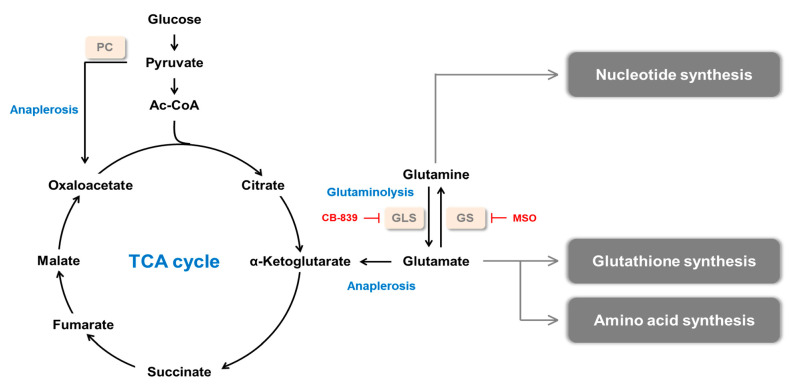
Figure 1
Figure 1
Glutamine metabolism in cancer. Glutamine synthesized by GS contributes to nucleotide synthesis. Glutamine is converted to glutamate by GLS, and glutamate is used for the biosynthesis of glutathione (GSH) and amino acid. α-ketoglutarate (α-KG) is converted from glutamate and replenishes tricarboxylic acid (TCA) cycle, supporting the synthesis of diverse macromolecules. PC: pyruvate carboxylase, GLS: glutaminase, GS: glutamine synthetase, MSO: methionine sulfoximine.
Figure 2
Figure 2
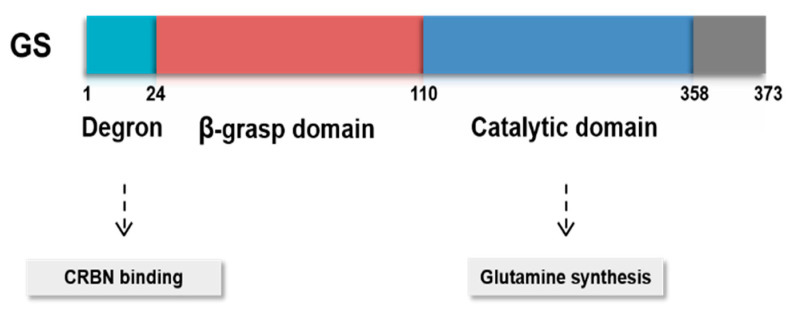
Functional domains of GS. GS possesses β-grasp domain and glutamine synthetase catalytic domain. Cereblon (CRBN) binds to GS degron, regulating its protein stability under sufficient glutamine level.
Figure 3
Figure 3
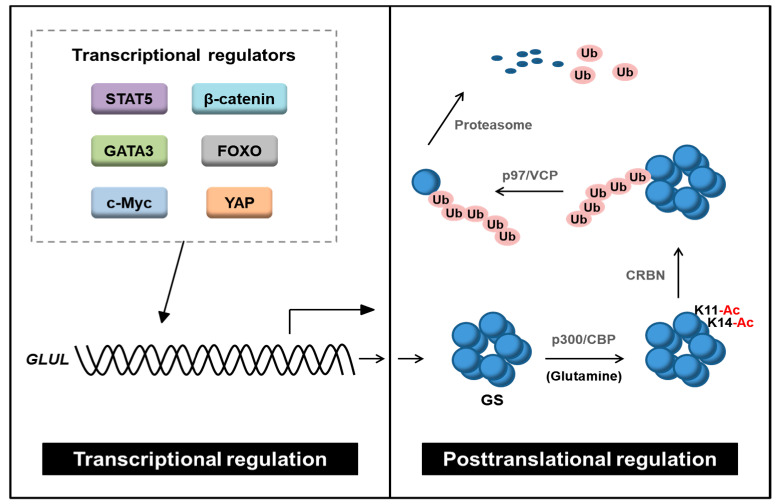
Transcriptional and posttranslational regulation of GS. GS is transcriptionally regulated by β-catenin, STAT5, GATA3, FOXO, YAP, and c-Myc. GS protein stability is regulated by acetylation. GS is acetylated by histone acetyltransferase, p300/CBP, and acetylated GS is ubiquitinated by the E3 ligase, CRBN. Ubiquitinated GS is segregated by p97/VCP and then degraded by the proteasome. STAT5: signal transducer and activator of transcription 5, GATA3: GATA Binding Protein 3, YAP: yes-associated protein, FOXO: members of the class O of forkhead box transcription factors, GS: glutamine synthetase, CBP: cyclic AMP response element-binding protein, CRBN: cereblon, Ub: ubiquitin, p97/VCP: valosin-containing protein.

References

    1. Cruzat V., Macedo Rogero M., Noel Keane K., Curi R., Newsholme P. Glutamine: Metabolism and Immune Function, Supplementation and Clinical Translation. Nutrients. 2018;10:1564. doi: 10.3390/nu10111564. - DOI - PMC - PubMed
    1. Watford M. Glutamine and glutamate metabolism across the liver sinusoid. J. Nutr. 2000;130:983S–987S. doi: 10.1093/jn/130.4.983S. - DOI - PubMed
    1. Janicki R.H., Goldstein L. Glutamine synthetase and renal ammonia metabolism. Am. J. Physiol. 1969;216:1107–1110. doi: 10.1152/ajplegacy.1969.216.5.1107. - DOI - PubMed
    1. Smith R.J., Larson S., Stred S.E., Durschlag R.P. Regulation of glutamine synthetase and glutaminase activities in cultured skeletal muscle cells. J. Cell. Physiol. 1984;120:197–203. doi: 10.1002/jcp.1041200213. - DOI - PubMed
    1. Suarez I., Bodega G., Fernandez B. Glutamine synthetase in brain: Effect of ammonia. Neurochem. Int. 2002;41:123–142. doi: 10.1016/S0197-0186(02)00033-5. - DOI - PubMed

MeSH terms

Substances

LinkOut - more resources