


Outcomes of newborn hearing screening at an academic secondary level hospital in Johannesburg, South Africa
- PMID: 33567828
- PMCID: PMC7876983
- DOI: 10.4102/sajcd.v68i1.741
Outcomes of newborn hearing screening at an academic secondary level hospital in Johannesburg, South Africa
Abstract
Background: The Health Professions Council of South Africa (HPCSA) issued early hearing detection and intervention guidelines, which has universal newborn hearing screening (UNHS) as one of the important goals. Despite established evidence of the importance of UNHS globally, there has been no mandated formalised and standardised implementation as yet in South Africa.
Objectives: The aim of this study was to describe the outcomes of newborn hearing screening (NHS) in an academic secondary level hospital in Johannesburg, South Africa.
Methods: This was a prospective non-experimental feasibility study over a 3-month period, involving conducting hearing screening of 121 neonates. Audiologists conducted a risk factor assessment, otoscopic examinations and distortion product otoacoustic emissions (DPOAEs) screening on each neonate, with follow-up appointments for re-screening and diagnostic audiological assessments for all neonates with refer findings. Data were analysed using STATA intercooled version 11©, through both descriptive and inferential statistics (Fisher's exact test), with significance established where p-values less than 0.05 were considered statistically significant.
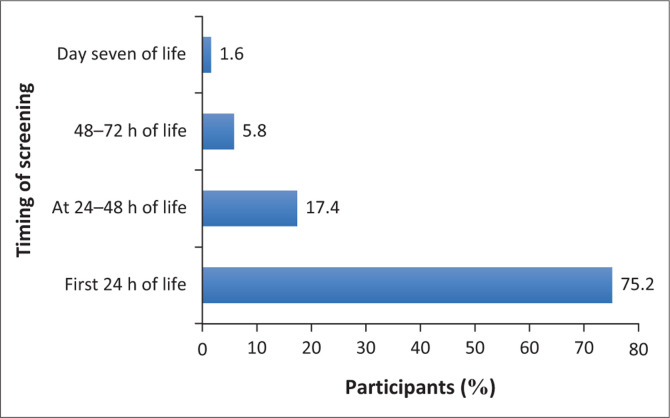
Results: Of the 121 neonates screened, the majority (75%) were screened in the first 24 h of life. A high refer rate (47%) of the total sample was found on DPOAE screening. No maternal or neonatal risk factors were found to be significantly associated with refer findings.
Conclusion: Findings contribute towards the existing evidence base that raises implications for successful implementation of NHS programmes in public healthcare in South Africa. Screening protocols need to consider the timing of screening, the measures and procedures adopted in the screening protocols, as well as the follow-up strategies.
Keywords: newborn hearing screening; otoacoustic emission; outcomes.; public healthcare; refer rates; risk factors.
Conflict of interest statement
The authors have declared that no competing interest exists.
Figures
References
-
- Bezuidenhout, J.K., Khoza-Shangase, K., De Maayer, T., & Strehlau, R (2018). Universal newborn hearing screening in public healthcare in South Africa: Challenges to implementation. South African Journal of Child Health, 12(4), 154–158. 10.7196/sajch.2018.v12i4.1522 - DOI
-
- Bonita, R., Beaglehole, R., Kjellström, T., & World Health Organization (2006). Basic epidemiology (2nd edn). World Health Organization; Retrieved from https://apps.who.int/iris/handle/10665/43541
-
- Chu, K., Elimian, A., Barbera, J., Ogburn, P., Spitzer, A., & Quirk, J.G (2003). Antecedents of newborn hearing loss. Obstetrics & Gynecology, 101(3), 584–588. - PubMed
MeSH terms
LinkOut - more resources
Full Text Sources
Other Literature Sources
Medical