Review
. 2021 Feb 10;13(1):23.
doi: 10.1186/s13073-021-00837-7.

Epigenetic signatures in cancer: proper controls, current challenges and the potential for clinical translation

Affiliations
Review

Epigenetic signatures in cancer: proper controls, current challenges and the potential for clinical translation

Daniela Mancarella et al. Genome Med. .

Abstract

Epigenetic alterations are associated with normal biological processes such as aging or differentiation. Changes in global epigenetic signatures, together with genetic alterations, are driving events in several diseases including cancer. Comparative studies of cancer and healthy tissues found alterations in patterns of DNA methylation, histone posttranslational modifications, and changes in chromatin accessibility. Driven by sophisticated, next-generation sequencing-based technologies, recent studies discovered cancer epigenomes to be dominated by epigenetic patterns already present in the cell-of-origin, which transformed into a neoplastic cell. Tumor-specific epigenetic changes therefore need to be redefined and factors influencing epigenetic patterns need to be studied to unmask truly disease-specific alterations. The underlying mechanisms inducing cancer-associated epigenetic alterations are poorly understood. Studies of mutated epigenetic modifiers, enzymes that write, read, or edit epigenetic patterns, or mutated chromatin components, for example oncohistones, help to provide functional insights on how cancer epigenomes arise. In this review, we highlight the importance and define challenges of proper control tissues and cell populations to exploit cancer epigenomes. We summarize recent advances describing mechanisms leading to epigenetic changes in tumorigenesis and briefly discuss advances in investigating their translational potential.

Keywords: Cancer; Cell-of-origin; Epigenetic signatures; Epigenetic therapy; Epigenomics; Oncohistones; Precision oncology; Tumor subclassification.


Conflict of interest statement

The authors declare that they have no competing interests.

Figures
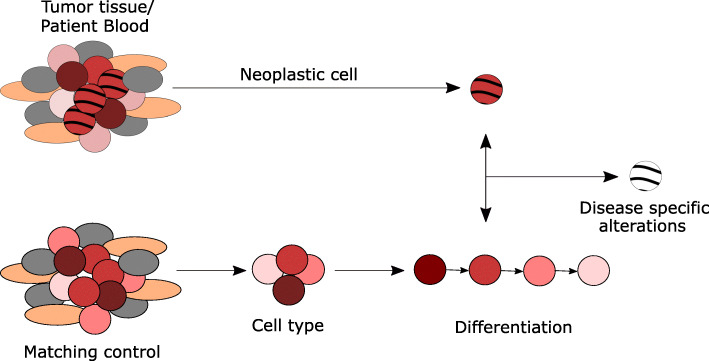
Fig. 1
Fig. 1
Reference epigenomes in cancer studies. Epigenetic studies use comparisons of normal and tumor samples to define disease-specific alterations. Even if those samples originate from the same patient (matching control, e.g., healthy tissue) and thereby exclude the detection of epigenetic variation based on environmental factors or aging, several other factors could potentially affect the analysis of disease-related epigenetic differences. The composition of cell types can differ between samples making the observed differences a mixture of cell-type-related and disease-specific divergences. The epigenome is also shaped during differentiation. Comparison of tumor and normal cells in different stages of differentiation would detect a mixture of differentiation- and disease-specific divergences. Therefore, factors affecting the normal epigenome have to be investigated and considered to define truly disease-specific epigenetic alterations
Fig. 2
Fig. 2
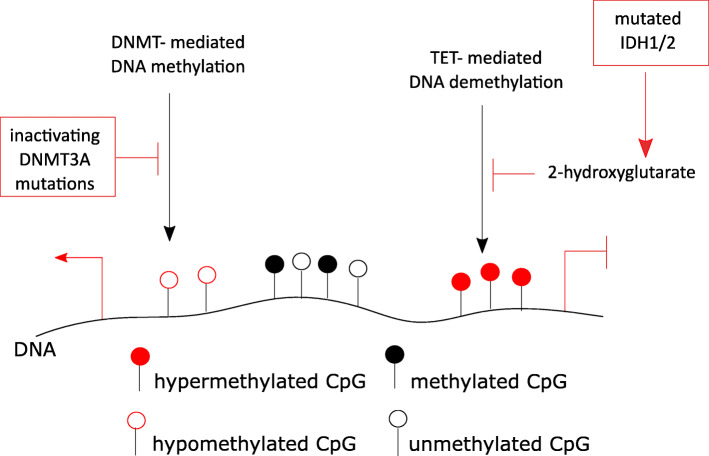
Effects of altered epigenetic modifiers. DNA methylation levels are maintained by a balance between methylation and demethylation. Mutations inactivating DNA methyltransferases (DNMT), such as DNMT3A, lead to hypomethylation and thereby affect gene transcription what might influence processes involved in tumorigenesis for example differentiation. Ten-eleven translocator (TET) enzymes demethylate DNA but can be inhibited by 2-hydroxyglutarate produced by mutated isocitrate-dehydrogenases. DNA hypermethylation is associated with gene silencing
Fig. 3
Fig. 3
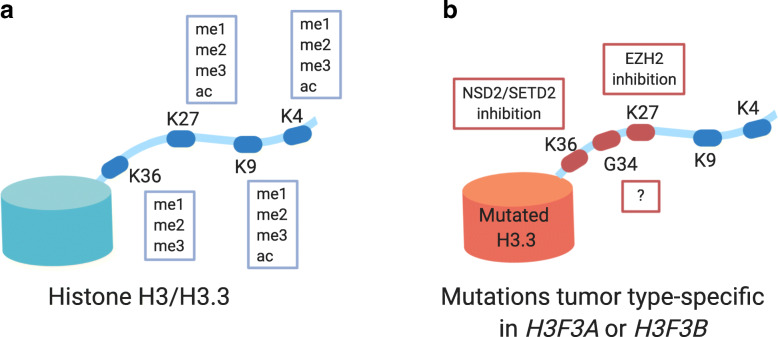
Impact of oncohistone mutations on modifications of the H3 and H3.3 N-terminal tail. a The N-terminal tail of H3 and H3.3 can be modified at several positions with different marks influencing the epigenetic state. K9me3 and K27me3 are associated with a heterochromatic state whereas K4me3, K36me3, and K27ac are found in active chromatin. b Some modification hot spots of H3 and H3.3 are found to be mutated in several cancer entities. They disrupt the epigenome by inhibition of epigenetic writers such as NSD2 or EZH2. The mechanism of H3.3 G34 mutation-associated disruption of the epigenome is currently intensely studied

References

    1. Allis CD, Jenuwein T. The molecular hallmarks of epigenetic control. Nat Rev Genet. 2016;17(8):487–500. doi: 10.1038/nrg.2016.59. - DOI - PubMed
    1. Atlasi Y, Stunnenberg HG. The interplay of epigenetic marks during stem cell differentiation and development. Nat Rev Genet. 2017;18(11):643–658. doi: 10.1038/nrg.2017.57. - DOI - PubMed
    1. Kulis M, et al. Whole-genome fingerprint of the DNA methylome during human B cell differentiation. Nat Genet. 2015;47(7):746–756. doi: 10.1038/ng.3291. - DOI - PMC - PubMed
    1. Tao Y, et al. Aging-like spontaneous epigenetic silencing facilitates Wnt activation, stemness, and Braf(V600E)-induced tumorigenesis. Cancer Cell. 2019;35(2):315–328. doi: 10.1016/j.ccell.2019.01.005. - DOI - PMC - PubMed
    1. Cheung P, et al. Single-cell chromatin modification profiling reveals increased epigenetic variations with aging. Cell. 2018;173(6):1385–1397. doi: 10.1016/j.cell.2018.03.079. - DOI - PMC - PubMed

Publication types