Surgery after neoadjuvant immunotherapy in patients with resectable non-small cell lung cancer
- PMID: 33569337
- PMCID: PMC7867741
- DOI: 10.21037/tlcr-20-509
Surgery after neoadjuvant immunotherapy in patients with resectable non-small cell lung cancer
Abstract
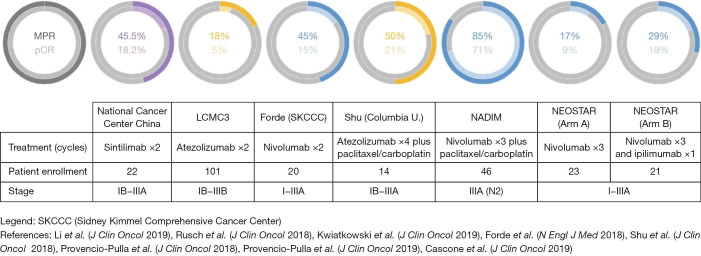
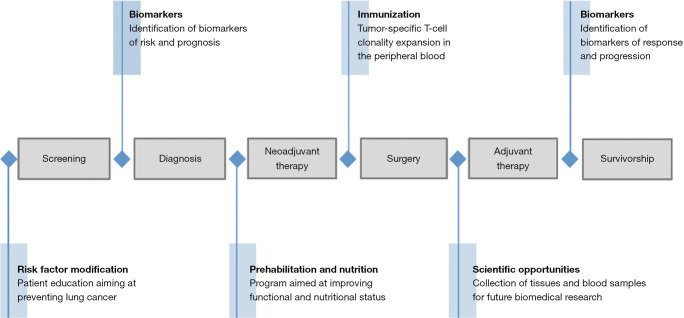
Surgery is the standard of care for patients with operable non-small cell lung cancer (NSCLC). However, as a single modality, surgery for early stage or locally advanced NSCLC remains associated with high rates of local and distant recurrence. The addition of neoadjuvant or adjuvant chemotherapy has modestly improved outcomes. While systemic therapy paired with surgery for other malignancies such as breast cancer have resulted in far better outcomes for equivalent stage designations, outcome improvements for operable NSCLC have lagged in part as a result of trials where adjuvant chemotherapy seemed to incur harm for stage IA patients and only modest survival benefit for stage IB-IIIA patients (AJCC 7th ed.). In recent years, immunotherapy for NSCLC has emerged as a systemic therapy with significant benefit over traditional chemotherapy regimens. These advances with immune checkpoint inhibitors (ICIs) have opened the door to administering peri-operative immunotherapy for operable NSCLC. As a result, a great multitude of studies investigating the use of immunotherapy in combination with surgery for NSCLC as well as several other malignancies have emerged. In this review, we outline the rationale for neoadjuvant immunotherapy in the treatment of operable NSCLC and summarize the available evidence that include preoperative ICI as a single modality or in combination with systemic agents and/or radiotherapy. Further, we summarize how such treatment trajectories open multiple unique windows of opportunity for scientific discovery and potential therapeutic gains for these vulnerable patients.
Keywords: Immunotherapy; carcinoma, non-small-cell lung; neoadjuvant therapy; thoracic surgery.
2021 Translational Lung Cancer Research. All rights reserved.
Conflict of interest statement
Conflicts of Interest: All authors have completed the ICMJE uniform disclosure form (available at http://dx.doi.org/10.21037/tlcr-20-509). The series “Multimodal management of locally advanced N2 non-small cell lung cancer” was commissioned by the editorial office without any funding or sponsorship. JDS serves on the scientific advisory board for Trans-Hit Bio Inc., is a member of clinical trial steering committees for AstraZeneca and Bristol-Myers-Squibb and has received clinical trial funding from Merck. The authors have no other conflicts of interest to declare.
Figures
References
-
- Papanikolaou IG, Dimitrakakis C, Zagouri F, et al. Paving the way for changing perceptions in breast surgery: a systematic literature review focused on oncological and aesthetic outcomes of oncoplastic surgery for breast cancer. Breast Cancer 2019;26:416-27. 10.1007/s12282-019-00968-1 - DOI - PubMed
Publication types
LinkOut - more resources
Full Text Sources
Other Literature Sources
Research Materials