


Youth engagement in HIV prevention intervention research in sub-Saharan Africa: a scoping review
- PMID: 33569913
- PMCID: PMC7876473
- DOI: 10.1002/jia2.25666
Youth engagement in HIV prevention intervention research in sub-Saharan Africa: a scoping review
Abstract
Introduction: Youth engagement in HIV research is generally recognized as essential, but often neglected or minimally implemented in practice. Engagement is a process of working collaboratively with diverse groups of people to address common issues. We conducted a scoping review of youth HIV prevention interventions in sub-Saharan Africa to identify and categorize forms and levels of youth engagement across the lifespan of intervention research.
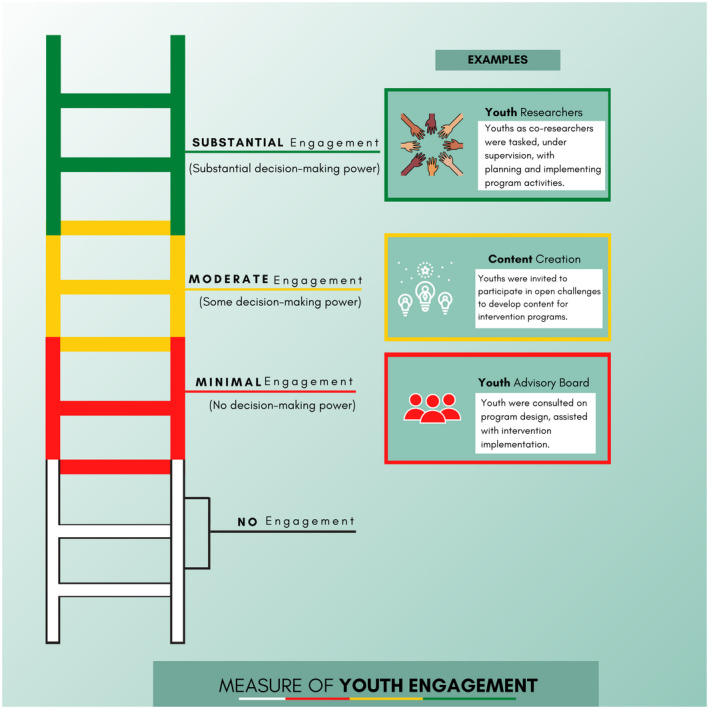
Methods: We followed Arksey and O'Malley's framework for organizing a scoping review. We searched seven databases for related articles on identified intervention studies through May 28th 2020. Included studies focused on youth (10 to 24 years old) HIV prevention interventions in sub-Saharan Africa. Two reviewers independently examined citations and full manuscripts for inclusion. Data were extracted on study characteristics, location, description of youth engagement and extent of engagement. Youth engagement approaches were categorized based on Hart's ladder as substantial engagement (strong youth decision-making power), moderate engagement (shared decision making with adults), minimal engagement (no youth decision-making power) or no engagement.
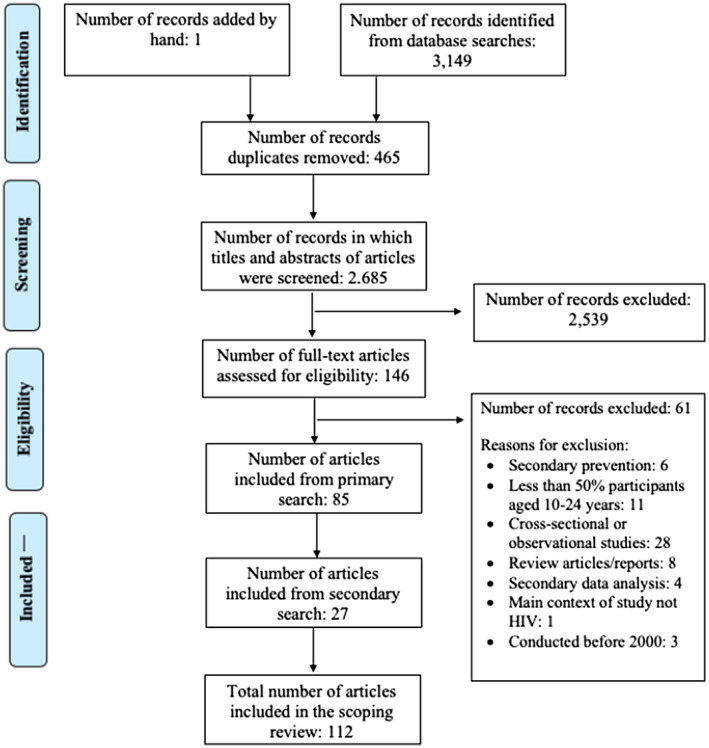
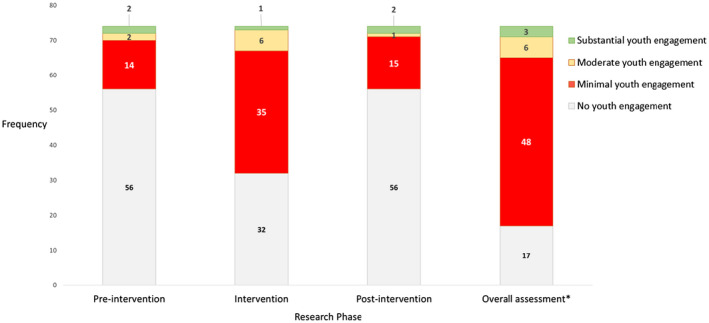
Results: We identified 3149 citations and included 112 studies reporting on 74 unique HIV interventions. Twenty-two interventions were in low-income countries, 49 in middle-income countries, and three were in both. Overall, only nine interventions (12%) had substantial or moderate youth engagement, two-thirds (48, 65%) had minimal youth engagement and 17 interventions (23%) had no youth engagement. We also identified specific engagement strategies (e.g. youth-led research, crowdsourcing) that were feasible in multiple settings and resulted in substantial engagement.
Conclusions: We found limited youth engagement in youth HIV prevention intervention studies in sub-Saharan Africa. However, several activities resulted in substantial youth engagement and could be relevant in many low-and-middle-income-country (LMIC) settings.
Keywords: HIV; Sub-Saharan Africa; engagement; research; youth.
© 2021 The Authors. Journal of the International AIDS Society published by John Wiley & Sons Ltd on behalf of the International AIDS Society.
Figures
References
-
- Global Statistics . HIV.gov n.d. [cited 2020 July 10]. Available from: https://www.hiv.gov/hiv‐basics/overview/data‐and‐trends/global‐statistics
-
- AIDSinfo. UNAIDS n.d. [cited 2020 May 19]. Available from: http://aidsinfo.unaids.org/
-
- United Nations Department of Economic and Social Affairs, Populations Division . Youth population trends and sustainable development. Geneva, Switzerland: United Nations; 2015.
-
- CTSA Consortium . Principles of community engagement. 2nd ed. Bethesda: National Institutes of Health; 2011.
Publication types
MeSH terms
Grants and funding
LinkOut - more resources
Full Text Sources
Other Literature Sources
Medical
