


The future of General Movement Assessment: The role of computer vision and machine learning - A scoping review
- PMID: 33571849
- PMCID: PMC7910279
- DOI: 10.1016/j.ridd.2021.103854
The future of General Movement Assessment: The role of computer vision and machine learning - A scoping review
Abstract
Background: The clinical and scientific value of Prechtl general movement assessment (GMA) has been increasingly recognised, which has extended beyond the detection of cerebral palsy throughout the years. With advancing computer science, a surging interest in developing automated GMA emerges.
Aims: In this scoping review, we focused on video-based approaches, since it remains authentic to the non-intrusive principle of the classic GMA. Specifically, we aimed to provide an overview of recent video-based approaches targeting GMs; identify their techniques for movement detection and classification; examine if the technological solutions conform to the fundamental concepts of GMA; and discuss the challenges of developing automated GMA.
Methods and procedures: We performed a systematic search for computer vision-based studies on GMs.
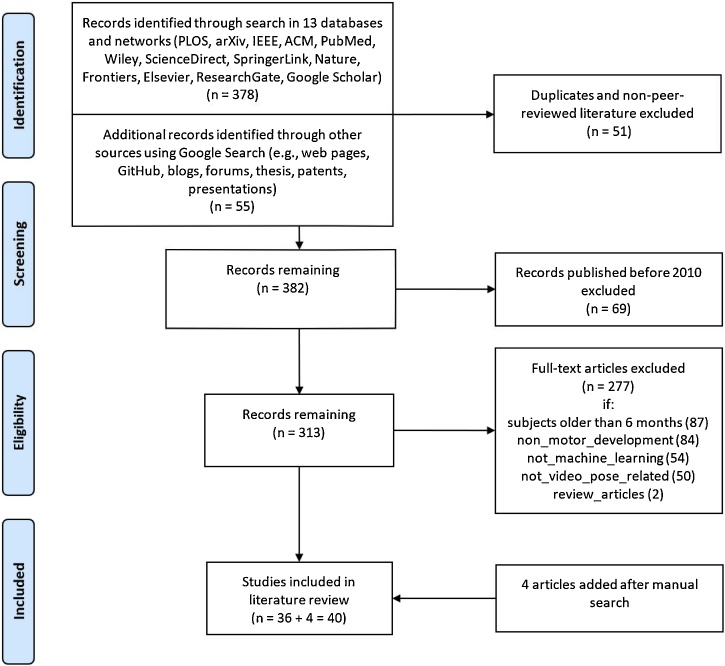
Outcomes and results: We identified 40 peer-reviewed articles, most (n = 30) were published between 2017 and 2020. A wide variety of sensing, tracking, detection, and classification tools for computer vision-based GMA were found. Only a small portion of these studies applied deep learning approaches. A comprehensive comparison between data acquisition and sensing setups across the reviewed studies, highlighting limitations and advantages of each modality in performing automated GMA is provided.
Conclusions and implications: A "method-of-choice" for automated GMA does not exist. Besides creating large datasets, understanding the fundamental concepts and prerequisites of GMA is necessary for developing automated solutions. Future research shall look beyond the narrow field of detecting cerebral palsy and open up to the full potential of applying GMA to enable an even broader application.
Keywords: Augmented general movement assessment; Automation; Cerebral palsy; Computer vision; Deep learning; Developmental disorder; Early detection; General movements; Infancy; Machine learning; Neurodevelopment; Pose estimation.
Copyright © 2021 The Author(s). Published by Elsevier Ltd.. All rights reserved.
Conflict of interest statement
We declare that there are no conflicts of interest, guiding this research work.
Figures
References
-
- Alcantarilla, P., Bartoli, A., & Davison, A. (2012, October 7). KAZE features. 10.1007/978-3-642-33783-3_16. - DOI
-
- Ali J., Charman T., Johnson M.H., Jones E.J.H., BASIS/STAARS Team Early motor differences in infants at elevated likelihood of autism spectrum disorder and/or attention deficit hyperactivity disorder. Journal of Autism and Developmental Disorders. 2020;50(12):4367–4384. doi: 10.1007/s10803-020-04489-1. - DOI - PMC - PubMed
-
- Bölte S., Bartl-Pokorny K.D., Jonsson U., Berggren S., Zhang D., Kostrzewa E.…Marschik P.B. How can clinicians detect and treat autism early? Methodological trends of technology use in research. Acta Paediatrica (Oslo, Norway : 1992) Supplement. 2016;105(2):137–144. doi: 10.1111/apa.13243. - DOI - PMC - PubMed
Publication types
MeSH terms
Grants and funding
LinkOut - more resources
Full Text Sources
Other Literature Sources
Medical
