Review
. 2021 Jan 29;18(3):1189.
doi: 10.3390/ijerph18031189.

Nicotinic Acetylcholine Receptor Involvement in Inflammatory Bowel Disease and Interactions with Gut Microbiota

Affiliations
Review

Nicotinic Acetylcholine Receptor Involvement in Inflammatory Bowel Disease and Interactions with Gut Microbiota

Lola Rueda Ruzafa et al. Int J Environ Res Public Health. .

Abstract

The gut-brain axis describes a complex interplay between the central nervous system and organs of the gastrointestinal tract. Sensory neurons of dorsal root and nodose ganglia, neurons of the autonomic nervous system, and immune cells collect and relay information about the status of the gut to the brain. A critical component in this bi-directional communication system is the vagus nerve which is essential for coordinating the immune system's response to the activities of commensal bacteria in the gut and to pathogenic strains and their toxins. Local control of gut function is provided by networks of neurons in the enteric nervous system also called the 'gut-brain'. One element common to all of these gut-brain systems is the expression of nicotinic acetylcholine receptors. These ligand-gated ion channels serve myriad roles in the gut-brain axis including mediating fast synaptic transmission between autonomic pre- and postganglionic neurons, modulation of neurotransmitter release from peripheral sensory and enteric neurons, and modulation of cytokine release from immune cells. Here we review the role of nicotinic receptors in the gut-brain axis with a focus on the interplay of these receptors with the gut microbiome and their involvement in dysregulation of gut function and inflammatory bowel diseases.

Keywords: COVID-19; cholinergic anti-inflammatory pathway; dysbiosis; gut microbiome; gut-brain axis; inflammatory bowel disease; nicotinic acetylcholine receptors; α7 and α9 nicotinic receptor subtypes.


Conflict of interest statement

The authors declare no conflict of interest.

Figures
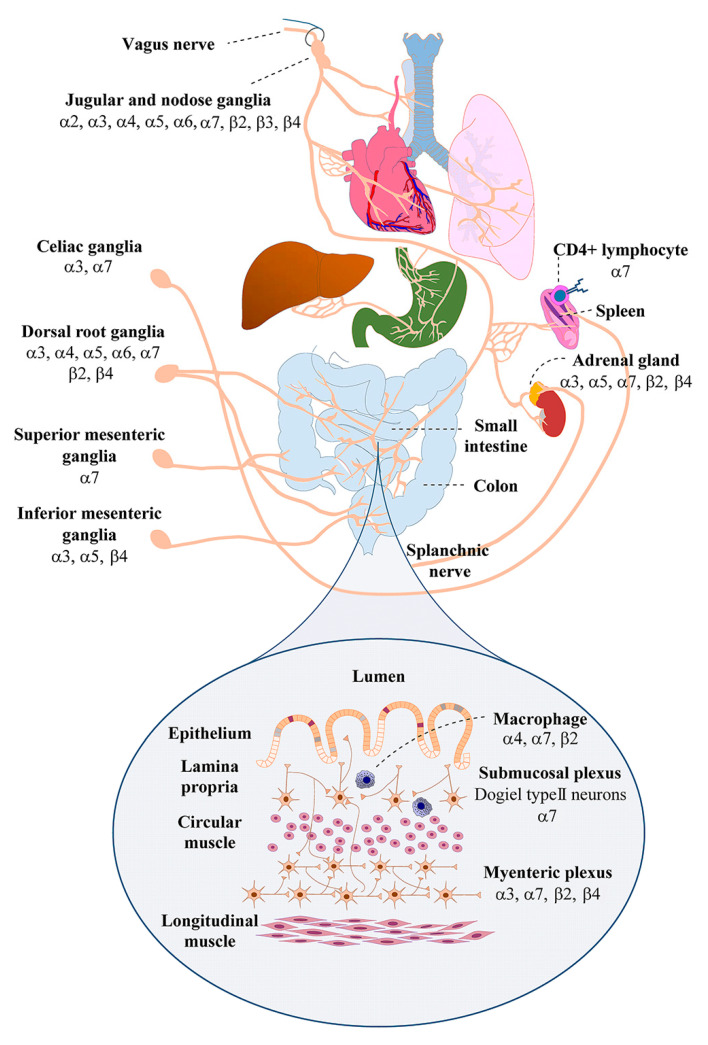
Figure 1
Figure 1
Cartoon representation depicting organs and structures of the gastrointestinal tract and the neurons that innervate them that express nAChR subunits. The inset in the lower part of the cartoon details the structures of the intestines; the myenteric and submucosal plexuses are shown along with select cell types.
Figure 2
Figure 2
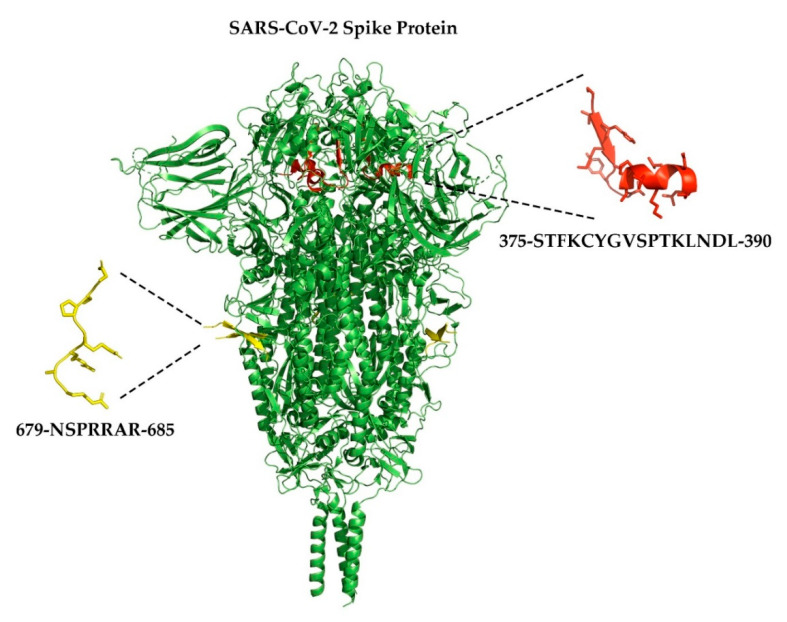
Cartoon representation of the SARS-CoV-2 spike protein trimer (green) showing the proposed domains that interact with α7 and α9α10 nAChRs. Note that residues 675-QTNSPRRARSVA-686 are unresolved in this structure. Residues highlighted in yellow are those that show homology with sequences of the three-finger neurotoxins from Elapidea serpents including α-bungarotoxin from Bungurus multicintus and α-cobratoxin from Naja naja species [163]. Residues highlighted in red have also been proposed to interact with α7 and α9α10 nAChRs [164]. Rendition of the spike protein was accomplished using PyMOL [166] and adapted from Cai et al., 2020 (PDB:6XR8) [167]; rendition of the NSPRRAR sequence was adapted from Daly et al., 2020 (PDB: 7JJC) [168].

References

    1. Gotti C., Zoli M., Clementi F. Brain nicotinic acetylcholine receptors: Native subtypes and their relevance. Trends Pharmacol. Sci. 2006;27:482–491. doi: 10.1016/j.tips.2006.07.004. - DOI - PubMed
    1. Skok V.I. Nicotinic acetylcholine receptors in autonomic ganglia. Auton. Neurosci. 2002;97:1–11. doi: 10.1016/S1566-0702(01)00386-1. - DOI - PubMed
    1. Albuquerque E.X., Pereira E.F.R., Alkondon M., Rogers S.W. Mammalian Nicotinic Acetylcholine Receptors: From Structure to Function. Physiol. Rev. 2009;89:73–120. doi: 10.1152/physrev.00015.2008. - DOI - PMC - PubMed
    1. Dani J.A. Neuronal Nicotinic Acetylcholine Receptor Structure and Function and Response to Nicotine. Int. Rev. Neurobiol. 2015;124:3–19. doi: 10.1016/bs.irn.2015.07.001. - DOI - PMC - PubMed
    1. De Biasi M. Nicotinic mechanisms in the autonomic control of organ systems. J. Neurobiol. 2002;53:568–579. doi: 10.1002/neu.10145. - DOI - PubMed

MeSH terms

Substances

LinkOut - more resources