Review
. 2021 Jan 29;13(3):509.
doi: 10.3390/cancers13030509.

Eighty Years of Targeting Androgen Receptor Activity in Prostate Cancer: The Fight Goes on

Affiliations
Review

Eighty Years of Targeting Androgen Receptor Activity in Prostate Cancer: The Fight Goes on

Eva Estébanez-Perpiñá et al. Cancers (Basel). .

Abstract

Prostate cancer (PCa) is the most common cancer in men in the West, other than skin cancer, accounting for over a quarter of cancer diagnoses in US men. In a seminal paper from 1941, Huggins and Hodges demonstrated that prostate tumours and metastatic disease were sensitive to the presence or absence of androgenic hormones. The first hormonal therapy for PCa was thus castration. In the subsequent eighty years, targeting the androgen signalling axis, where possible using drugs rather than surgery, has been a mainstay in the treatment of advanced and metastatic disease. Androgens signal via the androgen receptor, a ligand-activated transcription factor, which is the direct target of many such drugs. In this review we discuss the role of the androgen receptor in PCa and how the combination of structural information and functional screenings is continuing to be used for the discovery of new drug to switch off the receptor or modify its function in cancer cells.

Keywords: androgen ablation therapy; androgen receptor; antiandrogens; prostate cancer.


Conflict of interest statement

The authors declare no conflict of interest.

Figures
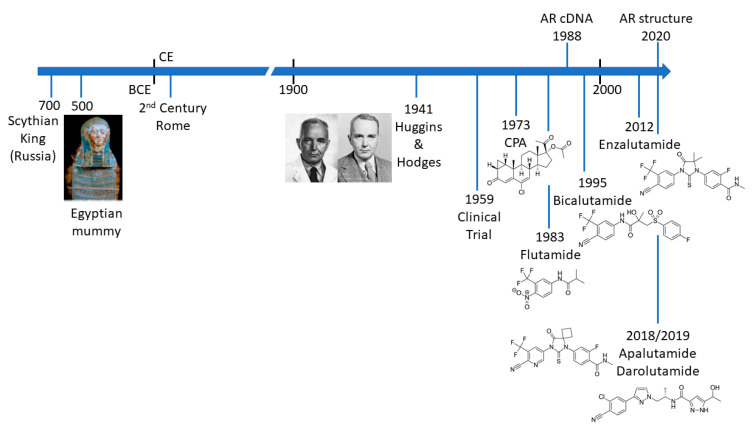
Figure 1
Figure 1
Timeline illustrating key events in the treatment of prostate cancer.
Figure 2
Figure 2
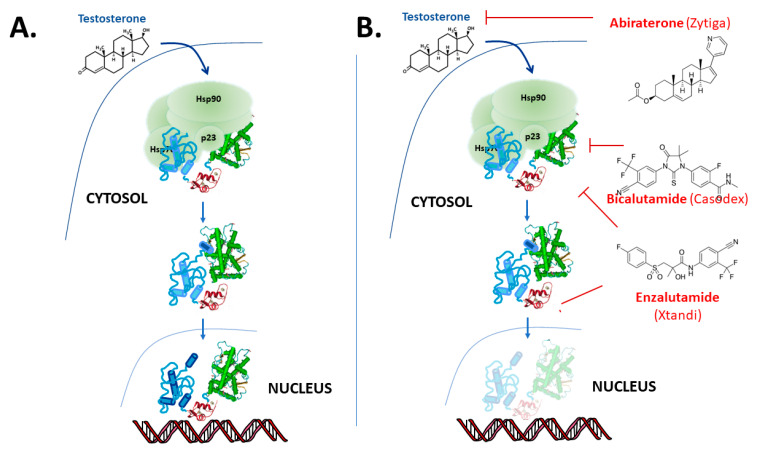
Overview of androgen receptor mechanism of action. (A) In the “classical” model the AR binds to testosterone and in tissues such as the prostate preferentially to the more potent metabolite 5α-dihydrotestosterone (DHT) and dissociates from molecular chaperones and translocates to the nucleus where it binds to DNA response elements and up- or down-regulates target gene expression. However, the details of a number of these steps in this model remain subject to debate and on-going research. (B) The action of the drugs abiraterone, bicalutamide and enzalutamide used in the treatment of PCa.
Figure 3
Figure 3
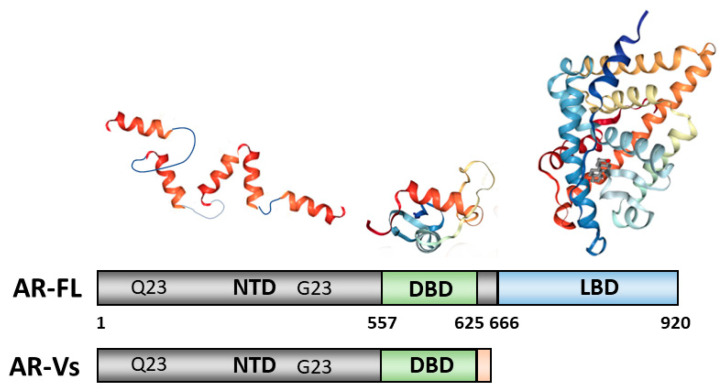
Functional and structural domains of the androgen receptor. The full-length androgen receptor (AR-FL) has a variable number of amino acids due to highly polymorphic glutamine (Q) and glycine (G) repeats in the amino-terminal domain (NTD). Splice variants (AR-Vs) lacking the ligand-binding domain (LBD), but retaining the DNA-binding domain (DBD) and NTD, are thought to emerge in PCa as a consequence of androgen ablation therapy. Available structural information for isolated ligand-binding (PDB 1I37) and DNA-binding (PBD 1R4I) domains is shown above the schematic of the AR-FL. Note—in the text the number of amino acids and point mutations is based on AR-FL of 920 amino acids.
Figure 4
Figure 4
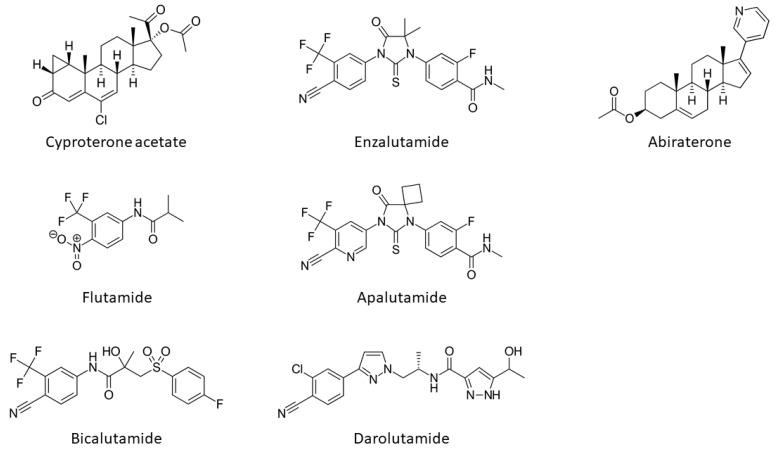
Structures of androgen receptor antagonists and the CYP17A1 inhibitor, abiraterone.
Figure 5
Figure 5
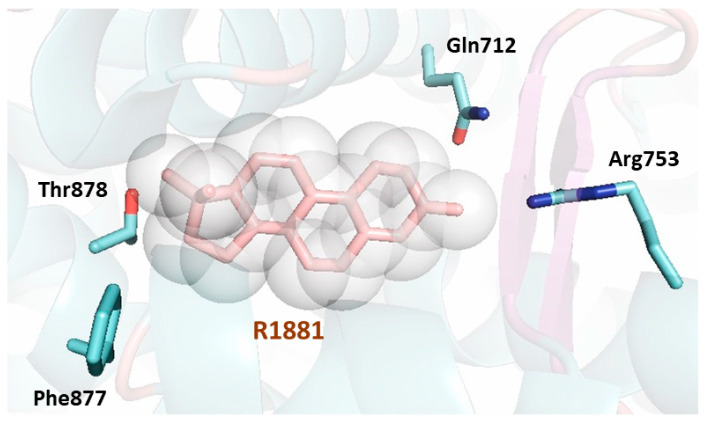
Cartoon representation of the first AR LBD crystal structure solved (PDB [Protein Data Bank] code 1E3G) [55]. The AR LBD secondary structure is shown depicting the helices, loops, and β-sheets surrounding the ligand (shown as a stick model in pink surrounded by a sphere representation). The LBP of the AR LBD is formed by twenty residues lining the bound ligand. Three residues make hydrogen bonds with the ligand (Gln712, Arg753 and Thr878) and are shown as sticks in blue showing their lateral chains. The residue Phe877, also shown as a stick representation in blue, has been found to be linked to enzalutamide resistance. All the residues lining the pocket extracted from the PISA server (https://www.ebi.ac.uk/pdbe/pisa/) are: Leu702, Leu705, Asn706, Leu708, Gly709, Gln712, Trp742, Met743, Met746, Val747, Met750, Arg753, Phe765, Met781, Met788, Leu 874, Phe877, Leu881, Met896 and Ile900.

References

    1. Bray F., Ferlay J., Soerjomataram I., Siegel R.L., Torre L.A., Jemal A. Global cancer statistics 2018: GLOBOCAN estimates of incidence and mortality worldwide for 36 cancers in 185 countries. CA Cancer J. Clin. 2018;68:394–424. doi: 10.3322/caac.21492. - DOI - PubMed
    1. Noone A.M. Cancer Statistics Review 1975–2015. National Cancer Institute; Bethesda, MD, USA: 2017.
    1. Rawla P. Epidemiology of Prostate Cancer. World J. Oncol. 2019;10:63–89. doi: 10.14740/wjon1191. - DOI - PMC - PubMed
    1. Ghabili K., Tosoian J.J., Schaeffer E.M., Pavlovich C.P., Golzari S.E.J., Khajir G., Andreas D., Benzon B., Vuica-Ross M., Ross A.E. The History of Prostate Cancer from Antiquity: Review of Paleopathological Studies. Urology. 2016;97:8–12. doi: 10.1016/j.urology.2016.08.032. - DOI - PubMed
    1. Minozzi S., Lunardini A., Caldarini C., Caramella D., Fornaciari G., Catalano P., Giuffra V. Metastatic Prostate Carcinoma from Imperial Rome (1st to 2nd Centuries AD) Pathobiology. 2018;85:289–299. doi: 10.1159/000490798. - DOI - PubMed