


Relationship between Chewing Ability and Nutritional Status in Japanese Older Adults: A Cross-Sectional Study
- PMID: 33572969
- PMCID: PMC7908427
- DOI: 10.3390/ijerph18031216
Relationship between Chewing Ability and Nutritional Status in Japanese Older Adults: A Cross-Sectional Study
Abstract
Objectives: This study aimed to determine the relationship between objective chewing ability and the nutritional status of Japanese community-dwelling elders.
Design: A cross-sectional study.
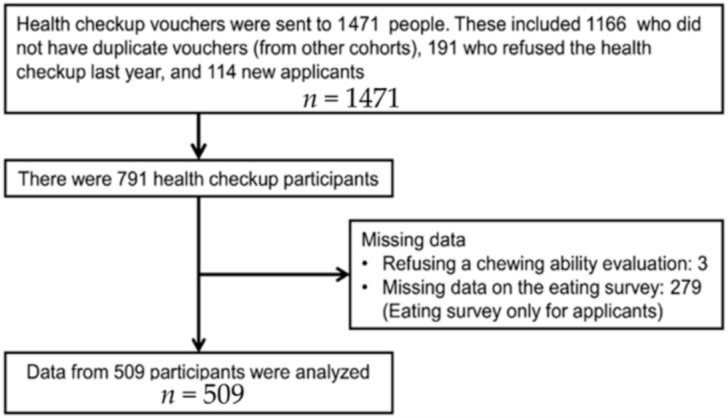
Participants: A total of 509 community-dwelling elders living in the Tokyo metropolitan area participated in a comprehensive survey conducted in October 2013.
Measurements: The basic characteristics were sex, age, and body mass index. Undernutrition was examined through serum albumin levels. Chewing ability was examined through color-changeable xylitol gum by evaluating the color changes in chewing gum. Nutritional intake was examined using the semi-quantitative food frequency questionnaire.
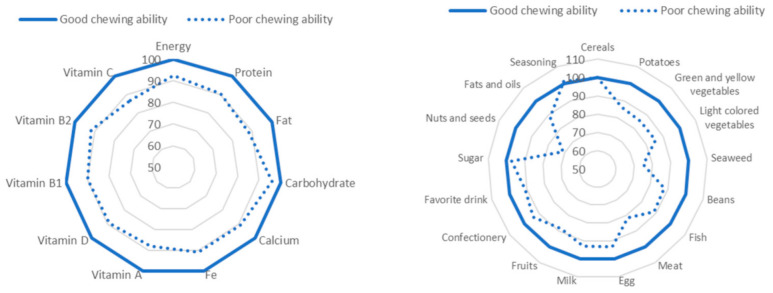
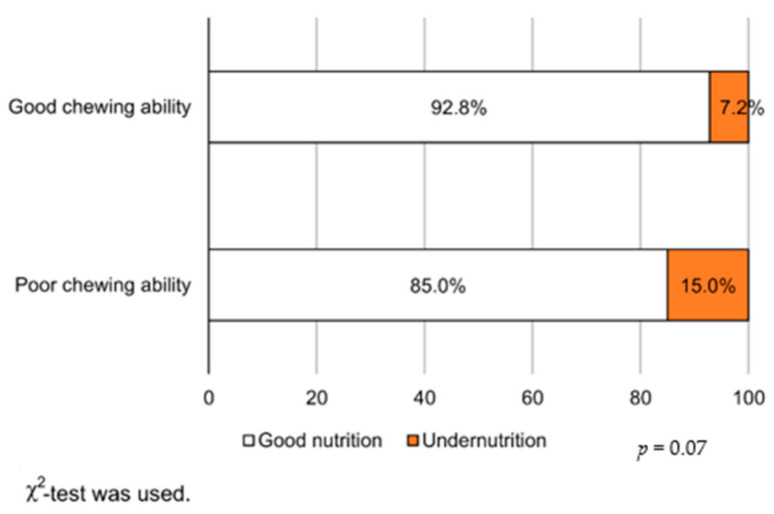
Results: In the poor chewing ability group, all nutrient intake levels were significantly low, except for carbohydrates, and intake levels for all food groups were significantly low, except for cereals, confectionery, sugars, seasonings, and spices. Additionally, after adjusting for covariates for sex, age, Tokyo Metropolitan Institute of Gerontology-Index of Competence (TMIG-IC) score, Mini-Mental State Examination (MMSE) score, body mass index (BMI), stroke, number of functional teeth, energy intake, and protein intake, chewing ability was found to be significantly associated with undernutrition.
Conclusion: We concluded that chewing ability was closely associated with nutrient and different food groups' intake, as well as undernutrition, among Japanese community-dwelling elders. Thus, to ensure comprehensive nutritional management, nutritionists and dentists should collaborate when treating the same patients.
Keywords: chewing ability; food groups; nutrient intake.
Conflict of interest statement
The authors declare no conflict of interest.
Figures
References
-
- Cabinet Office . Government of Japan; 2015. [(accessed on 25 April 2019)]. Annual Report on the Aging Society Japanese 2015. Available online: https://www8.cao.go.jp/kourei/whitepaper/w-2015/gaiyou/27pdf_indexg.html.
-
- Ministry of Health, Labor and Welfare . Government of Japan; 2012. [(accessed on 25 April 2019)]. Health Japan 21 (the Second Term) Available online: https://www.mhlw.go.jp/bunya/kenkou/dl/kenkounippon21_01.pdf.
-
- Antonelli Incalzi R., Landi F., Cipriani L., Bruno E., Pagano F., Gemma A., Capparella O., Carbonin P.U. Nutritional assessment: A primary component of multidimensional geriatric assessment in the acute care setting. J. Am. Geriatr. Soc. 1996;44:166–174. doi: 10.1111/j.1532-5415.1996.tb02434.x. - DOI - PubMed
Publication types
MeSH terms
LinkOut - more resources
Full Text Sources
Other Literature Sources
