. 2021 Jan 29;7(2):98.
doi: 10.3390/jof7020098.

Ustilaginaceae Biocatalyst for Co-Metabolism of CO2-Derived Substrates toward Carbon-Neutral Itaconate Production

Affiliations

Ustilaginaceae Biocatalyst for Co-Metabolism of CO2-Derived Substrates toward Carbon-Neutral Itaconate Production

Lena Ullmann et al. J Fungi (Basel). .

Abstract

The family Ustilaginaceae (belonging to the smut fungi) are known for their plant pathogenicity. Despite the fact that these plant diseases cause agricultural yield reduction, smut fungi attracted special attention in the field of industrial biotechnology. Ustilaginaceae show a versatile product spectrum such as organic acids (e.g., itaconate, malate, succinate), polyols (e.g., erythritol, mannitol), and extracellular glycolipids, which are considered value-added chemicals with potential applications in the pharmaceutical, food, and chemical industries. This study focused on itaconate as a platform chemical for the production of resins, plastics, adhesives, and biofuels. During this work, 72 different Ustilaginaceae strains from 36 species were investigated for their ability to (co-) consume the CO2-derived substrates acetate and formate, potentially contributing toward a carbon-neutral itaconate production. The fungal growth and product spectrum with special interest in itaconate was characterized. Ustilago maydis MB215 and Ustilago rabenhorstiana NBRC 8995 were identified as promising candidates for acetate metabolization whereas Ustilago cynodontis NBRC 7530 was identified as a potential production host using formate as a co-substrate enhancing the itaconate production. Selected strains with the best itaconate production were characterized in more detail in controlled-batch bioreactor experiments confirming the co-substrate utilization. Thus, a proof-of-principle study was performed resulting in the identification and characterization of three promising Ustilaginaceae biocatalyst candidates for carbon-neutral itaconate production contributing to the biotechnological relevance of Ustilaginaceae.

Keywords: CO2; Ustilaginaceae; Ustilago maydis; biodiversity; chassis; itaconate; organic acid; smut fungi.


Conflict of interest statement

The authors declare no conflict of interest.

Figures
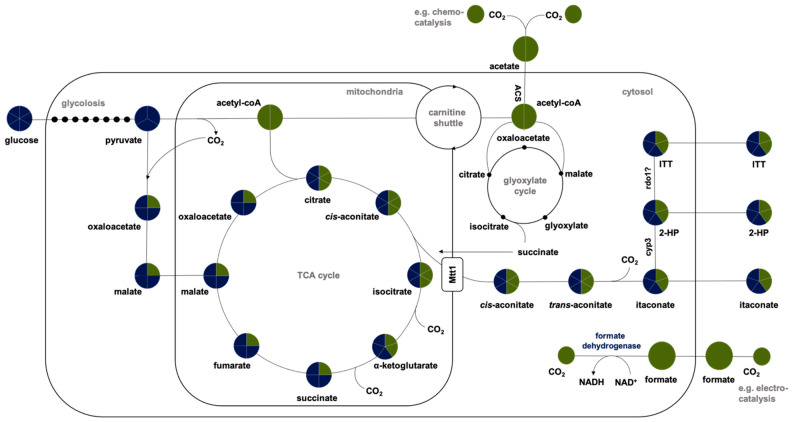
Figure 1
Figure 1
Itaconate biosynthesis pathway in Ustilago maydis with a proposed acetate and formate assimilation. Pyruvate is generated from glucose through glycolysis taking place in the cytoplasm. It enters the mitochondria, where it is converted to acetyl-CoA and forms citrate together with oxaloacetate during the TCA cycle. Citrate is dehydrated to cis-aconitate which is transported from the mitochondria into the cytosol via the mitochondrial tricarboxylate transporter Mtt1. In the cytosol, cis-aconitate is converted into itaconate via the intermediate trans-aconitate. Itaconate can be further converted to 2-hydroxyparaconate (2-HP) by Cyp3. 2-hydroxyparaconate might be converted to itatartarate (ITT) by Rdo1. Secretion of itaconate and possibly 2-hydroxyparaconate and itartarate into the medium is mediated by the major facilitator Itp1. Modified from [20,38]. Proposed acetate assimilation modified from [33,37]. Acetate enters the cell via passive diffusion and/or via putative acetate transporters [34,35,37]. It serves as a substrate for the enzyme acetyl-CoA synthase (ACS) [36], which converts acetate to acetyl-CoA in the cytosol [33]. Growth on acetate depends on peroxisomal activation to short acyl-CoAs including acetyl-CoA and its shuttling to the mitochondria via carnitine [37]. Proposed formate assimilation via formate dehydrogenases is known for methylotrophic microorganisms [39]. These enzymes are also present in U. maydis [40]. Indicated circle segments represent the number of carbon atoms per molecule. Blue circles indicate carbon derived from conventional glucose whereas green color indicates carbon possibly derived from CO2.
Figure 2
Figure 2
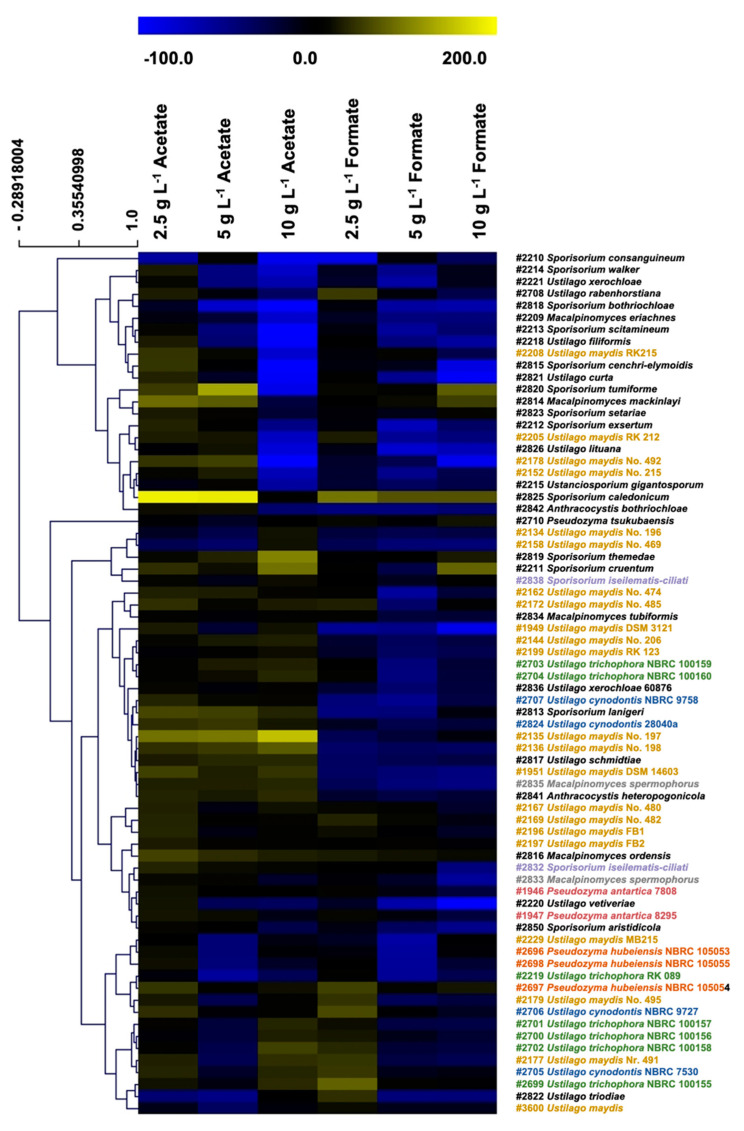
Overview of biodiversity screening results. Hierarchical cluster analysis (HCA) heatmap showing whole set growth screening results obtained during 24-deep-well plate cultivation in MTM medium with 4 g L−1 NH4Cl using the Growth Profiler system by EnzyScreen. Strains were cultivated for growth on both co-substrates under various conditions of 2.5, 5.0, and 10.0 g L−1 in combination with 20.0 g L−1 glucose. Maximum optical density (OD600) was normalized to the growth of the respective glucose reference and visualized via color scales in the HCA heatmap indicating relative growth [%] Blue color indicates a lower growth, black a comparable growth behavior, and yellow a higher growth compared to the respective glucose reference. Strains belonging to one species were colored accordingly in the displayed rows. Experiments were performed with two biological duplicates. Raw data are provided in Supplementary Materials (Tables S2 and S3).
Figure 3
Figure 3
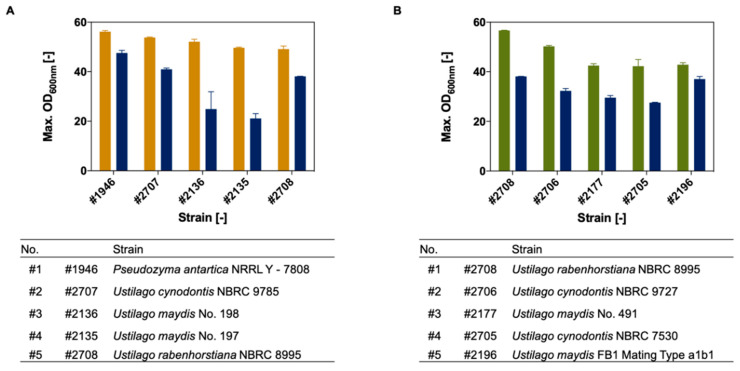
Maximum growth of best Ustilaginaceae candidates obtained from biodiversity screening. (A) The top 5 Ustilaginaceae candidates using acetate as a co-substrate (orange). #2707, #1946, and #2708 obtained the highest growth using 2.5 g L−1 acetate whereas #2135 and #2136 obtained the best results using 10 g L−1 acetate. (B) The top 5 Ustilaginaceae strains using 2.5 g L−1 formate as a co-substrate (green). Growth Profiler 24-deep-well plate cultivation was performed in MTM medium with 4 g L−1 NH4Cl. Respective glucose references (20 g L−1) are shown in blue. Error bars indicate the deviation from the mean for n = 2.
Figure 4
Figure 4
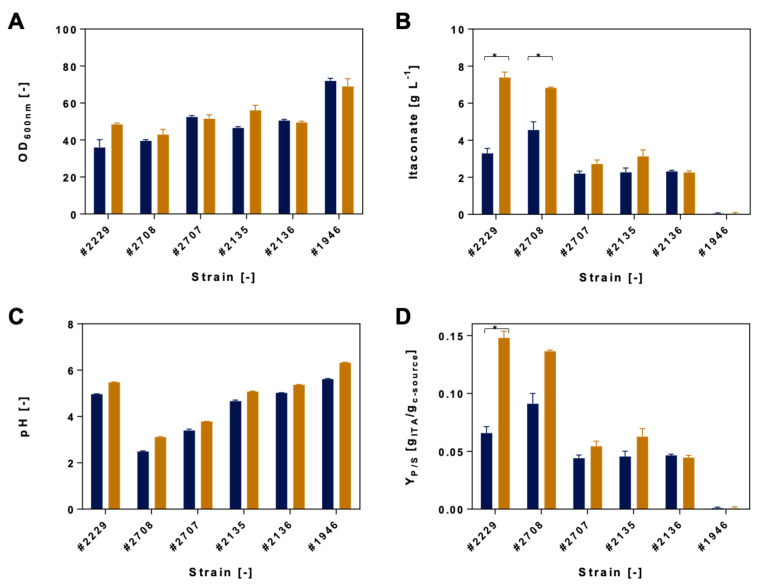
Itaconic acid production of selected Ustilaginaceae strains. (A) Maximum optical density (OD600 [−]), (B) maximum itaconic acid production [g L−1], (C) minimum pH [−], and (D) YP/S [gITA/gc-source] during System Duetz® 24-deep-well plate cultivation experiments with 1.5 mL MTM medium and 0.8 g L−1 NH4Cl. Ustilaginaceae candidates using acetate as a co-substrate are shown in orange (6.25 g L−1). Respective glucose references (50 g L−1) are shown in blue. Error bars indicate the deviation from the mean for n = 2. Statistically significant differences in itaconic acid production (p ≤ 0.05) are indicated as *. Details of statistical analyses are displayed in Tables S11 and S12.
Figure 5
Figure 5
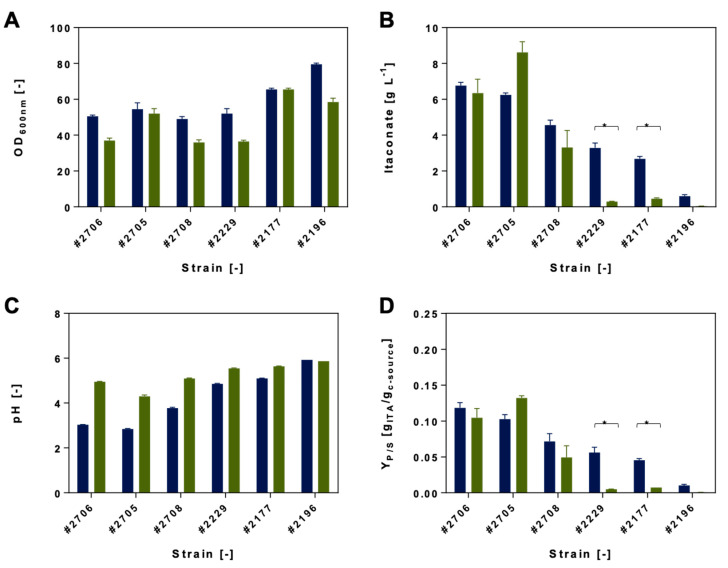
Itaconic acid production of selected Ustilaginaceae strains. (A) Max. optical density (OD600 [−]), (B) maximum itaconic acid production [g L−1], (C) minimum pH [−], and (D) YP/S [gITA/gc-source] during System Duetz® 24-deep-well plate cultivation experiments with 1.5 mL MTM medium and 0.8 g L−1 NH4Cl. Ustilaginaceae candidates using formate as a co-substrate are shown in green (6.25 g L−1). Respective glucose references (50 g L−1) are shown in blue. Error bars indicate the deviation from the mean for n = 2. Statistically significant differences in itaconic acid production (p ≤ 0.05) are indicated as *. Details of statistical analyses are displayed in Tables S11 and S12.
Figure 6
Figure 6
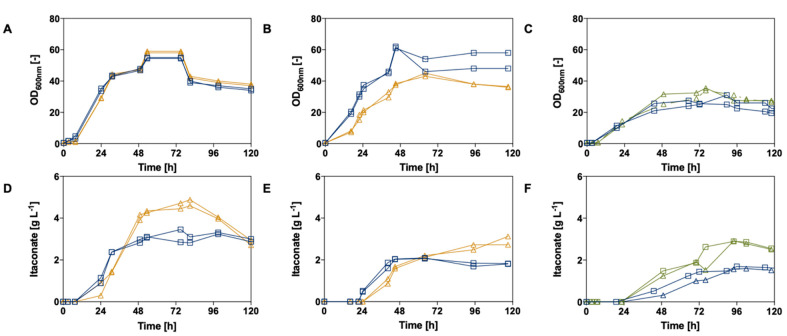
Controlled-batch fermentations of selected Ustilaginaceae candidates. OD600 of (A) U. maydis #2229, (B) U. rabenhorstiana #2708, and (C) U. cynodontis #2705. Itaconate production is shown for (D) U. maydis #2229, (E) U. rabenhorstiana #2708, and (F) U. cynodontis #2705 during fermentation in a bioreactor containing MTM medium (0.8 g L−1 NH4Cl, 30 °C, 80% DOT, at pH 6.5). Ustilaginaceae candidates using acetate as a co-substrate are shown in orange, and formate co-substrate cultivations are shown in green (6.25 g L−1). Respective glucose references (50 g L−1) are shown in blue.
Figure 7
Figure 7
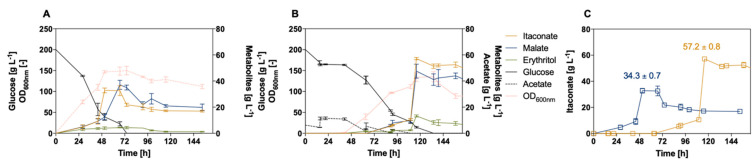
Controlled-batch fermentations of U. maydis #2229 increasing glucose concentration to 200 g L−1. (A) Bioreactor experiments using 200 g L−1 glucose, (B) with 200 g L−1 glucose and 25 g L−1 acetate. Cultivations were performed in MTM medium (0.8 g L−1 NH4Cl, 30 °C, 80% DOT, at pH 6.5). (C) Overview of itaconate production of both experiments. Cultivations using acetate as a co-substrate are shown in orange (YP/S = 0.25 ± 0.00 [gITA/gc-source]), and respective glucose references are shown in blue (YP/S = 0.17 ± 0.00 [gITA/gc-source]). Error bars indicate the standard error of the mean (n = 3).
Figure 8
Figure 8
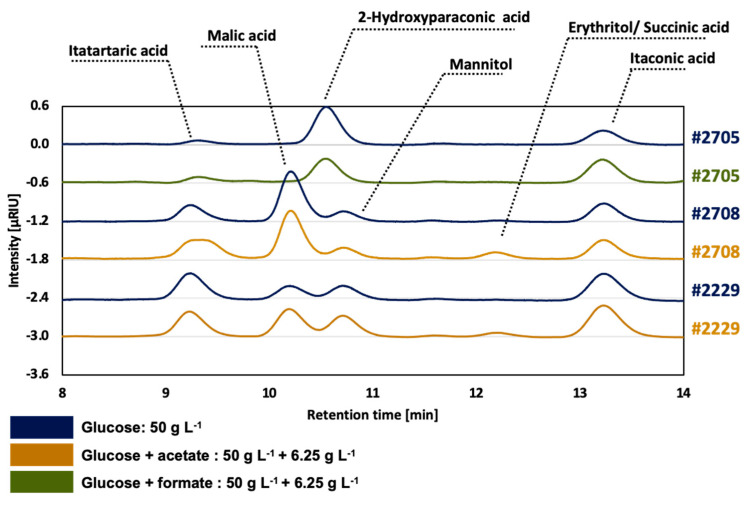
HPLC chromatogram overlay (RI detector). Extracellular metabolites in the supernatant formed by selected Ustilaginaceae candidates. Samples were taken after 75, 64, and 114 h of U. maydis #2229, U. rabenhorstiana #2708, and U. cynodontis #2705, respectively, during fermentation in a bioreactor containing MTM medium (0.8 g L−1 NH4Cl, 30 °C, 80% DOT, at pH 6.5). Ustilaginaceae using acetate as a co-substrate are shown in orange; formate co-substrate cultivations are shown in green (6.25 g L−1). Respective glucose references (50 g L−1) are shown in blue.

References

    1. Okabe M., Lies D., Kanamasa S., Park E.Y. Biotechnological production of itaconic acid and its biosynthesis in Aspergillus terreus. Appl. Microbiol. Biotechnol. 2009;84:597–606. doi: 10.1007/s00253-009-2132-3. - DOI - PubMed
    1. Hosseinpour Tehrani H., Becker J., Bator I., Saur K., Meyer S., Rodrigues Lóia A.C., Blank L.M., Wierckx N. Integrated strain- and process design enable production of 220 g L−1 itaconic acid with Ustilago maydis. Biotechnol. Biofuels. 2019;12:263. doi: 10.1186/s13068-019-1605-6. - DOI - PMC - PubMed
    1. Robert T., Friebel S. Itaconic acid—A versatile building block for renewable polyesters with enhanced functionality. Green Chem. 2016;18:2922–2934. doi: 10.1039/C6GC00605A. - DOI
    1. Steiger M.G., Wierckx N., Blank L.M., Mattanovich D., Sauer M. Industrial Biotechnology: Products and Processes. Wiley; Hoboken, NJ, USA: 2016. Itaconic acid an emerging building block. Chapter 15. - DOI
    1. Klement T., Büchs J. Itaconic acid—a biotechnological process in change. Bioresour. Technol. 2013;135:422–431. doi: 10.1016/j.biortech.2012.11.141. - DOI - PubMed

LinkOut - more resources