Review
. 2021 Jan 30;13(2):463.
doi: 10.3390/nu13020463.

Magnesium in Aging, Health and Diseases

Affiliations
Review

Magnesium in Aging, Health and Diseases

Mario Barbagallo et al. Nutrients. .

Abstract

Several changes of magnesium (Mg) metabolism have been reported with aging, including diminished Mg intake, impaired intestinal Mg absorption and renal Mg wasting. Mild Mg deficits are generally asymptomatic and clinical signs are usually non-specific or absent. Asthenia, sleep disorders, hyperemotionality, and cognitive disorders are common in the elderly with mild Mg deficit, and may be often confused with age-related symptoms. Chronic Mg deficits increase the production of free radicals which have been implicated in the development of several chronic age-related disorders. Numerous human diseases have been associated with Mg deficits, including cardiovascular diseases, hypertension and stroke, cardio-metabolic syndrome and type 2 diabetes mellitus, airways constrictive syndromes and asthma, depression, stress-related conditions and psychiatric disorders, Alzheimer's disease (AD) and other dementia syndromes, muscular diseases (muscle pain, chronic fatigue, and fibromyalgia), bone fragility, and cancer. Dietary Mg and/or Mg consumed in drinking water (generally more bioavailable than Mg contained in food) or in alternative Mg supplements should be taken into consideration in the correction of Mg deficits. Maintaining an optimal Mg balance all through life may help in the prevention of oxidative stress and chronic conditions associated with aging. This needs to be demonstrated by future studies.

Keywords: aging; dementia; diabetes; diseases; health; hypertension; longevity; magnesium; osteoporosis; oxidative stress.


Conflict of interest statement

The authors declare no conflict of interest.

Figures
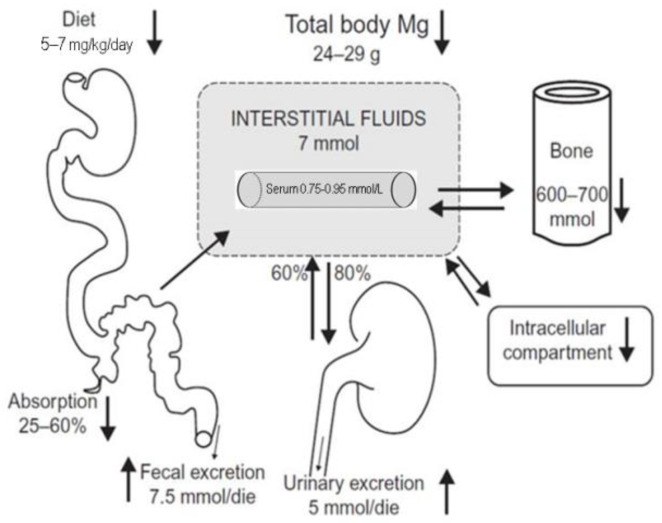
Figure 1
Figure 1
Mg balance (arrows show most common sites of Mg depletion with aging), including daily amount of Mg intake and excretion. Total human body content of Mg is 24 to 29 g. In order to maintain Mg balance, a healthy person needs to consume around 5–7 mg/kg/day. Daily intestinal absorption varies from 25 to 60% of Mg intake. In the kidney, 80% of circulating Mg is filtered and about 60% is reabsorbed along the kidney tubule. This results in a net excretion of about 5 mmol/day. Fecal excretion is about 7.5 mmol/day. The intracellular compartment provides the most important Mg stores.
Figure 2
Figure 2
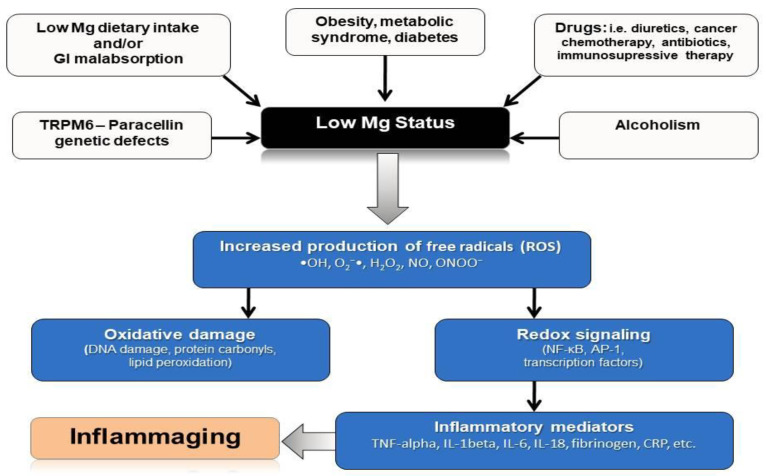
Mg deficit, inflammation, oxidative stress, and aging. The relationship of low Mg status, generated by multiple factors (i.e., low Mg intake and absorption, Mg transport genetic defects, obesity, type 2 diabetes mellitus (T2DM) and cardio-metabolic syndrome, polypharmacotherapy, and alcohol abuse), which may trigger an increased production of free radicals (ROS), oxidative damage, and activation of redox signaling (i.e., NF-KB, AP-1, and other transcription factors). The elevation in oxidative stress may lead to the release of inflammatory mediators conforming a state of chronic low-grade inflammation, which has been proposed to accompany aging and called “inflammaging”. TRPM7: Transient Receptor Potential cation channel, subfamily M, member 7; ROS: reactive oxygen species; NF-KB nuclear factor kappa-light-chain-enhancer of activated B cells; AP-1: activator protein 1; TNF-alpha: tumor necrosis factor-alpha; IL: interleukin; CRP: C-reactive protein.

References

    1. Saris N.E., Mervaala E., Karppanen H., Khawaja J.A., Lewenstam A. Magnesium. An update on physiological, clinical and analytical aspects. Clin. Chim. Acta. 2000;294:1–26. doi: 10.1016/S0009-8981(99)00258-2. - DOI - PubMed
    1. Barbagallo M., Dominguez L.J. Magnesium metabolism in type 2 diabetes mellitus, metabolic syndrome and insulin resistance. Arch. Biochem. Biophys. 2007;458:40–47. doi: 10.1016/j.abb.2006.05.007. - DOI - PubMed
    1. Reinhart R.A. Magnesium metabolism. A review with special reference to the relationship between intracellular content and serum levels. Arch. Intern. Med. 1988;148:2415–2420. doi: 10.1001/archinte.1988.00380110065013. - DOI - PubMed
    1. Resnick L.M., Barbagallo M., Dominguez L.J., Veniero J.M., Nicholson J.P., Gupta R.K. Relation of cellular potassium to other mineral ions in hypertension and diabetes. Pt 2Hypertension. 2001;38:709–712. doi: 10.1161/01.HYP.38.3.709. - DOI - PubMed
    1. Reddy S.T., Soman S.S., Yee J. Magnesium Balance and Measurement. Adv. Chronic Kidney Dis. 2018;25:224–229. doi: 10.1053/j.ackd.2018.03.002. - DOI - PubMed