


Study of heart rate recovery and cardiovascular autonomic modulation in healthy participants after submaximal exercise
- PMID: 33574441
- PMCID: PMC7878503
- DOI: 10.1038/s41598-021-83071-w
Study of heart rate recovery and cardiovascular autonomic modulation in healthy participants after submaximal exercise
Abstract
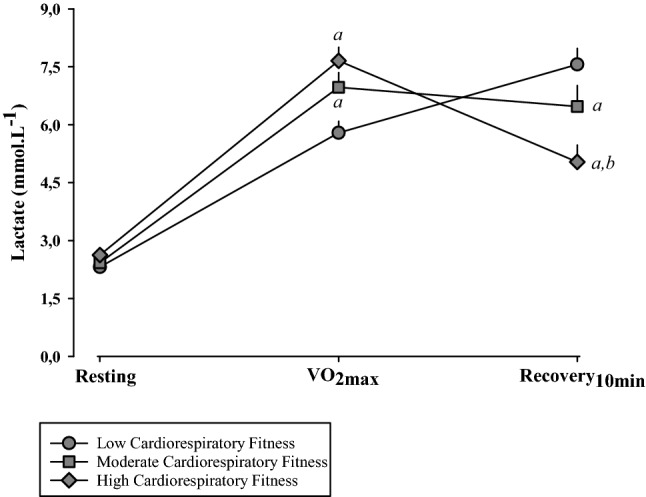
Heart rate variability (HRV), blood pressure variability (BPV), and baroreflex sensitivity (BRS) provide important information on cardiovascular autonomic control. However, little is known about the reorganization of HRV, BPV, and BRS after aerobic exercise. While there is a positive relationship between heart rate (HR) recovery rate and cardiorespiratory fitness, it is unclear whether there is a relationship between cardiorespiratory fitness and reorganization of cardiovascular autonomic modulation during recovery. Thus, this study aimed to investigate whether cardiorespiratory fitness influences the cardiovascular autonomic modulation recovery, after a cardiopulmonary exercise test. Sixty men were assigned into groups according to their cardiorespiratory fitness: low cardiorespiratory fitness (LCF = VO2: 22-38 mL kg-1 min-1), moderate (MCF = VO2: 38-48 mL kg-1 min-1), and high (HCF = VO2 > 48 mL kg-1 min-1). HRV (linear and non-linear analysis) and BPV (spectral analysis), and BRS (sequence method) were performed before and after a cardiopulmonary exercise test. The groups with higher cardiorespiratory fitness had lower baseline HR values and HR recovery time after the cardiopulmonary exercise test. On comparing rest and recovery periods, the spectral analysis of HRV showed a decrease in low-frequency (LF) oscillations in absolute units and high frequency (HF) in absolute and normalized units. It also showed increases in LF oscillations of blood pressure. Nonlinear analysis showed a reduction in approximate entropy (ApEn) and in Poincare Plot parameters (SD1 and SD2), accompanied by increases in detrended fluctuation analysis (DFA) parameters α1 and α2. However, we did not find differences in cardiovascular autonomic modulation parameters and BRS in relation to cardiorespiratory fitness neither before nor after the cardiopulmonary test. We concluded that cardiorespiratory fitness does not affect cardiovascular autonomic modulations after cardiopulmonary exercise test, unlike HR recovery.
Conflict of interest statement
The authors declare no competing interests.
Figures
References
-
- Höcht C. Blood pressure variability: prognostic value and therapeutic implications. ISRN Hypertens. 2013;16:1–13. doi: 10.5402/2013/398485. - DOI
Publication types
MeSH terms
Substances
LinkOut - more resources
Full Text Sources
Other Literature Sources
Medical
Research Materials
Miscellaneous
