


Racial, Ethnic, and Geographic Disparities in Novel Coronavirus (Severe Acute Respiratory Syndrome Coronavirus 2) Test Positivity in North Carolina
- PMID: 33575416
- PMCID: PMC7499753
- DOI: 10.1093/ofid/ofaa413
Racial, Ethnic, and Geographic Disparities in Novel Coronavirus (Severe Acute Respiratory Syndrome Coronavirus 2) Test Positivity in North Carolina
Abstract
Background: Emerging evidence suggests that black and Hispanic communities in the United States are disproportionately affected by coronavirus disease 2019 (COVID-19). A complex interplay of socioeconomic and healthcare disparities likely contribute to disproportionate COVID-19 risk.
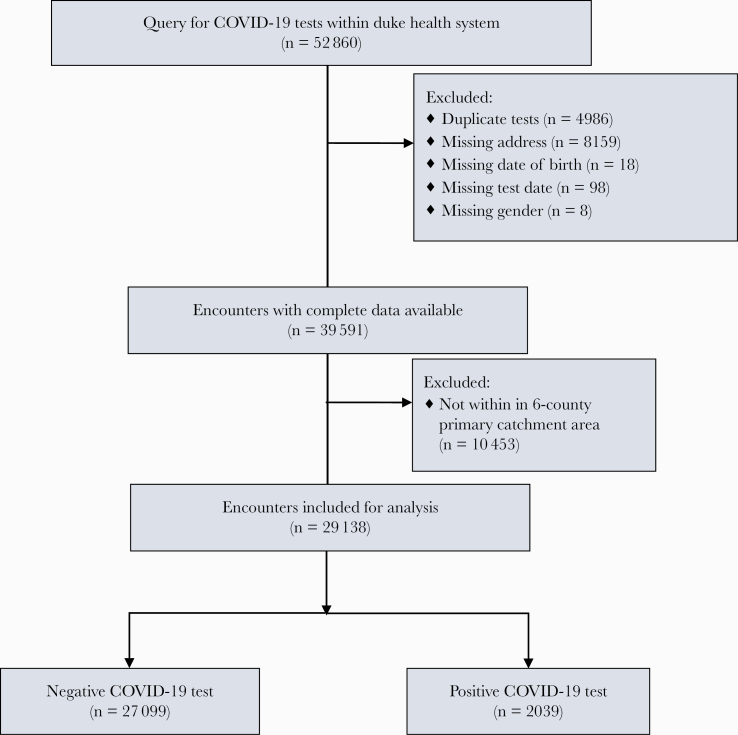
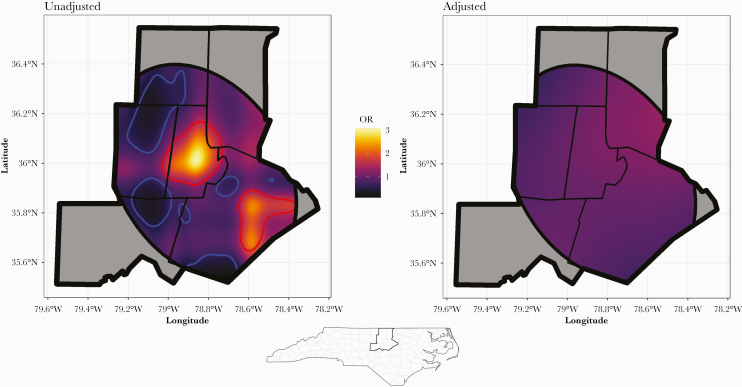
Methods: We conducted a geospatial analysis to determine whether individual- and neighborhood-level attributes predict local odds of testing positive for severe acute respiratory syndrome coronavirus 2 (SARS-CoV-2). We analyzed 29 138 SARS-CoV-2 tests within the 6-county catchment area for Duke University Health System from March to June 2020. We used generalized additive models to analyze the spatial distribution of SARS-CoV-2 positivity. Adjusted models included individual-level age, gender, and race, as well as neighborhood-level Area Deprivation Index, population density, demographic composition, and household size.
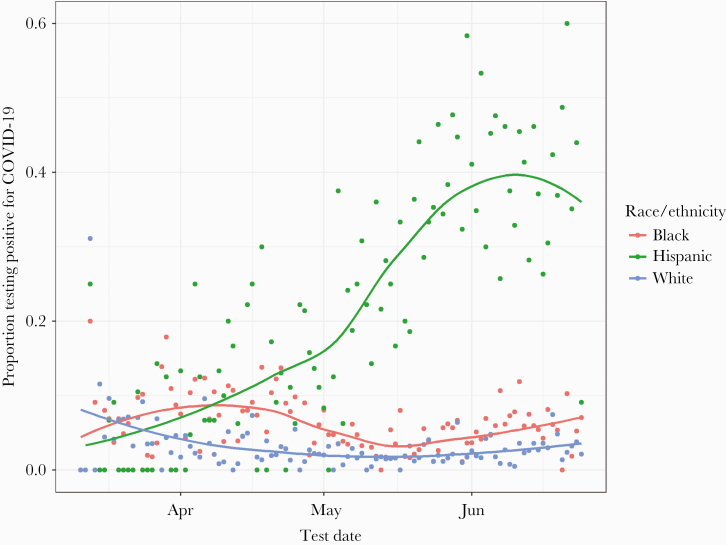
Results: Our dataset included 27 099 negative and 2039 positive unique SARS-CoV-2 tests. The odds of a positive SARS-CoV-2 test were higher for males (odds ratio [OR], 1.43; 95% credible interval [CI], 1.30-1.58), blacks (OR, 1.47; 95% CI, 1.27-1.70), and Hispanics (OR, 4.25; 955 CI, 3.55-5.12). Among neighborhood-level predictors, percentage of black population (OR, 1.14; 95% CI, 1.05-1.25), and percentage Hispanic population (OR, 1.23; 95% CI, 1.07-1.41) also influenced the odds of a positive SARS-CoV-2 test. Population density, average household size, and Area Deprivation Index were not associated with SARS-CoV-2 test results after adjusting for race.
Conclusions: The odds of testing positive for SARS-CoV-2 were higher for both black and Hispanic individuals, as well as within neighborhoods with a higher proportion of black or Hispanic residents-confirming that black and Hispanic communities are disproportionately affected by SARS-CoV-2.
Keywords: Bayesian statistics; COVID-19; SARS-CoV-2; disparities; geographic information systems.
© The Author(s) 2020. Published by Oxford University Press on behalf of Infectious Diseases Society of America.
Figures
References
-
- Centers for Disease Control and Prevention. Coronavirus disease 2019 (COVID-19) cases in the U.S. 2020. Available at: https://www.cdc.gov/coronavirus/2019-ncov/cases-updates/cases-in-us.html. Accessed 28 October 2020..
-
- HIPxChange. Area deprivation index databases. Available at: https://www.hipxchange.org/ADI. Accessed 28 October 2020.
LinkOut - more resources
Full Text Sources
Miscellaneous
