


Medication review interventions to reduce hospital readmissions in older people
- PMID: 33576506
- PMCID: PMC8247962
- DOI: 10.1111/jgs.17041
Medication review interventions to reduce hospital readmissions in older people
Abstract
Objective: To assess the efficacy of medication review as an isolated intervention and with several co-interventions for preventing hospital readmissions in older adults.
Methods: Ovid MEDLINE, Embase, The Cochrane Central Register of Controlled Trials and CINAHL were searched for randomized controlled trials evaluating the effectiveness of medication review interventions with or without co-interventions to prevent hospital readmissions in hospitalized or recently discharged adults aged ≥65, until September 13, 2019. Included outcomes were "at least one all-cause hospital readmission within 30 days and at any time after discharge from the index admission."
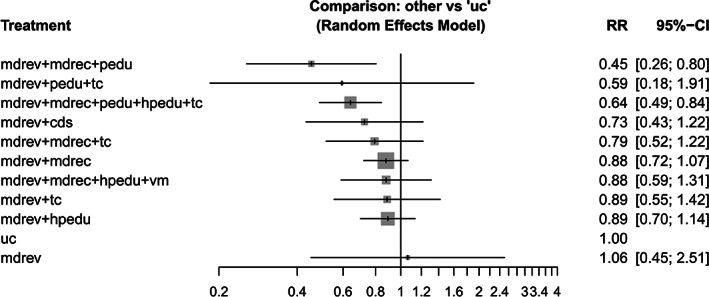
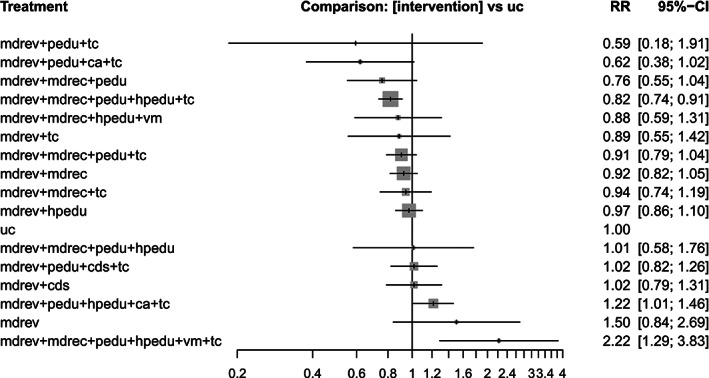
Results: Twenty-five studies met the inclusion criteria. Of these, 11 studies (7,318 participants) contributed to the network meta-analysis (NMA) on all-cause hospital readmission within 30 days. Medication review in combination with (a) medication reconciliation and patient education (risk ratio (RR) 0.45; 95% confidence interval (CI) 0.26-0.80) and (b) medication reconciliation, patient education, professional education and transitional care (RR 0.64; 95% CI 0.49-0.84) were associated with a lower risk of all-cause hospital readmission compared to usual care. Medication review in isolation did not significantly influence hospital readmissions (RR 1.06; 95% CI 0.45-2.51). The NMA on all-cause hospital readmission at any time included 24 studies (11,677 participants). Medication review combined with medication reconciliation, patient education, professional education and transitional care resulted in a reduction of hospital readmissions (RR 0.82; 95% CI 0.74-0.91) compared to usual care. The quality of the studies included in this systematic review raised some concerns, mainly regarding allocation concealment, blinding and contamination.
Conclusion: Medication review in combination with medication reconciliation, patient education, professional education and transitional care, was associated with a lower risk of hospital readmissions compared to usual care. An effect of medication review without co-interventions was not demonstrated. Trials of higher quality are needed in this field.
Keywords: hospital readmission; medication review; older adults.
© 2021 The Authors. Journal of the American Geriatrics Society published by Wiley Periodicals LLC on behalf of The American Geriatrics Society.
Conflict of interest statement
The authors have no financial or personal conflicts.
Figures
References
-
- Hanlon JT, Schmader KE, Samsa GP, Weinberger M, Uttech KM, Lewis IK. A method for assessing drug therapy appropriateness. J Clin Epidemiol. 1992;45(10):1045‐1,051. - PubMed
Publication types
MeSH terms
LinkOut - more resources
Full Text Sources
Other Literature Sources
Miscellaneous
