. 2021 Sep:191:114463.
doi: 10.1016/j.bcp.2021.114463. Epub 2021 Feb 10.

Sleep during COVID-19 lockdown: A cross-cultural study investigating job system relevance

Affiliations

Sleep during COVID-19 lockdown: A cross-cultural study investigating job system relevance

Cristina Florea et al. Biochem Pharmacol. 2021 Sep.

Abstract

Our study aimed to assess the change in the sleep patterns during the Coronavirus lockdown in five regions (Austria/Germany, Ukraine, Greece, Cuba and Brazil), using online surveys, translated in each language. Part of the cohort (age 25-65, well-educated) was collected directly during lockdown, to which retrospective cross-sectional data from and after lockdown (retrospective) questionnaires were added. We investigated sleep times and sleep quality changes from before to during lockdown and found that, during lockdown, participants had (i) worse perceived sleep quality if worried by COVID-19, (ii) a shift of bedtimes to later hours during workdays, and (iii) a sleep loss on free days (resulting from more overall sleep during workdays in non-system relevant jobs), leading to (iv) a marked reduction of social jetlag across all cultures. For further analyses we directly compared system relevant and system irrelevant jobs, because it was assumed that the nature of the lockdown's consequences is dependent upon system relevance. System relevant jobs were found to have earlier wake-up times as well as shorter total sleep times on workdays, leading to higher social jetlag for people in system relevant jobs. Cultural differences revealed a general effect that participants from Greece and Ukraine had later bedtimes (on both work and free days) and wake-up times (on workdays) than Cuba, Brazil and Austria, irrespective of COVID-19 lockdown restrictions.

Keywords: COVID-19; Cross-cultural; Pandemic; Sleep habits; Sleep problems; Social jetlag.


Figures

None
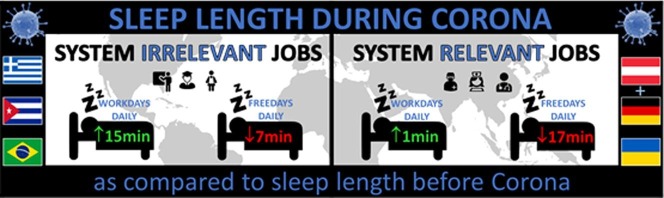
Graphical abstract
Fig. 1
Fig. 1
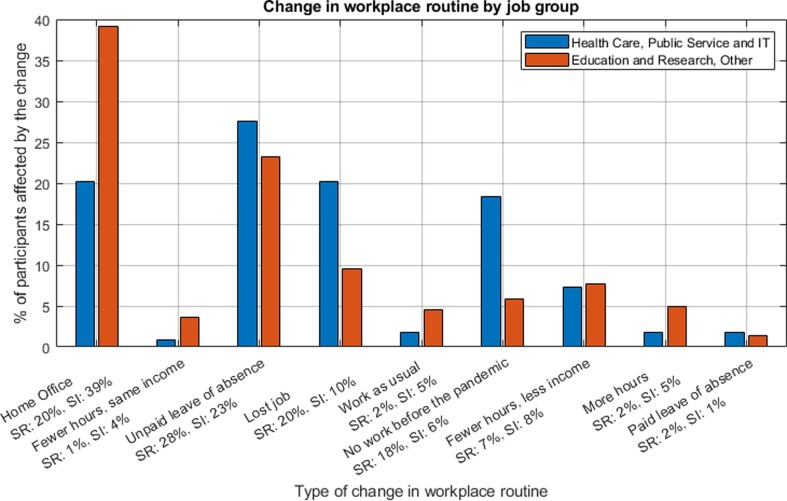
How the COVID-19 lockdown affected job routines for participants in different job groups. Note that system relevant (SR) jobs are less likely to do home office or to work fewer hours with a constant income, but are more likely to take unpaid leave of absence, or to lose their job. (SR = System Relevant jobs, N = 109, SI = System Irrelevant jobs, N = 220; participants who reported to have no job or who did not provide an answer about their job were excluded here for better illustration, N = 59).
Fig. 2
Fig. 2
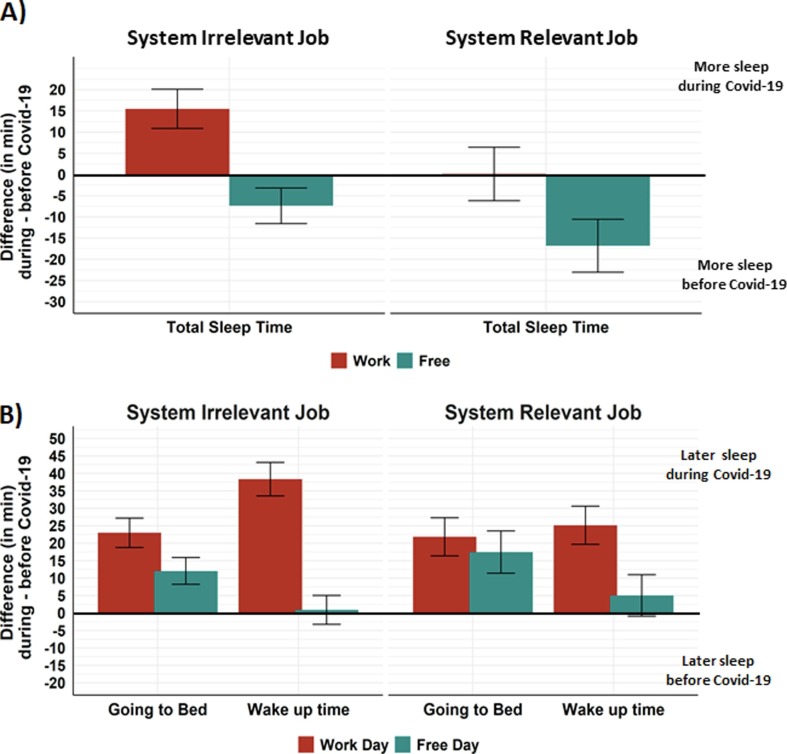
(A) Differences in total-sleep-times during minus before COVID-19 lockdown, for system relevant and system irrelevant jobs. On workdays (red) participants with system irrelevant jobs sleep more during lockdown than before, but participants with system relevant jobs do not. On free days (green), all participants sleep less during the lockdown than before. (B) Differences in bedtimes and wake up times during minus before COVID-19 lockdown, for system relevant and system irrelevant jobs. On workdays (red), both job groups go to bed and wake up later during lockdown than before. On free days (green), participants from both job groups go to bed a little later during than before the lockdown, but wake up at almost the same time as before the lockdown. Negative values describe a loss of sleep during lockdown; positive values describe a gain in sleep during lockdown.
Fig. 3
Fig. 3
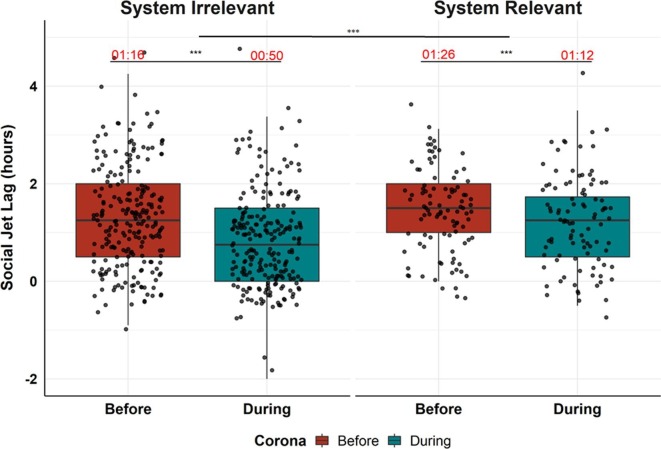
Social jetlag in hours (difference of sleep midpoint of workdays minus sleep midpoint of free days) for system relevant (n = 108) and system irrelevant (n = 262) jobs before and during COVID-19. Note that during COVID-19 there is reduced social jetlag for both groups. Participants with system relevant jobs reported higher social jetlag than participants with system irrelevant jobs, independent of the COVID-19 situation. (*p < .05, **p < .001).
Fig. 4
Fig. 4
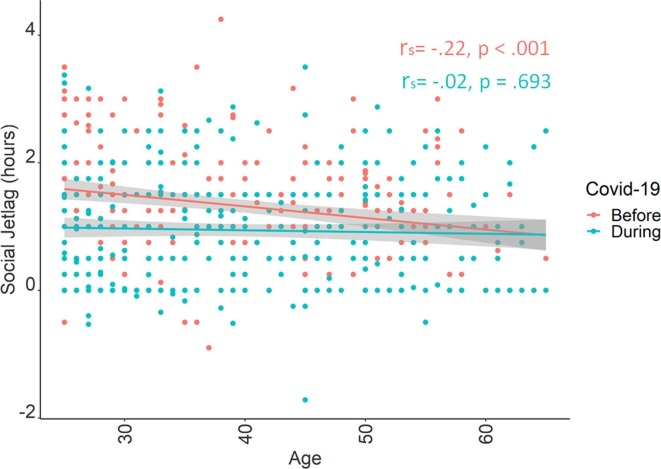
Correlation between age and social jetlag before (red) and during (blue) COVID-19 lockdown. Note that the negative relationship between age and social jetlag before lockdown (red) disappears during (blue) COVID-19 lockdown.
Fig. 5
Fig. 5
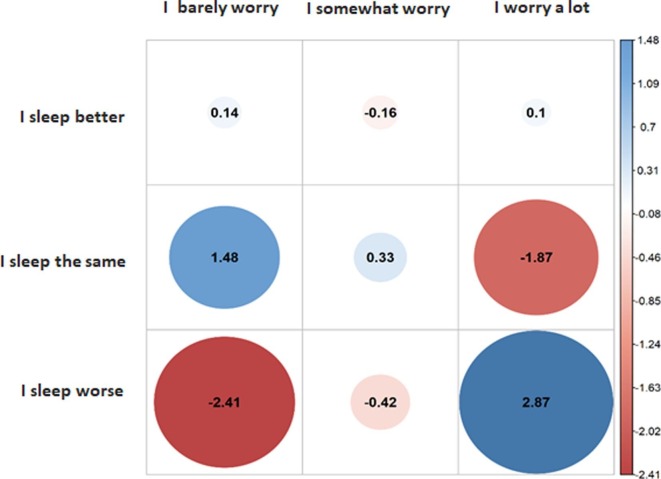
Effects of worry about the COVID-19 pandemic on subjective sleep quality visualised as χ2 residuals. Note that people who do not (or barely) worry are less likely (than expected) to sleep worse (in red), whereas the participants who worry a lot about the pandemic are more likely to sleep worse (in blue).

References

    1. Team TNCPERE. The Epidemiological Characteristics of an Outbreak of 2019 Novel Coronavirus Diseases (COVID-19) — China. CCDC Weekly. 2(x) (2020). - PMC - PubMed
    1. Organisation WH. WHO Timeline on COVID-19. https://www.who.int/news-room/detail/27-04-2020-who-timeline---COVID-19. Published 2020. Accessed 21.07.2020.
    1. Lau H., Khosrawipour V., Kocbach P., et al. The positive impact of lockdown in Wuhan on containing the COVID-19 outbreak in China. J Travel Med. 2020;27(3) - PMC - PubMed
    1. Flaxman S., Mishra S., Gandy A., et al. Estimating the effects of non-pharmaceutical interventions on COVID-19 in Europe. Nature. 2020;584(7820):257–261. - PubMed
    1. Morin C.M., Carrier J., Bastien C., Godbout R., Canadian S., Circadian N. Sleep and circadian rhythm in response to the COVID-19 pandemic. Can. J. Public Health. 2020;111(5):654–657. - PMC - PubMed

MeSH terms