Review
. 2021 Feb 10;10(2):140.
doi: 10.3390/biology10020140.

On Origin and Evolution of the Antibody Molecule

Affiliations
Review

On Origin and Evolution of the Antibody Molecule

Umberto Oreste et al. Biology (Basel). .

Abstract

The vertebrate immune system provides a powerful defense because of the ability to potentially recognize an unlimited number of pathogens. The antibody molecule, also termed immunoglobulin (Ig) is one of the major mediators of the immune response. It is built up from two types of Ig domains: the variable domain, which provides the capability to recognize and bind a potentially infinite range of foreign substances, and the constant domains, which exert the effector functions. In the last 20 years, advances in our understanding of the molecular mechanisms and structural features of antibody in mammals and in a variety of other organisms have uncovered the underlying principles and complexity of this fundamental molecule. One notable evolutionary topic is the origin and evolution of antibody. Many aspects have been clearly stated, but some others remain limited or obscure. By considering a wide range of prokaryotic and eukaryotic organisms through a literature survey about the topic, we have provided an integrated view of the emergence of antibodies in evolution and underlined the very ancient origins.

Keywords: Fc receptors; Ig domain; IgSF; RAG; antibody; evolution; immune system; immunoglobulin genes; somatic hypermutation; somatic recombination.


Conflict of interest statement

The authors declare no conflict of interest.

Figures
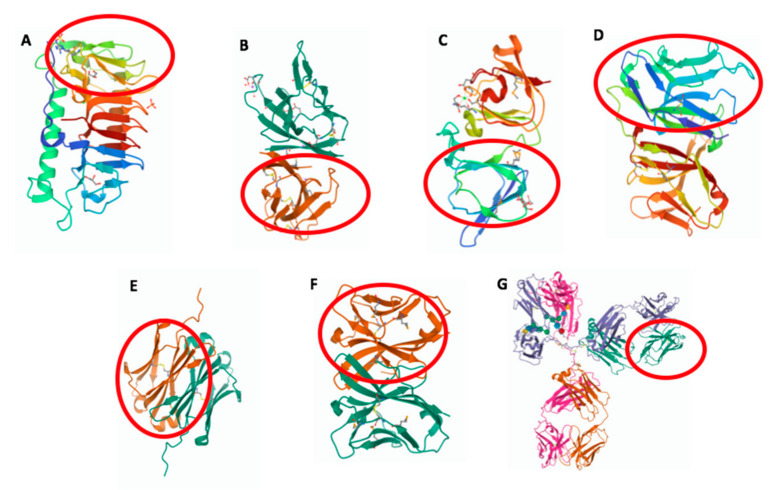
Figure 1
Figure 1
Three-dimensional structure of molecules from different species containing an IgV-like or IgV domain (in red circle). (A) Shewanella frigidimarina ice-binding protein_1, PDB entry: 6BG8; (B) SARS-CoV-2 ORF8, PDB entry: 7JX6; (C) Geodia cydonium geodin, PDB entry: 4IAU; (D) Branchiostoma floridae VCBP, PDB entry: FBO; (E) Ginglymostoma cirratum IgNAR V domain, PDB entry: 2I27; (F) Ictalurus punctatus NITR11, PDB entry: 2QQQ; and (G) Mus musculus IgG1, PDB entry: 1IGY.
Figure 2
Figure 2
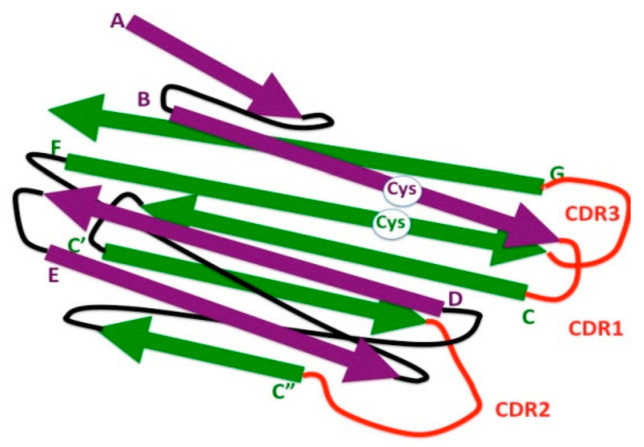
Schematic representation of 3-D strand topology in the eukaryotic IgV domain. Antiparallel strands of the two β sheets are colored in purple and green, respectively, and identified by letters. Connecting loops are depicted in black. Loops bearing the complementary determining regions (CDR1, CDR2, and CDR3) are depicted in red. The highly conserved cysteine residues (Cys) involved in the formation of the disulfide bond between the β strands B and F are indicated (white circle).
Figure 3
Figure 3
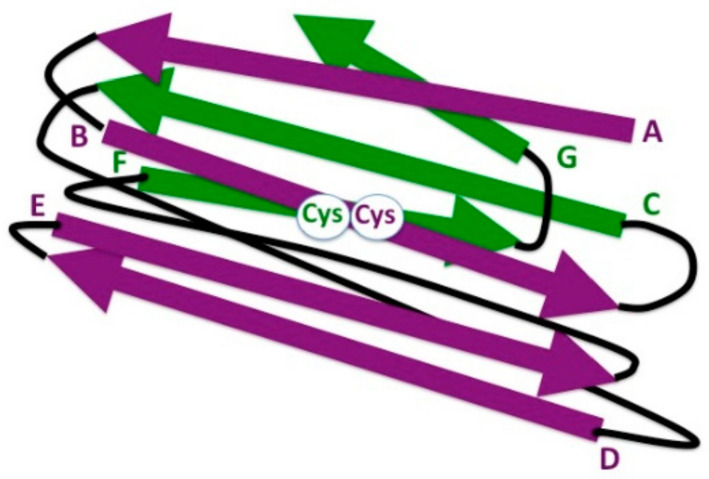
Schematic representation of 3-D strand topology in the eukaryotic IgC1 domain. Antiparallel strands of the two β sheets are colored in purple and green, respectively, and identified by letters. Connecting loops are depicted in black. The highly conserved cysteine residues (Cys) involved in the formation of the disulfide bond between the β strands B and F are indicated (white circle).

References

    1. Janeway C.A., Travers P., Walport M., Shlomchik M.J. Immunobiology: The Immune System in Health and Disease. 5th ed. Garland Science; New York, NY, USA: 2001.
    1. Matz H., Munir D., Logue J., Dooley H. The Immunoglobulins of Cartilaginous Fishes. Dev. Comp. Immunol. 2021;115:103873. doi: 10.1016/j.dci.2020.103873. - DOI - PMC - PubMed
    1. Eason D.D., Cannon J.P., Haire R.N., Rast J.P., Ostrov D.A., Litman G.W. Mechanisms of Antigen Receptor Evolution. Semin. Immunol. 2004;16:215–226. doi: 10.1016/j.smim.2004.08.001. - DOI - PubMed
    1. Lesk A.M., Chothia C. Evolution of Proteins Formed by Beta-Sheets. II. The Core of the Immunoglobulin Domains. J. Mol. Biol. 1982;160:325–342. doi: 10.1016/0022-2836(82)90179-6. - DOI - PubMed
    1. Feige M.J., Hendershot L.M., Buchner J. How Antibodies Fold. Trends Biochem. Sci. 2010;35:189–198. doi: 10.1016/j.tibs.2009.11.005. - DOI - PMC - PubMed

LinkOut - more resources