


A tiered approach to prioritizing registered pesticides for potential cancer hazard evaluations: implications for decision making
- PMID: 33579300
- PMCID: PMC7881680
- DOI: 10.1186/s12940-021-00696-0
A tiered approach to prioritizing registered pesticides for potential cancer hazard evaluations: implications for decision making
Abstract
Background: Over 800 pesticides are registered for use in the United States. Human studies indicate concern that some pesticides currently in use in large quantities may also pose a carcinogenic hazard. Our objective is to identify candidates for future hazard evaluations among pesticides used in high volumes in the United States and also classified as potential carcinogens by U.S. Environmental Protection Agency (USEPA). We also identify data gaps where further research is needed.
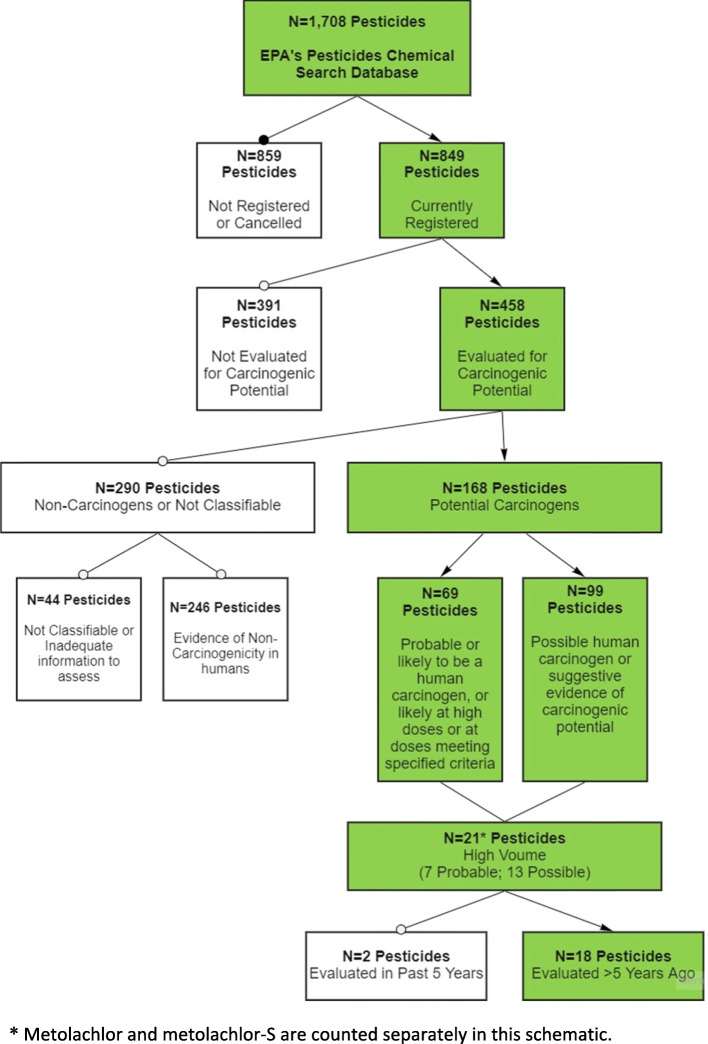
Methods: We used a systematic, two-tiered review approach to prioritize pesticides. First, we identified currently registered pesticides classified by USEPA as "possible", "suggestive", or "likely" human carcinogens. Among these, we selected pesticides USEPA has listed as commonly used by volume in at least one sector (agriculture, home and garden, or industry, commercial, and/or government), and those without a published hazard evaluation in the past 5 years. Second, we searched primary literature databases for peer-reviewed human cancer studies reporting pesticide-specific data published since the last USEPA carcinogenicity evaluation for each pesticide, and created evidence maps of the number of studies meeting our criteria for each identified pesticide. No evaluation of study results or risk-of-bias assessments were conducted.
Results: We identified 18 pesticides meeting our selection criteria, 16 pesticides had information from human cancer studies published after their initial carcinogenicity review. Of these, eight pesticides had at least three studies for one or more cancer sites: carbaryl, dichloropropene, dimethoate, mancozeb, metolachlor, pendimethalin, permethrin, and trifluralin. A major limitation in the literature revealed a shortage of studies reporting risk estimates for individual pesticides, rather pesticides were grouped by chemical class.
Conclusions: Our scoping report provides a map of the existing literature on real-world exposures and human cancer that has accumulated on pesticides classified as potential carcinogens by USEPA and used in high volumes. We also illustrate that several pesticides which are "data-rich" may warrant updated authoritative hazard evaluations. Our two-tiered approach and utilization of evidence mapping can be used to inform future decision-making to update cancer hazard evaluations.
Keywords: Cancer; Epidemiology; Evidence mapping; Hazard identification; Pesticides; Scoping.
Conflict of interest statement
The authors declare that they have no competing interests.
Figures

References
-
- Fernandez-Cornejo J, Nehring R, Osteen C, Wechsler S, Martin A, Vialou A. Pesticide Use in U.S. Agriculture: 21 Selected Crops, 1960–2008: EIB-124. U.S. Department of Agriculture; 2014. www.ers.usda.gov/publications/eib-economic-information-bulletin/eib124.aspx
-
- Atwood D, Paisley-Jones C. Pesticides Industry Sales and Usage, 2008–2012 Market Estimates Report. Washington, DC: U.S. Environmental Protection Agency, Office of Chemical Safety and Pollution Prevention, Office of Pesticide Programs; 2017.
-
- WHO . Pesticides Residues in Food 2016. Special session of the joint FAO/WHO meeting on pesticide residues. FAO Plant Production and Protection Paper 227. Geneva: Food and Agriculture Organization (FAO) and World Health Organization (WHO); 2017.
Publication types
MeSH terms
Substances
Associated data
Grants and funding
LinkOut - more resources
Full Text Sources
Other Literature Sources
Medical
Miscellaneous
