


Global burden of active smoking among people living with HIV on antiretroviral therapy: a systematic review and meta-analysis
- PMID: 33579391
- PMCID: PMC7881452
- DOI: 10.1186/s40249-021-00799-3
Global burden of active smoking among people living with HIV on antiretroviral therapy: a systematic review and meta-analysis
Abstract
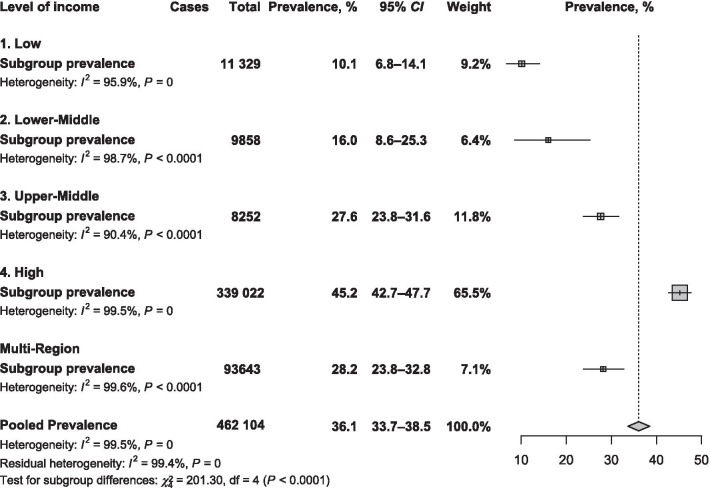
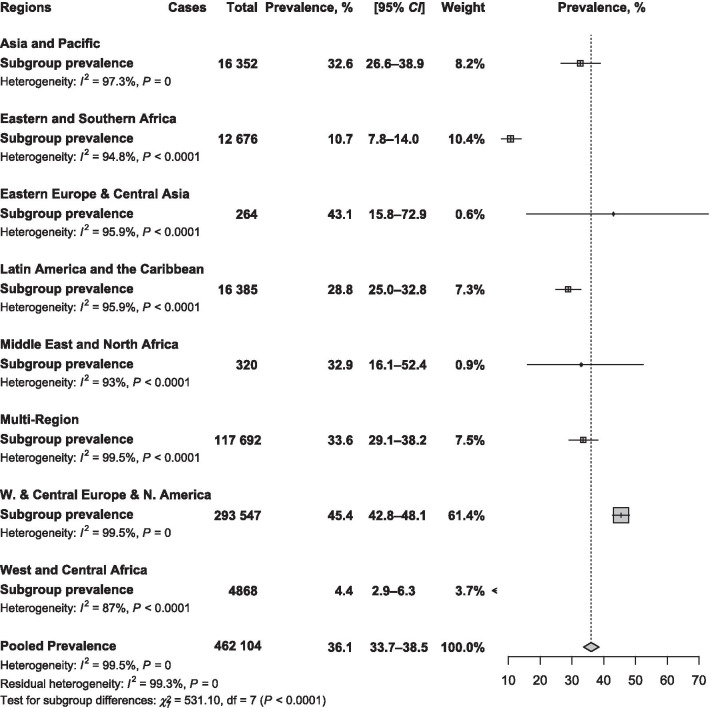
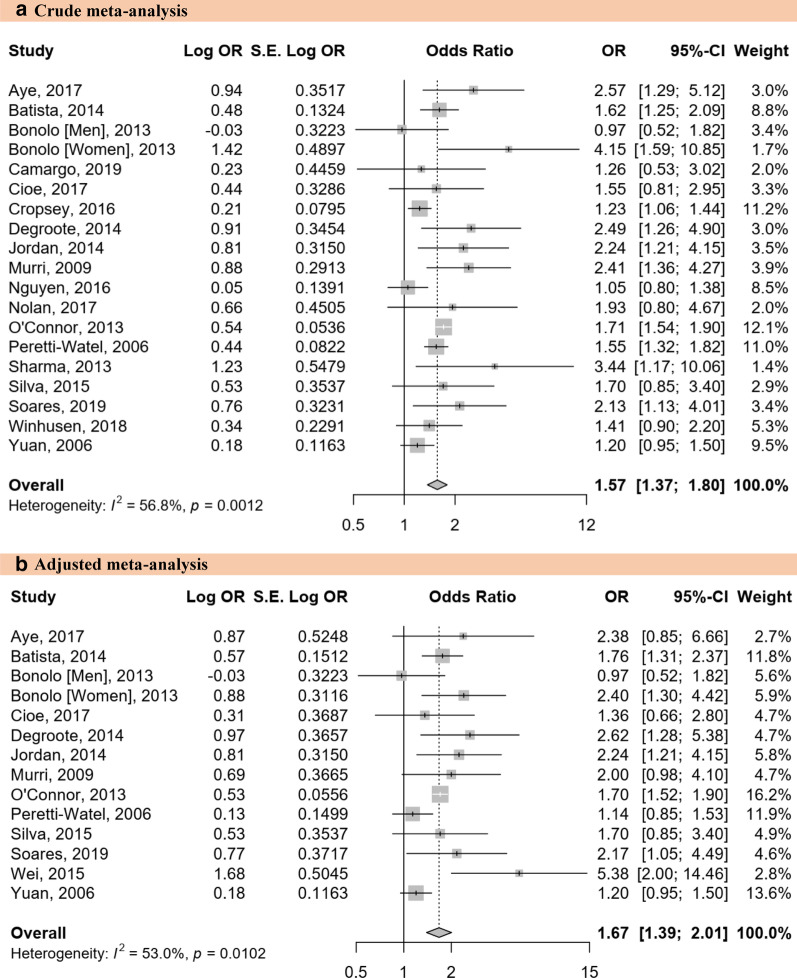
Background: Although the high burden of both active smoking and human immunodeficiency virus (HIV) is clearly known, the relationship between them is still not well characterized. Therefore, we estimated the global prevalence of active smoking in people living with HIV (PLHIV) on antiretroviral therapy (ART) and investigated the association between exposure to active smoking and risk for suboptimal adherence to ART. Main text: We searched PubMed, Embase, and Web of Science to identify articles published until September 19, 2019. Eligible studies reported the prevalence of active smoking in PLHIV on ART or investigated the association between active smoking and ART adherence; or enough data to compute these estimates. We used a random-effects model to pool data and quantified heterogeneity (I2). The global prevalence of active smoking was 36.1% (95% CI: 33.7-37.2; 329 prevalence data; 462 104 participants) with substantial heterogeneity. The prevalence increased with level of country income; from 10.1% (95% CI: 6.8-14.1) in low-income to 45.2% (95% CI: 42.7-47.7) in high-income countries; P < 0.0001. With regards to the Joint United Nations Programme on HIV/AIDS (UNAIDS) regions, the prevalence was higher in West and Central Europe and North America 45.4% (42.7-48.1) and lowest in the two UNAIDS regions of sub-Saharan Africa: Eastern and Southern Africa 10.7% (95% CI: 7.8-14.0) and West and Central Africa 4.4% (2.9-6.3); P < 0.0001. Globally, we estimated that there were 4 110 669 PLHIV on ART who were active smokers, among which the highest number was from Eastern and Southern Africa (35.9%) followed by Asia and the Pacific (25.9%). Active smoking was significantly associated with suboptimal ART adherence: pooled odds ratio 1.57 (95% CI: 1.37-1.80; I2 = 56.8%; 19 studies; 48 450 participants); even after considering adjusted estimates: 1.67 (95% CI: 1.39-2.01; I2 = 53.0%; 14 studies).
Conclusions: This study suggests a high prevalence of active smoking in PLHIV on ART and an association between active smoking and ART suboptimal adherence. As such, healthcare providers and policy makers should focus on adopting and implementing tobacco harm reduction strategies in HIV care, especially in sub-Saharan Africa known as epicenter of HIV pandemic with highest number of active tobacco smoking among PLHIV on ART.
Keywords: AIDS; Antiretroviral therapy; Global health; HIV; Smoking; Tobacco.
Conflict of interest statement
The authors declare that they have no competing interests.
Figures
References
-
- UNAIDS. Global HIV & AIDS statistics — 2019 fact sheet. 2019. https://www.unaids.org/en/resources/fact-sheet. Accessed June 29 2020.
-
- UNAIDS. UNAIDS data 2019. 2019. https://www.unaids.org/sites/default/files/media_asset/2019-UNAIDS-data_.... Accessed June 29 2020.
-
- UNAIDS. Understanding fast-track: accelerating action to end the AIDS epidemic by 2030. 2015. https://www.unaids.org/sites/default/files/media_asset/201506_JC2743_Und.... Accessed June 29 2020.
-
- WHO. Tobacco: Key facts. 2020. https://www.who.int/news-room/fact-sheets/detail/tobacco. Accessed June 29 2020.
Publication types
MeSH terms
Substances
LinkOut - more resources
Full Text Sources
Other Literature Sources
Medical
Research Materials
