


Reduced nest development of reared Bombus terrestris within apiary dense human-modified landscapes
- PMID: 33580131
- PMCID: PMC7881143
- DOI: 10.1038/s41598-021-82540-6
Reduced nest development of reared Bombus terrestris within apiary dense human-modified landscapes
Abstract
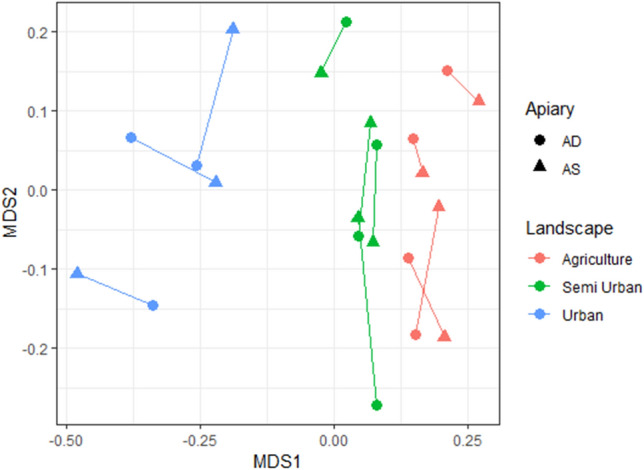
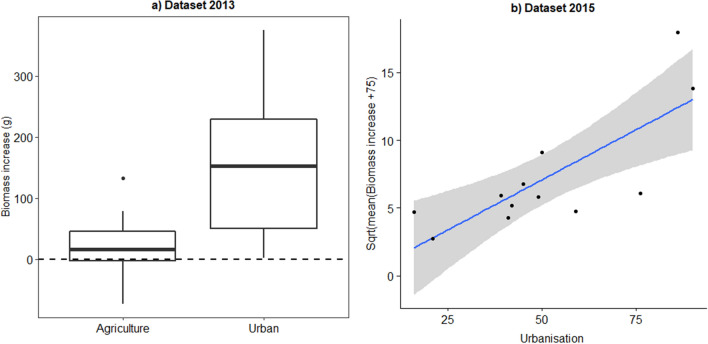
Wild bees are in decline on a local to global scale. The presence of managed honey bees can lead to competition for resources with wild bee species, which has not been investigated so far for human-modified landscapes. In this study we assess if managed honey bee hive density influence nest development (biomass) of bumble bees, an important trait affecting fitness. We hypothesize that domesticated honey bees can negatively affect Bombus terrestris nest development in human-modified landscapes. In Flanders, Belgium, where such landscapes are dominantly present, we selected 11 locations with landscape metrics ranging from urban to agricultural. The bee hive locations were mapped and each location contained one apiary dense (AD) and one apiary sparse (AS) study site (mean density of 7.6 ± 5.7 managed honey bee hives per km2 in AD sites). We assessed the effect of apiary density on the reproduction of reared B. terrestris nests. Reared B. terrestris nests had more biomass increase over 8 weeks in apiary sparse (AS) sites compared to nests located in apiary dense (AD) sites. This effect was mainly visible in urban locations, where nest in AS sites have 99.25 ± 60.99 g more biomass increase compared to nest in urban AD sites. Additionally, we found that managed bumble bee nests had higher biomass increase in urban locations. We conclude that the density of bee hives is a factor to consider in regard to interspecific competition between domesticated honey bees and bumble bees.
Conflict of interest statement
The authors declare no competing interests.
Figures


References
-
- Ollerton J, Winfree R, Tarrant S. How many flowering plants are pollinated by animals? Oikos. 2011;120:321–326. doi: 10.1111/j.1600-0706.2010.18644.x. - DOI
Publication types
MeSH terms
LinkOut - more resources
Full Text Sources
Other Literature Sources
Research Materials
