. 2021 Feb 12;11(1):3697.
doi: 10.1038/s41598-021-83355-1.

Phylogenomics reveals viral sources, transmission, and potential superinfection in early-stage COVID-19 patients in Ontario, Canada

Affiliations

Phylogenomics reveals viral sources, transmission, and potential superinfection in early-stage COVID-19 patients in Ontario, Canada

Calvin P Sjaarda et al. Sci Rep. .

Abstract

The emergence and rapid global spread of SARS-CoV-2 demonstrates the importance of infectious disease surveillance, particularly during the early stages. Viral genomes can provide key insights into transmission chains and pathogenicity. Nasopharyngeal swabs were obtained from thirty-two of the first SARS-CoV-2 positive cases (March 18-30) in Kingston Ontario, Canada. Viral genomes were sequenced using Ion Torrent (n = 24) and MinION (n = 27) sequencing platforms. SARS-CoV-2 genomes carried forty-six polymorphic sites including two missense and three synonymous variants in the spike protein gene. The D614G point mutation was the predominate viral strain in our cohort (92.6%). A heterozygous variant (C9994A) was detected by both sequencing platforms but filtered by the ARTIC network bioinformatic pipeline suggesting that heterozygous variants may be underreported in the SARS-CoV-2 literature. Phylogenetic analysis with 87,738 genomes in the GISAID database identified global origins and transmission events including multiple, international introductions as well as community spread. Reported travel history validated viral introduction and transmission inferred by phylogenetic analysis. Molecular epidemiology and evolutionary phylogenetics may complement contact tracing and help reconstruct transmission chains of emerging diseases. Earlier detection and screening in this way could improve the effectiveness of regional public health interventions to limit future pandemics.


Conflict of interest statement

The authors declare no competing interests.

Figures
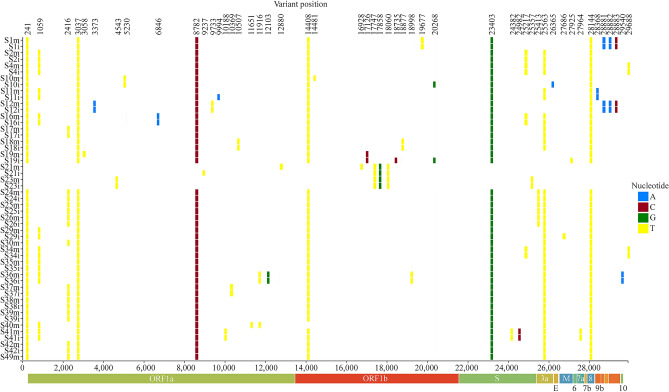
Figure 1
Figure 1
Distribution of polymorphisms in 27 SARS-CoV-2 genome sequences isolated from the early cases of COVID-19 in eastern Ontario. Viral genome sequencing identified forty-six polymorphic sites in twenty-seven viral genomes. S_m refers to the sample sequenced on the MinION and S_i refers to the sample sequenced on the Ion Torrent next generation sequencing platform.
Figure 2
Figure 2
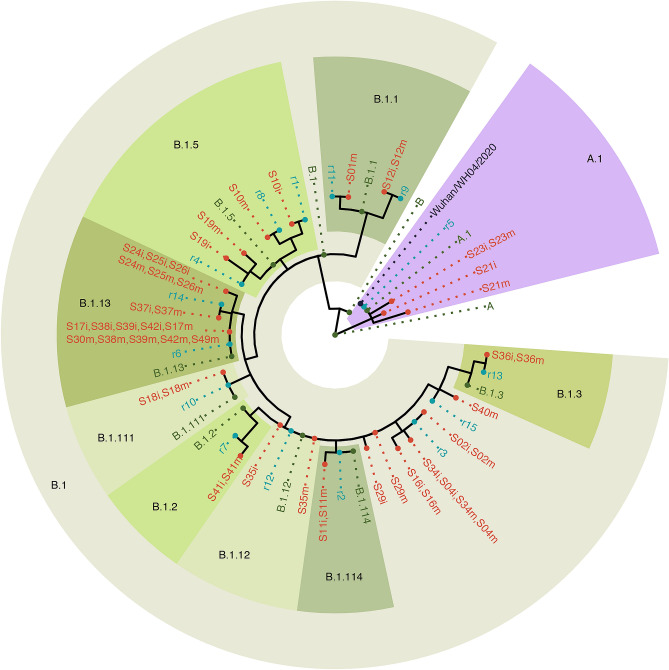
Nextstrain phylogenetic tree of local cases of SARS-CoV-2 and the most similar reference sequences in the GISAID database. Phylogenetic analysis suggests that S1, S10, S12, and S19 are similar to reference sequences that are predominately European. S21 and S23 are A.1 lineage viruses similar to reference sequences from the USA. The other samples are composed of B.1 and B.1 derived lineages and share genomes with reference sequences described predominantly in the USA. S_m refers to the sample sequenced on the MinION and S_i refers to the sample sequenced on the Ion Torrent next generation sequencing platforms; r_ refers to reference genome (Supplementary Table 3).

References

    1. Lee N, Hui D, Wu A, Chan P, Cameron P, Joynt GM, et al. A major outbreak of severe acute respiratory syndrome in Hong Kong. N. Engl. J. Med. 2003;348(20):1986–1994. doi: 10.1056/NEJMoa85. - DOI - PubMed
    1. Zaki AM, van Boheemen S, Bestebroer TM, Osterhaus ADME, Fouchier RAM. Isolation of a novel coronavirus from a man with pneumonia in Saudi Arabia. N. Engl. J. Med. 2012;367(19):1814–1820. doi: 10.1056/NEJMoa1211721. - DOI - PubMed
    1. Wu F, Zhao S, Yu B, Chen YM, Wang W, Song ZG, et al. A new coronavirus associated with human respiratory disease in China. Nature. 2020;579(7798):265–269. doi: 10.1038/s41586-020-2008-3. - DOI - PMC - PubMed
    1. Gorbalenya AE, Baker SC, Baric RS, de Groot RJ, Drosten C, Gulyaeva AA, et al. The species severe acute respiratory syndrome-related coronavirus: Classifying 2019-nCoV and naming it SARS-CoV-2. Nat. Microbiol. 2020;5(4):536–544. doi: 10.1038/s41564-020-0695-z. - DOI - PMC - PubMed
    1. Cui J, Li F, Shi Z-L. Origin and evolution of pathogenic coronaviruses. Nat. Rev. Microbiol. 2019;17(3):181–192. doi: 10.1038/s41579-018-0118-9. - DOI - PMC - PubMed

Publication types

MeSH terms

Substances