. 2021 Feb 12;11(1):3726.
doi: 10.1038/s41598-021-83257-2.

A small-molecular inhibitor against Proteus mirabilis urease to treat catheter-associated urinary tract infections

Affiliations

A small-molecular inhibitor against Proteus mirabilis urease to treat catheter-associated urinary tract infections

Scarlet Milo et al. Sci Rep. .

Abstract

Infection and blockage of indwelling urinary catheters is significant owing to its high incidence rate and severe medical consequences. Bacterial enzymes are employed as targets for small molecular intervention in human bacterial infections. Urease is a metalloenzyme known to play a crucial role in the pathogenesis and virulence of catheter-associated Proteus mirabilis infection. Targeting urease as a therapeutic candidate facilitates the disarming of bacterial virulence without affecting bacterial fitness, thereby limiting the selective pressure placed on the invading population and lowering the rate at which it will acquire resistance. We describe the design, synthesis, and in vitro evaluation of the small molecular enzyme inhibitor 2-mercaptoacetamide (2-MA), which can prevent encrustation and blockage of urinary catheters in a physiologically representative in vitro model of the catheterized urinary tract. 2-MA is a structural analogue of urea, showing promising competitive activity against urease. In silico docking experiments demonstrated 2-MA's competitive inhibition, whilst further quantum level modelling suggests two possible binding mechanisms.


Conflict of interest statement

The authors declare no competing interests.

Figures
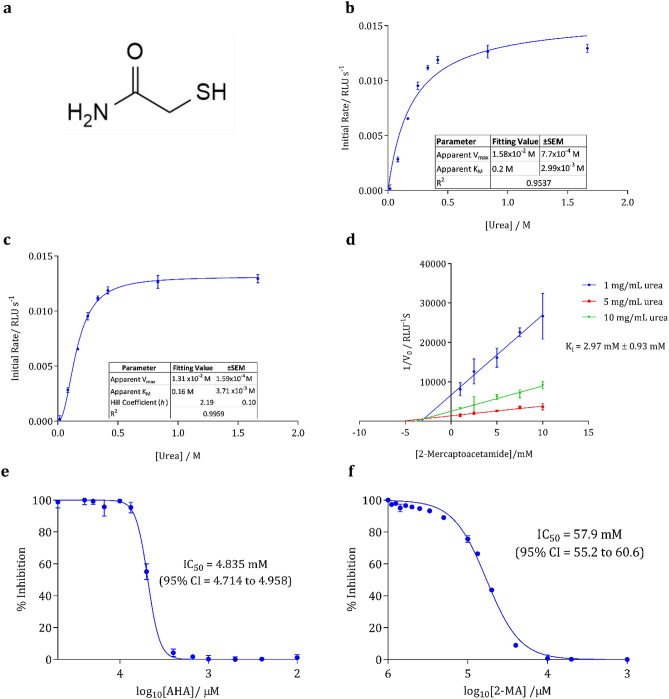
Figure 1
Figure 1
(a) Molecular structure of 2-mercatoacetamide, the proposed inhibitor of P. mirabilis urease activity. Michaelis–Menten kinetics of C. ensiformis urease, with the substrate urea. (b) Hyperbolic curve fitting (least squares fit) was used to determine Michaelis–Menten parameters. (c) Sigmoidal curve fitting (least squares fit, Hill slope) was used to determine Michaelis–Menten parameters and determination of the Hill Coefficient. (d) Dixon plot for the competitive inhibition of C. ensiformis urease by 2-MA. The abscissa of line intersection yields the inhibition constant (− Ki). The error of Ki was calculated as relative uncertainty combining the standard error of mean (SEM) error from the equations of each line. Determining IC50 of AHA (e) and 2-MA (f) inhibiting urease. Data was fitted with sigmoidal dose–response curves and IC50 determined by non-linear regression. Results are from three biological replicates; error bars represent SEM (standard error of mean). Data fitted using GraphPad Prism Version 7.
Figure 2
Figure 2
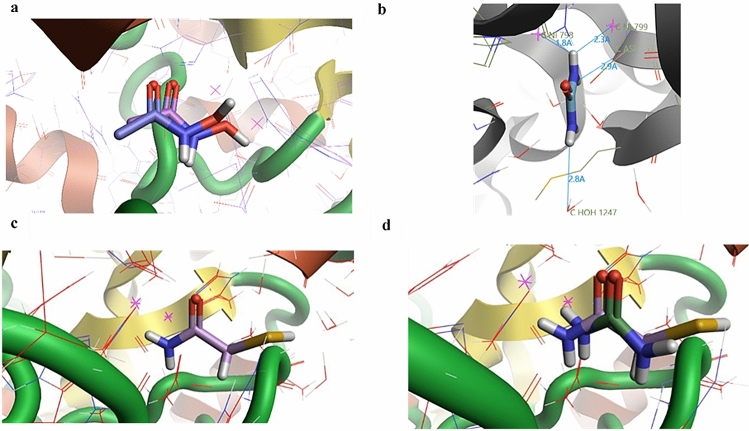
(a) AHA self-docked into the active site of urease (from S. pasteurii, PDB = 4UBP). The bottom compound is crystallized AHA overlaid with the docked AHA. A RMSQ of 0.387 Å is calculated for the difference between the crystallized AHA and the docked AHA. (b) Analysis of the contacts of docked urea with the active site of urease. Urea is coordinating with the bi-nickel active site (Ni shown as pink crosses) and with D363, as well as interacting with surrounding water molecules. Distances are marked with blue lines and measured in Å. (c) 2-MA docked to urease, 2-MA binds to H222, H275, and D363. (d) Overlay of 2-MA docking and urea docking to the active site of urease. Docking carried out using Flare (Flare 3.0.0, Revision 38710; Cresset, Litlington, Cambridgeshire, UK).
Figure 3
Figure 3
PM6 optimized structures of the active site of S. pasteurii urease. (a) monodentate urea binding as shown by Nordlander et al.. (b) 2-MA mimicking monodentate binding of urea. (c) Binding of urea through a tetrahedral intermediate as shown by Mazzei et al.. (d) 2-MA bound through a tetrahedral intermediate. (e) AHA anion binding in same fashion as found in crystal structure (PDB = 4UBP). (f) 2-MA anion mimicking the binding of the AHA anion. Graphics generated using Chemcraft.
Figure 4
Figure 4
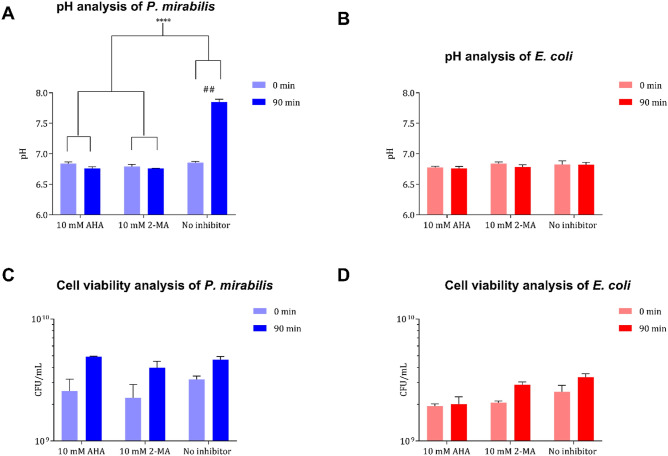
Whole cell evaluation of 2-MA and AHA. (A, B) Ability to penetrate bacterial cell membrane and inhibit intracellular urease activity was determined via measurement of the macromolecular changes in pH. (C, D) Viable cell counts were performed to ensure the viability of cultures before (0 min) and after (90 min) treatment with 10 mM dosage of inhibitory drugs. Evaluation was performed on both urease-positive (P. mirabilis B4) (blue), and urease-negative (E. coli NSM59) (red) uropathogenic clinical isolates. Data shown are the mean of three biological replicates, error bars represent SEM ****p < 0.0001, ##p < 0.005.
Figure 5
Figure 5
(a) measuring the time to block of in vitro bladder models comparing P. mirabilis infection with 2-MA, AHA or no treatment (control). Analysis of the in vitro bladder models infected with P. mirabilis and treated with either 2-MA, or AHA, or no treatment. (b) pH measurements of the residual urine. (c) measurements of the bacterial biomass. Results are from three biological replicates, error bars represent SEM, ****p < 0.0001.
Figure 6
Figure 6
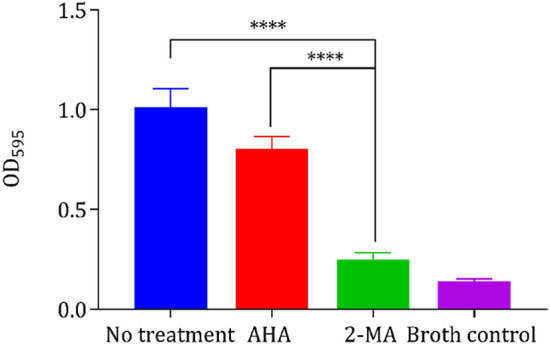
Quantitative measurement of P. mirabilis B4 static biofilm inhibition by 10 mM 2-MA and AHA. Quantification was performed via crystal violet biofilm staining. Results are from three biological replicates. Error bars represent SEM. ****p < 0.0001.
Figure 7
Figure 7
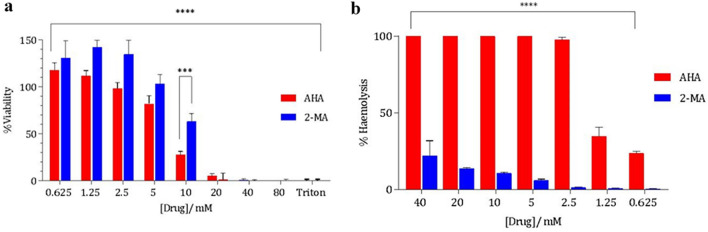
(a) CyQUANT XTT assay measuring the viability of HaCaT keratinocytes at varying concentrations of 2-MA and AHA. Corrected against absorbance of 450 nm of untreated control to give % viability. At 10 mM there is a significant difference between the viability observed to treated cells with AHA and 2-MA. Triton X-100 was used as positive control. (b) Percentage ex vivo hemolytic activity of dose-dependent 2-MA and AHA treatment human erythrocytes. Drug concentrations 0.625–40 mM. Hemolysis was calculated by correcting to the positive lysis control Triton X-100. Results are from three biological replicates. Error bars represent SEM. ****p < 0.0001, ***p < 0.001.

References

    1. Zowawi HM, et al. The emerging threat of multidrug-resistant Gram-negative bacteria in urology. Nat. Rev. Urol. 2015;12:570–584. doi: 10.1038/nrurol.2015.199. - DOI - PubMed
    1. Smith DRM, et al. Epidemiology and health-economic burden of urinary-catheter-associated infection in English NHS hospitals: A probabilistic modelling study. J. Hosp. Infect. 2019;103:44–54. doi: 10.1016/j.jhin.2019.04.010. - DOI - PubMed
    1. Feneley RCL, Hopley IB, Wells PNT. Urinary catheters: History, current status, adverse events and research agenda. J. Med. Eng. Technol. 2015;39:459–470. doi: 10.3109/03091902.2015.1085600. - DOI - PMC - PubMed
    1. Armbruster CE, Mobley HLT, Pearson MM. Pathogenesis of Proteus mirabilis infection. EcoSal Plus. 2018;8:1–73. doi: 10.1128/ecosalplus.ESP-0009-2017. - DOI - PMC - PubMed
    1. Hooton TM, et al. Diagnosis, prevention, and treatment of catheter-associated urinary tract infection in adults: 2009 international clinical practice guidelines from the Infectious Diseases Society of America. Clin. Infect. Dis. 2010;10:321–324. - PubMed

Publication types

MeSH terms