


Health care's response to climate change: a carbon footprint assessment of the NHS in England
- PMID: 33581070
- PMCID: PMC7887664
- DOI: 10.1016/S2542-5196(20)30271-0
Health care's response to climate change: a carbon footprint assessment of the NHS in England
Abstract
Background: Climate change threatens to undermine the past 50 years of gains in public health. In response, the National Health Service (NHS) in England has been working since 2008 to quantify and reduce its carbon footprint. This Article presents the latest update to its greenhouse gas accounting, identifying interventions for mitigation efforts and describing an approach applicable to other health systems across the world.
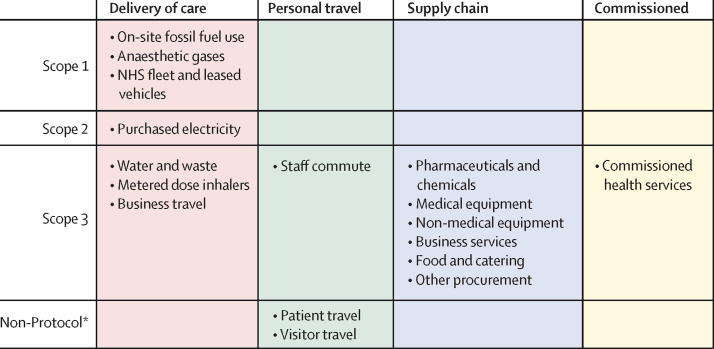
Methods: A hybrid model was used to quantify emissions within Scopes 1, 2, and 3 of the Greenhouse Gas Protocol, as well as patient and visitor travel emissions, from 1990 to 2019. This approach complements the broad coverage of top-down economic modelling with the high accuracy of bottom-up data wherever available. Available data were backcasted or forecasted to cover all years. To enable the identification of measures to reduce carbon emissions, results were disaggregated by organisation type.
Findings: In 2019, the health service's emissions totalled 25 megatonnes of carbon dioxide equivalent, a reduction of 26% since 1990, and a decrease of 64% in the emissions per inpatient finished admission episode. Of the 2019 footprint, 62% came from the supply chain, 24% from the direct delivery of care, 10% from staff commute and patient and visitor travel, and 4% from private health and care services commissioned by the NHS.
Interpretation: This work represents the longest and most comprehensive accounting of national health-care emissions globally, and underscores the importance of incorporating bottom-up data to improve the accuracy of top-down modelling and enabling detailed monitoring of progress as health systems act to reduce emissions.
Funding: Wellcome Trust.
Copyright © 2021 The Author(s). Published by Elsevier Ltd. This is an Open Access article under the CC BY 4.0 license. Published by Elsevier Ltd.. All rights reserved.
Figures


Comment in
-
Planetary health care: a framework for sustainable health systems.Lancet Planet Health. 2021 Feb;5(2):e66-e68. doi: 10.1016/S2542-5196(21)00005-X. Lancet Planet Health. 2021. PMID: 33581064 No abstract available.
-
Climate responsibilities in intensive care medicine-let's go green! An introduction to a new series in Intensive Care Medicine.Intensive Care Med. 2023 Jan;49(1):62-64. doi: 10.1007/s00134-022-06930-8. Epub 2022 Nov 29. Intensive Care Med. 2023. PMID: 36446855 Free PMC article. No abstract available.
-
Carbon Footprint of Elective Endovascular Abdominal Aortic Aneurysm Repair.Eur J Vasc Endovasc Surg. 2023 Dec;66(6):877-878. doi: 10.1016/j.ejvs.2023.08.062. Epub 2023 Aug 28. Eur J Vasc Endovasc Surg. 2023. PMID: 37647983 No abstract available.
References
-
- Karliner J, Slotterback S, Boyd R, Ashby B, Steele K. Health Care Without Harm; Reston, VA: 2019. Health care's climate footprint. How the health sector contributes to the global climate crisis and opportunities for action.
-
- Williams ML, Lott MC, Kitwiroon N. The Lancet Countdown on health benefits from the UK Climate Change Act: a modelling study for Great Britain. Lancet Planet Heath. 2018;2:e202–e213. - PubMed
-
- Malik A, Lenzen M, McAlister S, McGain F. The carbon footprint of Australian health care. Lancet Planet Health. 2018;2:e27–e35. - PubMed
Publication types
MeSH terms
Substances
Grants and funding
LinkOut - more resources
Full Text Sources
Other Literature Sources
Medical
Miscellaneous
