


COVID-19 Infection in Critically Ill Patients Carries a High Risk of Venous Thrombo-embolism
- PMID: 33583710
- PMCID: PMC7757344
- DOI: 10.1016/j.ejvs.2020.12.015
COVID-19 Infection in Critically Ill Patients Carries a High Risk of Venous Thrombo-embolism
Abstract
Objective: The coronavirus disease of 2019 (COVID-19) due to SARS-CoV-2 infection has been found to cause an increased risk of venous thrombo-embolism (VTE). The aims of the study were to determine the frequency of VTE in critically ill patients with COVID-19 and its correlation with D dimer levels and pharmacological prophylaxis.
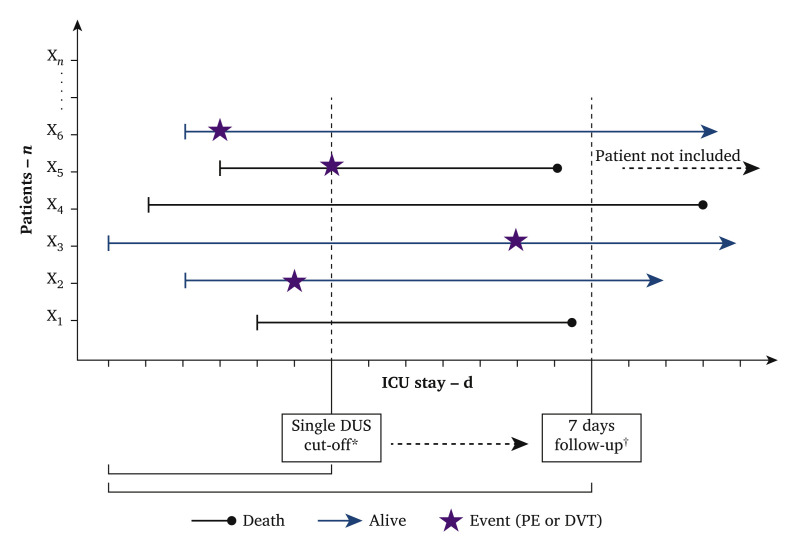
Methods: This was a cohort study of critically ill patients due to COVID-19. All patients admitted to the intensive care unit on the same day of April 2020 were selected, regardless of length of stay, and a single bilateral venous duplex ultrasound in the lower extremities was performed up to 72 hours later. Pulmonary embolism (PE) was diagnosed by computed tomography angiography. Asymptomatic and symptomatic VTE were registered, including pre-screening in hospital VTE. Characteristics of patients, blood test results, doses of thromboprophylaxis received, VTE events, and mortality after seven day follow up were recorded.
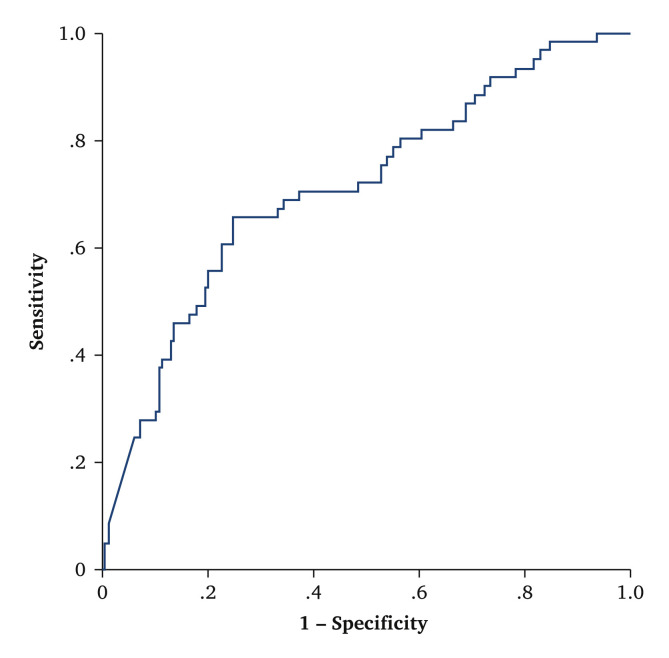
Results: A total of 230 critically ill patients were studied. The median intensive care unit stay of these patients was 12 days (interquartile range [IQR] 5 - 19 days). After seven days follow up, the frequency of patients with VTE, both symptomatic and asymptomatic, was 26.5% (95% confidence interval [CI] 21% - 32%) (69 events in 61 patients): 45 with DVT and 16 with PE (eight of them with concomitant DVT). The cumulative frequency of symptomatic VTE was 8.3% (95% CI 4.7% - 11.8%). D dimer values ≥ 1 500 ng/mL were diagnostic of VTE, with a sensitivity of 80% and a specificity of 42%. During follow up after screening, six patients developed new VTE. Three of them developed a recurrence after a DVT diagnosed at screening, despite receiving therapeutic doses of heparin. Mortality rates at seven day follow up were the same for those with (6.6%) and without (5.3%) VTE.
Conclusion: Patients with severe COVID-19 infection are at high risk of VTE, and further new symptomatic VTE events and recurrence can occur despite anticoagulation. The prophylactic anticoagulant dose may need to be increased in patients with a low risk of bleeding.
Keywords: COVID-19; Deep vein thrombosis; Pulmonary embolism; SARS-CoV-2 infection; Venous thromboembolism.
Copyright © 2020 European Society for Vascular Surgery. Published by Elsevier B.V. All rights reserved.
Conflict of interest statement
Conflict of interest Dr Bellmunt reports personal fees from Sanofi, Rovi, and Bayer, outside the submitted work. Dr Monreal reports unrestricted research grants from Sanofi, Spain and Bayer, Spain during the conduct of the study to sponsor RIETE registry. All other authors have nothing to disclose.
Figures
Comment in
-
The New Virus Tells the Old Story.Eur J Vasc Endovasc Surg. 2021 Apr;61(4):635. doi: 10.1016/j.ejvs.2020.12.014. Epub 2021 Jan 9. Eur J Vasc Endovasc Surg. 2021. PMID: 33431288 Free PMC article. No abstract available.
References
-
- Phelan A.L., Katz R., Gostin L.O. The novel coronavirus originating in Wuhan, China: challenges for global health governance. JAMA. 2020;323:709–710. - PubMed
-
- Han H., Yang L., Liu R., Liu F., Wu K.L., Li J. Prominent changes in blood coagulation of patients with SARS-CoV-2 infection. Clin Chem Lab Med. 2020;58:1116–1120. - PubMed
MeSH terms
Substances
LinkOut - more resources
Full Text Sources
Medical
Miscellaneous
