


Assessment of Management Options on Striga Infestation and Maize Grain Yield in Kenya
- PMID: 33583963
- PMCID: PMC7797635
- DOI: 10.1017/wsc.2018.4
Assessment of Management Options on Striga Infestation and Maize Grain Yield in Kenya
Abstract
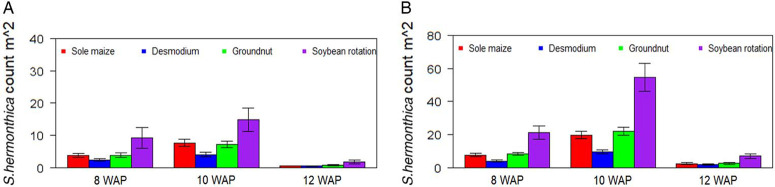
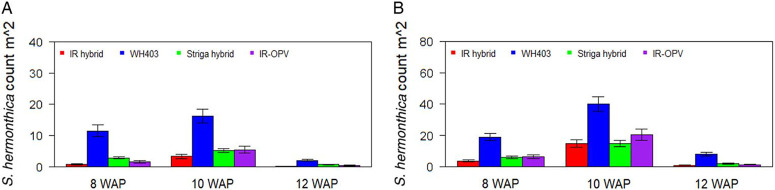
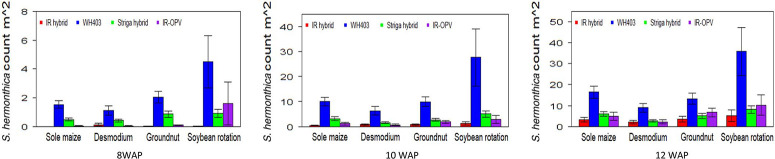
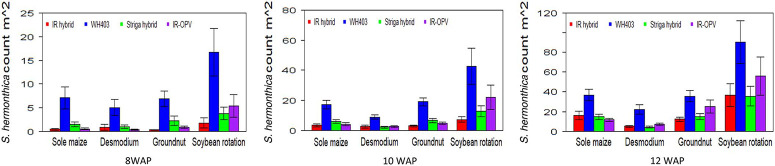
The parasitic purple witchweed [Striga hermonthica (Del.) Benth.] is a serious constraint to maize production in sub-Saharan Africa, especially in poor soils. Various Striga spp. control measures have been developed, but these have not been assessed in an integrated system. This study was conducted to evaluate a set of promising technologies for S. hermonthica management in western Kenya. We evaluated three maize genotypes either intercropped with peanut (Arachis hypogaea L.), soybean [Glycine max (L.) Merr.], or silverleaf desmodium [Desmodium uncinatum (Jacq.) DC] or as a sole crop at two locations under artificial S. hermonthica infestation and at three locations under natural S. hermonthica infestation between 2011 and 2013. Combined ANOVA showed significant (P < 0.05) cropping system and cropping system by environment interactions for most traits measured. Grain yield was highest for maize grown in soybean rotation (3,672 kg ha-1) under artificial infestation and in D. uncinatum and peanut cropping systems (3,203 kg ha-1 and 3,193 kg ha-1) under natural infestation. Grain yield was highest for the Striga spp.-resistant hybrid under both methods of infestation. A lower number of emerged S. hermonthica plants per square meter were recorded at 10 and 12 wk after planting on maize grown under D. uncinatum in the artificial S. hermonthica infestation. A combination of herbicide-resistant maize varieties intercropped with legumes was a more effective method for S. hermonthica control than individual component technologies. Herbicide-resistant and Striga spp.-resistant maize integrated with legumes would help reduce the Striga spp. seedbank in the soil. Farmers should be encouraged to adopt an integrated approach to control Striga spp. for better maize yields.
Keywords: Cropping systems; herbicide resistance; imazapyr-resistant hybrids; legumes; maize varieties; peanut.
© Weed Science Society of America, 2018.
Figures
References
-
- Abate T, van Huis A, Ampofo JKO (2000) Pest management strategies in traditional agriculture: an African perspective. Ann Rev Entomol 45: 631–659 - PubMed
-
- Ariga ES. (1996) Isolation and Bioassay of Striga hermonthica Seed Germination Stimulants from Non-host Crops and Field Testing for Control Efficacy. Ph.D thesis. Nairobi, Kenya: University of Nairobi
-
- Badu-Apraku B, Lum AF (2007) Agronomic performance of Striga resistant early-maturing maize varieties and inbred lines in the savannas of West and Central Africa. Crop Sci 47:737–750
-
- Bünemann EK, Smithson PC, Jama B, Frossard E, Oberson A (2004) Maize productivity and nutrient dynamics in maize-fallow rotations in western Kenya. Plant Soil 264:195–208
-
- Cairns JE, Hellin J, Sonder K, Araus JL, MacRobert JF, Thierfelder C, Prasanna BM (2013) Adapting maize production to climate change in sub-Saharan Africa. Food Sec 5:345–360
LinkOut - more resources
Full Text Sources
Research Materials
Miscellaneous