


Changes in gut microbiota composition and diversity associated with post-cholecystectomy diarrhea
- PMID: 33584071
- PMCID: PMC7856843
- DOI: 10.3748/wjg.v27.i5.391
Changes in gut microbiota composition and diversity associated with post-cholecystectomy diarrhea
Abstract
Background: Post-cholecystectomy diarrhea (PCD) frequently occurs in patients following gallbladder removal. PCD is part of the post-cholecystectomy (PC) syndrome, and is difficult to treat. After cholecystectomy, bile enters the duodenum directly, independent of the timing of meals. The interaction between the bile acids and the intestinal microbes is changed. Therefore, the occurrence of PCD may be related to the change in microbiota. However, little is known about the relationship between the gut microbiota and PCD.
Aim: To better understand the role of the gut microbiota in PCD patients.
Methods: Fecal DNA was isolated. The diversity and profiles of the gut microbiota were analyzed by performing high-throughput 16S rRNA gene sequencing. The gut microbiota were characterized in a healthy control (HC) group and a PC group. Subsequently, the PC group was further divided into a PCD group and a post-cholecystectomy non-diarrhea group (PCND) according to the patients' clinical symptoms. The composition, diversity and richness of microbial communities were determined and compared.
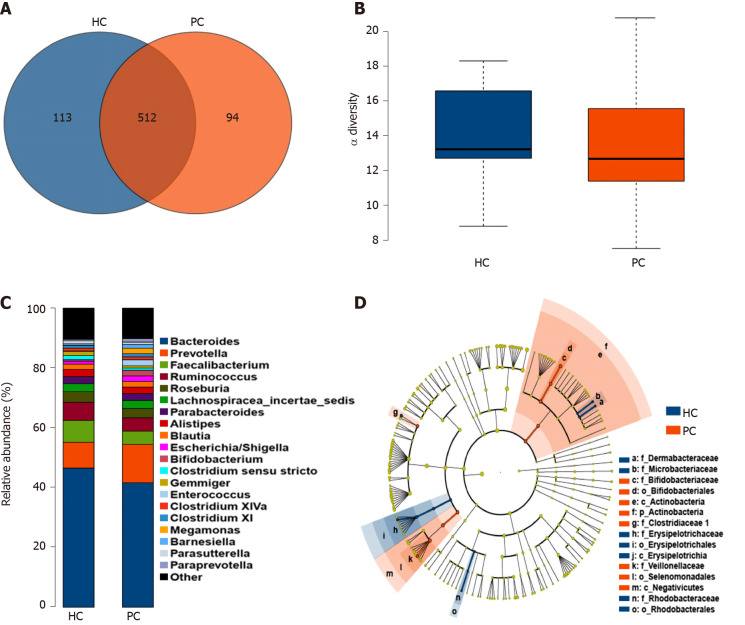
Results: In the PC and HC groups, 720 operational taxonomic units (OTUs) were identified. The PC group had fewer OTUs than the HC group. β-diversity was decreased in the PC group. This indicated decreased microbial diversity in the PC group. Fifteen taxa with differential abundance between the HC and PC groups were identified. In the PCD group compared to the PCND group, significant decreases in microbial diversity, Firmicutes/Bacteroidetes ratio, and richness of probiotic microbiota (Bifidobacterium and Lactococcus), and an increase in detrimental microbiota (Prevotella and Sutterella) were observed. Moreover, a negative correlation was found between Prevotella and Bifidobacterium. Using a Kyoto Encyclopedia of Genes and Genomes functional analysis, it was found that the abundances of gut microbiota involved in lipid metabolism pathways were markedly lower in the PCD group compared to the PCND group.
Conclusion: This study demonstrated that gut dysbiosis may play a critical role in PCD, which provides new insights into therapeutic options for PCD patients.
Keywords: 16S rRNA; Bifidobacterium; Cholecystectomy; Diarrhea; Microbiota; Post-cholecystectomy.
©The Author(s) 2021. Published by Baishideng Publishing Group Inc. All rights reserved.
Conflict of interest statement
Conflict-of-interest statement: The authors declare no conflict of interest.
Figures


References
-
- Keren N, Konikoff FM, Paitan Y, Gabay G, Reshef L, Naftali T, Gophna U. Interactions between the intestinal microbiota and bile acids in gallstones patients. Environ Microbiol Rep. 2015;7:874–880. - PubMed
-
- Lamberts MP, Lugtenberg M, Rovers MM, Roukema AJ, Drenth JP, Westert GP, van Laarhoven CJ. Persistent and de novo symptoms after cholecystectomy: a systematic review of cholecystectomy effectiveness. Surg Endosc. 2013;27:709–718. - PubMed
-
- Sciarretta G, Furno A, Mazzoni M, Malaguti P. Post-cholecystectomy diarrhea: evidence of bile acid malabsorption assessed by SeHCAT test. Am J Gastroenterol. 1992;87:1852–1854. - PubMed
-
- Caenepeel P, Janssens J, Vantrappen G, Eyssen H, Coremans G. Interdigestive myoelectric complex in germ-free rats. Dig Dis Sci. 1989;34:1180–1184. - PubMed
MeSH terms
Substances
LinkOut - more resources
Full Text Sources
Other Literature Sources
