


Comparative study of indocyanine green-R15, Child-Pugh score, and model for end-stage liver disease score for prediction of hepatic encephalopathy after transjugular intrahepatic portosystemic shunt
- PMID: 33584073
- PMCID: PMC7856842
- DOI: 10.3748/wjg.v27.i5.416
Comparative study of indocyanine green-R15, Child-Pugh score, and model for end-stage liver disease score for prediction of hepatic encephalopathy after transjugular intrahepatic portosystemic shunt
Abstract
Background: Hepatic encephalopathy (HE) remains an enormous challenge in patients who undergo transjugular intrahepatic portosystemic shunt (TIPS) implantation. The preoperative indocyanine green retention rate at 15 min (ICG-R15), as one of the liver function assessment tools, has been developed as a prognostic indicator in patients undergoing surgery, but there are limited data on its role in TIPS.
Aim: To determine whether the ICG-R15 can be used for prediction of post-TIPS HE in decompensated cirrhosis patients with portal hypertension (PHT) and compare the clinical value of ICG-R15, Child-Pugh score (CPS), and model for end-stage liver disease (MELD) score in predicting post-TIPS HE with PHT.
Methods: This retrospective study included 195 patients with PHT who underwent elective TIPS at Beijing Shijitan Hospital from January 2018 to June 2019. All patients underwent the ICG-R15 test, CPS evaluation, and MELD scoring 1 wk before TIPS. According to whether they developed HE or not, the patients were divided into two groups: HE group and non-HE group. The prediction of one-year post-TIPS HE by ICG-R15, CPS and MELD score was evaluated by the areas under the receiver operating characteristic curves (AUCs).
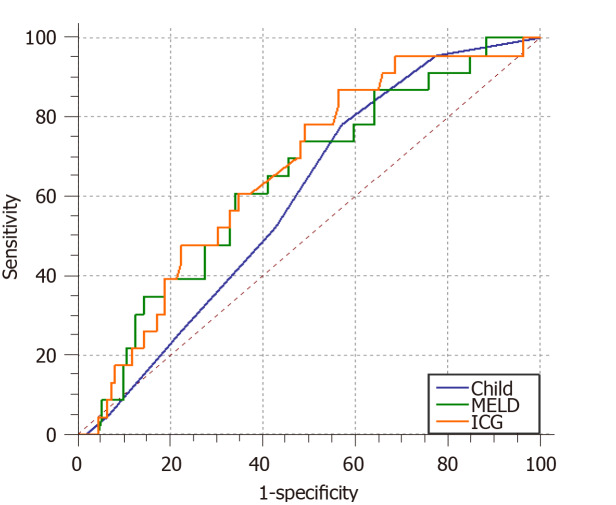
Results: A total of 195 patients with portal hypertension were included and 23% (45/195) of the patients developed post-TIPS HE. The ICG-R15 was identified as an independent predictor of post-TIPS HE. The AUCs for the ICG-R15, CPS, and MELD score for predicting post-TIPS HE were 0.664 (95% confidence interval [CI]: 0.557-0.743, P = 0.0046), 0.596 (95%CI: 0.508-0.679, P = 0.087), and 0.641 (95%CI: 0.554-0.721, P = 0.021), respectively. The non-parametric approach (Delong-Delong & Clarke-Pearson) showed that there was statistical significance in pairwise comparison between AUCs of ICG-R15 and MELD score (P = 0.0229).
Conclusion: The ICG-R15 has appreciated clinical value for predicting the occurrence of post-TIPS HE and is a choice for evaluating the prognosis of patients undergoing TIPS.
Keywords: Child-Pugh score; Hepatic encephalopathy; Indocyanine green-R15; Model for end-stage liver disease score; Portal hypertention; Transjugular intrahepatic portosystemic shunt.
©The Author(s) 2021. Published by Baishideng Publishing Group Inc. All rights reserved.
Figures
References
-
- Tsochatzis EA, Bosch J, Burroughs AK. Liver cirrhosis. Lancet. 2014;383:1749–1761. - PubMed
-
- Hung ML, Lee EW. Role of Transjugular Intrahepatic Portosystemic Shunt in the Management of Portal Hypertension: Review and Update of the Literature. Clin Liver Dis. 2019;23:737–754. - PubMed
-
- Sankar K, Moore CM. Transjugular Intrahepatic Portosystemic Shunts. JAMA. 2017;317:880. - PubMed
-
- Fonio P, Discalzi A, Calandri M, Doriguzzi Breatta A, Bergamasco L, Martini S, Ottobrelli A, Righi D, Gandini G. Incidence of hepatic encephalopathy after transjugular intrahepatic portosystemic shunt (TIPS) according to its severity and temporal grading classification. Radiol Med. 2017;122:713–721. - PubMed
MeSH terms
Substances
LinkOut - more resources
Full Text Sources
Other Literature Sources
