Review
. 2021 Jan 29:11:621054.
doi: 10.3389/fphar.2020.621054. eCollection 2020.

HIF Prolyl Hydroxylase Inhibitors for COVID-19 Treatment: Pros and Cons

Affiliations
Review

HIF Prolyl Hydroxylase Inhibitors for COVID-19 Treatment: Pros and Cons

Andrey A Poloznikov et al. Front Pharmacol. .

Abstract

The review analyzes the potential advantages and problems associated with using HIF prolyl hydroxylase inhibitors as a treatment for COVID-19. HIF prolyl hydroxylase inhibitors are known to boost endogenous erythropoietin (Epo) and activate erythropoiesis by stabilizing and activating the hypoxia inducible factor (HIF). Recombinant Epo treatment has anti-inflammatory and healing properties, and thus, very likely, will be beneficial for moderate to severe cases of COVID-19. However, HIF PHD inhibition may have a significantly broader effect, in addition to stimulating the endogenous Epo production. The analysis of HIF target genes reveals that some HIF-targets, such as furin, could play a negative role with respect to viral entry. On the other hand, HIF prolyl hydroxylase inhibitors counteract ferroptosis, the process recently implicated in vessel damage during the later stages of COVID-19. Therefore, HIF prolyl hydroxylase inhibitors may serve as a promising treatment of COVID-19 complications, but they are unlikely to aid in the prevention of the initial stages of infection.

Keywords: SARS-CoV; adaptaquin; hypoxia inducible factor; neuradapt; roxadustat; vadadustat.


Conflict of interest statement

The authors declare that the research was conducted in the absence of any commercial or financial relationships that could be construed as a potential conflict of interest.

Figures
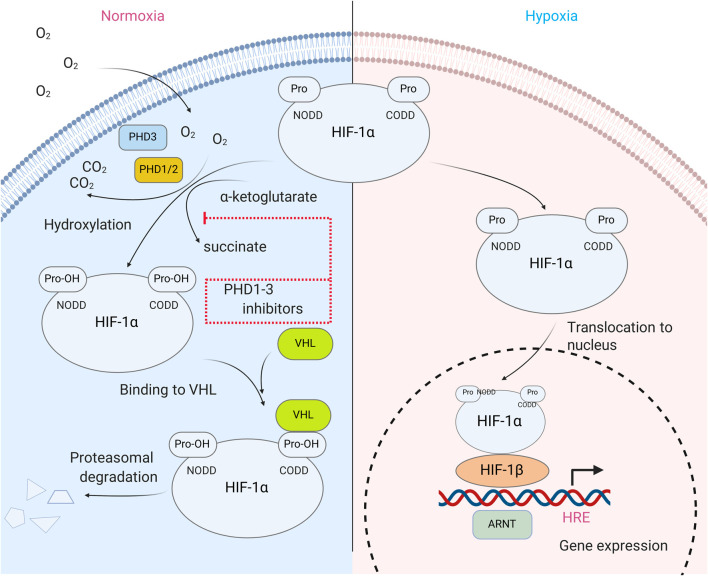
FIGURE 1
FIGURE 1
HIF prolyl hydroxylase in HIF stability regulation. In normoxia, HIFα subunit is hydroxylated at Pro 402 and 564 via reaction catalyzed by isoenzymes of HIF prolyl hydroxylase (PHD1-3). Hydroxylated prolines are recognized by VHL protein, a component of ubiquitin ligase complex, and thus, eventually target HIF for degradation. In hypoxia, PHD activity is strongly reduced, which results in HIFα protein stabilization, its dimerization with HIFβ subunit and translocation to the nucleus, where HIF dimer binds on the enhancer sequence of HIF target genes and activates gene transcription.
FIGURE 2
FIGURE 2
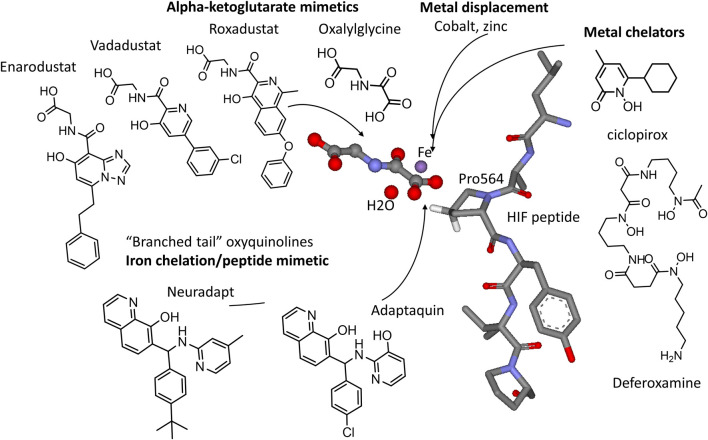
HIF PHD inhibitors and their targets in the active site of HIF prolyl hydroxylase (3HQR.pdb). Alpha-ketoglutarate mimetics include N-oxalylglycine (DMOG), Roxadustat, Vadadustat, and Enarodustat. Metal chelators, e.g., ciclopirox, deferoxamine (DFO), and various transition metals target the active site iron (in purple). Branched tail oxyquinolines (adaptaquin and neuradapt) provide two ligands to chelate iron and to mimic the fold of the HIF peptide.
FIGURE 3
FIGURE 3
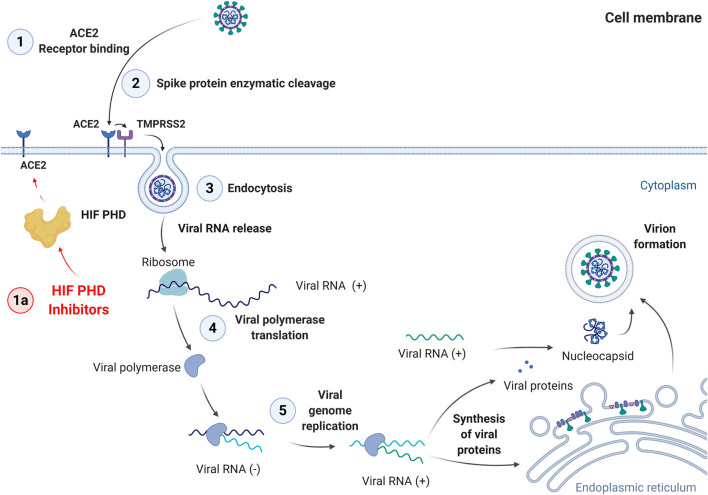
Steps of SARS-Cov-2 cell entry and replication cycle. 1: Binding to ACE2 receptor; 2: Enzymatic cleavage of Spike protein; 3: Endocytosis; 4: Viral polymerase translation; 5: Viral genome replication. The last step is followed by synthesis of viral proteins, virion formation, and exocytosis.
FIGURE 4
FIGURE 4
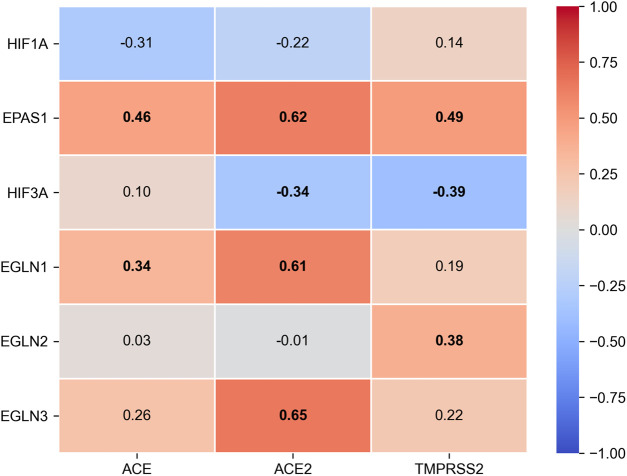
Spearman’s rank correlation matrix between HIF alpha subunits (HIF-1α, HIF-2α encoded by EPAS1, HIF-3α), HIF prolyl-hydroxylase isoforms (EGLN1 encodes PHD2, EGLN2 - PHD1, EGLN3 - PHD3) and ACE2 expression and TMPRSS2 expression in healthy intestinal tissues from TCGA-COAD dataset. RNA sequencing count data for n = 38 normal samples were obtained from GDC Data Portal (https://portal.gdc.cancer.gov/) and converted to format of TMM-normalized Fragment Per kilobase of transcript per Million mapped reads (FPKM) with edgeR v3.30.3 (Robinson et al., 2010). Bold labels represent statistically significant correlation (p < 0.05).

References

    1. Afsar B., Kanbay M., Afsar R. E. (2020). Hypoxia inducible factor-1 protects against COVID-19: a hypothesis. Med. Hypotheses 143, 109857 10.1016/j.mehy.2020.109857 - DOI - PMC - PubMed
    1. Aimé P., Karuppagounder S. S., Rao A., Chen Y., Burke R. E., Ratan R. R., et al. (2020). The drug adaptaquin blocks ATF4/CHOP-dependent pro-death Trib3 induction and protects in cellular and mouse models of Parkinson’s disease. Neurobiol. Dis. 136, 104725 10.1016/j.nbd.2019.104725 - DOI - PMC - PubMed
    1. Alexander J., Tinkov A., Strand T. A., Alehagen U., Skalny A., Aaseth J. (2020). Early nutritional interventions with zinc, selenium and vitamin D for raising anti-viral resistance against progressive COVID-19. Nutrients 12, 2358 10.3390/nu12082358 - DOI - PMC - PubMed
    1. Arias-Reyes C., Zubieta-DeUrioste N., Poma-Machicao L., Aliaga-Raduan F., Carvajal-Rodriguez F., Dutschmann M., et al. (2020). Does the pathogenesis of SARS-CoV-2 virus decrease at high-altitude? Respir. Physiol. Neurobiol. 277, 103443 10.1016/j.resp.2020.103443 - DOI - PMC - PubMed
    1. Ariazi J. L., Duffy K. J., Adams D. F., Fitch D. M., Luo L., Pappalardi M., et al. (2017). Discovery and preclinical characterization of GSK1278863 (daprodustat), a small molecule hypoxia inducible factor-prolyl hydroxylase inhibitor for anemia. J. Pharmacol. Exp. Therapeut. 363, 336–347. 10.1124/jpet.117.242503 - DOI - PubMed