


Connecting tree-ring phenotypes, genetic associations and transcriptomics to decipher the genomic architecture of drought adaptation in a widespread conifer
- PMID: 33586257
- PMCID: PMC8451828
- DOI: 10.1111/mec.15846
Connecting tree-ring phenotypes, genetic associations and transcriptomics to decipher the genomic architecture of drought adaptation in a widespread conifer
Abstract
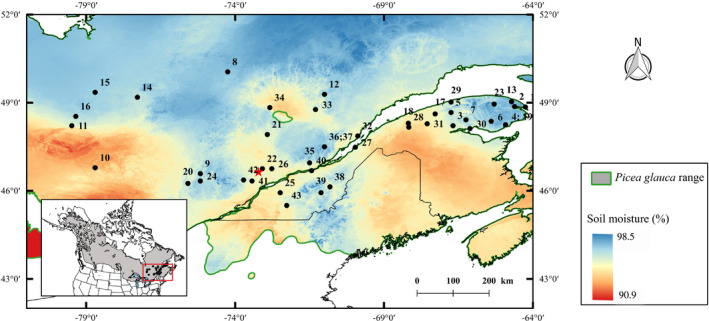
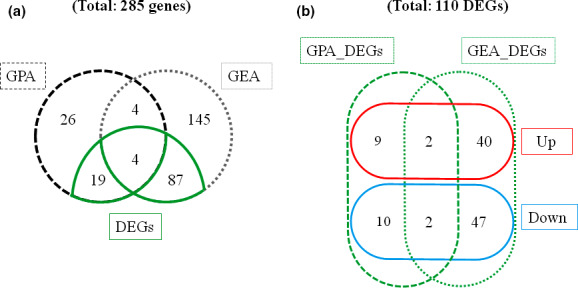
As boreal forests face significant threats from climate change, understanding evolutionary trajectories of coniferous species has become fundamental to adapting management and conservation to a drying climate. We examined the genomic architecture underlying adaptive variation related to drought tolerance in 43 populations of a widespread boreal conifer, white spruce (Picea glauca [Moench] Voss), by combining genotype-environment associations, genotype-phenotype associations, and transcriptomics. Adaptive genetic variation was identified by correlating allele frequencies for 6,153 single nucleotide polymorphisms from 2,606 candidate genes with temperature, precipitation and aridity gradients, and testing for significant associations between genotypes and 11 dendrometric and drought-related traits (i.e., anatomical, growth response and climate-sensitivity traits) using a polygenic model. We identified a set of 285 genes significantly associated with a climatic factor or a phenotypic trait, including 110 that were differentially expressed in response to drought under greenhouse-controlled conditions. The interlinked phenotype-genotype-environment network revealed eight high-confidence genes involved in white spruce adaptation to drought, of which four were drought-responsive in the expression analysis. Our findings represent a significant step toward the characterization of the genomic basis of drought tolerance and adaptation to climate in conifers, which is essential to enable the establishment of resilient forests in view of new climate conditions.
Keywords: association studies; climate adaptation; dendroecology; gene expression; tree-ring phenotypes; white spruce.
© 2021 The Authors. Molecular Ecology published by John Wiley & Sons Ltd.
Figures


Comment in
-
Tackling the challenges of evolutionary forest research with multidata approaches.Mol Ecol. 2021 Aug;30(16):3893-3895. doi: 10.1111/mec.16031. Epub 2021 Jul 18. Mol Ecol. 2021. PMID: 34152056
References
-
- Allen, C. D., Macalady, A. K., Chenchouni, H., Bachelet, D., McDowell, N., Vennetier, M., Kitzberger, T., Rigling, A., Breshears, D. D., Hogg, E. H. (. T., Gonzalez, P., Fensham, R., Zhang, Z., Castro, J., Demidova, N., Lim, J.‐H., Allard, G., Running, S. W., Semerci, A., & Cobb, N. (2010). A global overview of drought and heat‐induced tree mortality reveals emerging climate change risks for forests. Forest Ecology and Management, 259, 660–684. 10.1016/j.foreco.2009.09.001. - DOI
-
- Anderegg, W. R. L., Kane, J. M., & Anderegg, L. D. L. (2013). Consequences of widespread tree mortality triggered by drought and temperature stress. Nature Climate Change, 3, 30–36. 10.1038/nclimate1635. - DOI
-
- Aubin, I., Munson, A. D., Cardou, F., Burton, J. P., Isabel, N., Pedlar, J. H., Paquette, A., Taylor, A. R., Delagrange, S., Kebli, H., Messier, C., Shipley, B., Valladares, F., Kattge, J., Boisvert‐Marsh, L., & McKenney, D. (2016). Traits to stay, traits to move: a review of functional traits to assess sensitivity and adaptive capacity of temperate and boreal trees to climate change. Environmental Reviews, 24(2), 164–186. 10.1139/er-2015-0072. - DOI
Publication types
MeSH terms
Grants and funding
LinkOut - more resources
Full Text Sources
Other Literature Sources
Research Materials
