


Changing trends in the disease burden of esophageal cancer in China from 1990 to 2017 and its predicted level in 25 years
- PMID: 33586344
- PMCID: PMC7940228
- DOI: 10.1002/cam4.3775
Changing trends in the disease burden of esophageal cancer in China from 1990 to 2017 and its predicted level in 25 years
Abstract
Background: Nearly half of the cases of esophageal cancer in the world were in China, but the corresponding burden in China has not been estimated for the past decades or for the near future.
Methods: Data on the incidence, mortality, and disability-adjusted life years (DALYs) rates owing to esophageal cancer in China from 1990 to 2017 were extracted from the Global Burden of Disease Study 2017. To reflect the trend in the disease burden, we calculated the estimated annual percentage change (EAPC) in the age-standardized rates of these three outcomes in China from 1990 to 2017.
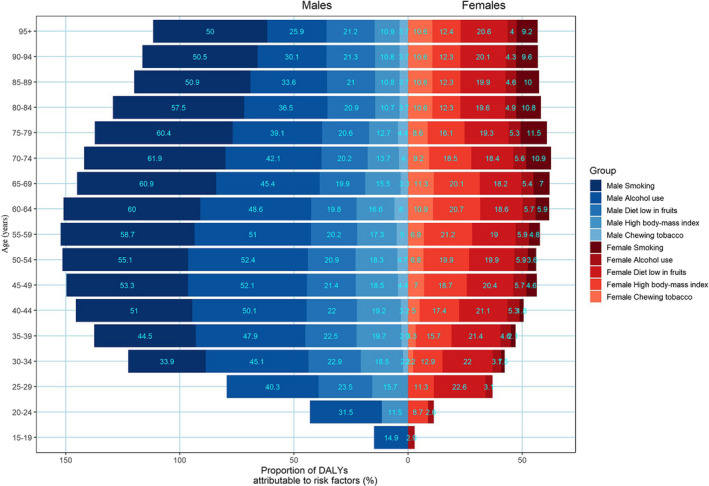
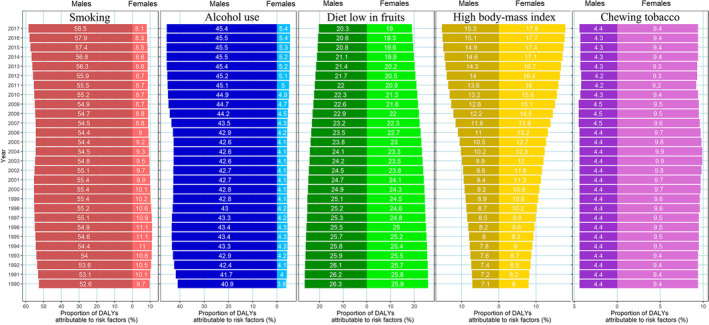
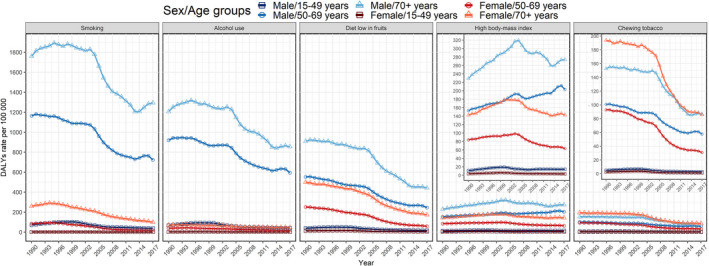
Results: The age-standardized incidence rate (ASIR) for esophageal cancer decreased from 19.38/100,000 in 1990 to 12.23/100,000 in 2017, with an EAPC of -2.53 (95%CI: -2.90, -2.16), but the number of cases of esophageal cancer increased from 164,473 to 234,624. The age-standardized rates of esophageal cancer in females were always lower than they were in males during the study period, and there was a downward trend that was more pronounced among females than males. The most common risk factors for males were smoking and alcohol consumption, while the most common risk factors for females were a diet low in fruits and a high body mass index (BMI). New cases of, and deaths from esophageal cancer are predicted to increase by about 1.5 times in the coming 25 years.
Conclusion: Although the age-standardized burden of esophageal cancer has been declining, the number of new cases of, and deaths from esophageal cancer have increased in China over the past 30 years, and they will continue to increase in the near future. Hence, national policies should be adopted to promote the prevention and management of known risk factors for it, especially smoking and excessive caloric intake.
Keywords: disease burden; esophageal cancer; prediction; risk factors; trend.
© 2021 The Authors. Cancer Medicine published by John Wiley & Sons Ltd.
Conflict of interest statement
The authors state that the study was conducted without any commercial or financial relationships, which may be interpreted as potential conflicts of interest.
Figures



References
-
- Global Burden of Disease Cancer Collaboration , Fitzmaurice C, Allen C, et al. Global, regional, and national cancer incidence, mortality, years of life lost, years lived with disability, and disability‐adjusted life‐years for 32 cancer groups, 1990 to 2015: a systematic analysis for the global burden of disease study [published correction appears in JAMA Oncol. 2017 Mar 1;3(3):418]. JAMA Oncol. 2017;3(4):524‐548. 10.1001/jamaoncol.2016.5688 - DOI - PMC - PubMed
-
- Bray F, Ferlay J, Soerjomataram I, Siegel RL, Torre LA, Jemal A. Global cancer statistics 2018: GLOBOCAN estimates of incidence and mortality worldwide for 36 cancers in 185 countries [published correction appears in CA Cancer J Clin. 2020 Jul; 70(4):313]. CA Cancer J Clin. 2018;68(6):394‐424. 10.3322/caac.21492 - DOI - PubMed
-
- Global Burden of Disease Cancer Collaboration , Fitzmaurice C, Abate D, et al. Global, regional, and national cancer incidence, mortality, years of life lost, years lived with disability, and disability‐adjusted life‐years for 29 cancer groups, 1990 to 2017: a systematic analysis for the global burden of disease study [published online ahead of print, 2019 Sep 27]. JAMA Oncol. 2019;5(12):1749‐1768. 10.1001/jamaoncol.2019.2996 - DOI - PMC - PubMed
-
- Wen‐Xian Y, Shi‐Xin LU, Gui‐Ting L. Etiological prevention trial for esophageal cancer among high‐risk population in Linzhou city, China[J]. China Cancer. 2008;17(7):548‐552.
Publication types
MeSH terms
LinkOut - more resources
Full Text Sources
Other Literature Sources
Medical
Miscellaneous
