


Challenges and Promise of Human Immunodeficiency Virus Remission
- PMID: 33586773
- PMCID: PMC8171803
- DOI: 10.1093/infdis/jiaa568
Challenges and Promise of Human Immunodeficiency Virus Remission
Abstract
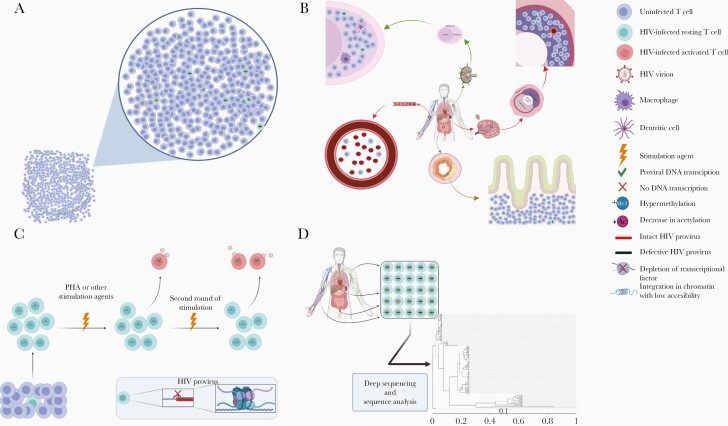
Antiretroviral therapy effectively controls human immunodeficiency virus (HIV) replication but it is unable to fully eradicate the HIV reservoir and treatment must be life-long. Progress toward a strategy for HIV remission will require overcoming key hurdles to fill gaps in our understanding of HIV persistence, but the identification of individuals who have attained sterilizing or functional HIV cure show that such a goal is achievable. In this review, we first outline challenges in targeting the HIV reservoir, including difficulties identifying HIV-infected cells, ongoing work elucidating the complex intracellular environment that contribute to HIV latency, and barriers to reactivating and clearing the HIV reservoir. We then review reported cases of HIV sterilizing cure and explore natural models of HIV remission and the promise that such HIV spontaneous and posttreatment controllers may hold in our search for a broadly-applicable strategy for the millions of patients living with HIV.
Keywords: HIV reservoir; latency; post-treatment controller; provirus; spontaneous controller.
© The Author(s) 2021. Published by Oxford University Press for the Infectious Diseases Society of America. All rights reserved. For permissions, e-mail: journals.permissions@oup.com.
Figures
References
-
- Danforth K, Granich R, Wiedeman D, Baxi S, Padian N. Global mortality and morbidity of HIV/AIDS. In: Holmes KK, Bertozzi S, Bloom BR, Jha P. Major infectious diseases. 3rd ed. Washington, DC: International Bank for Reconstruction and Development/World Bank, 2017. - PubMed
-
- Sung JM, Margolis DM. HIV Persistence on antiretroviral therapy and barriers to a cure. Adv Exp Med Biol 2018; 1075:165–85. - PubMed
-
- Siliciano JD, Kajdas J, Finzi D, et al. Long-term follow-up studies confirm the stability of the latent reservoir for HIV-1 in resting CD4+ T cells. Nat Med 2003; 9:727–8. - PubMed
Publication types
MeSH terms
Substances
Grants and funding
LinkOut - more resources
Full Text Sources
Other Literature Sources
Medical
