


Effectiveness of Disease-Specific mHealth Apps in Patients With Diabetes Mellitus: Scoping Review
- PMID: 33587045
- PMCID: PMC7920757
- DOI: 10.2196/23477
Effectiveness of Disease-Specific mHealth Apps in Patients With Diabetes Mellitus: Scoping Review
Abstract
Background: According to the World Health Organization, the worldwide prevalence of diabetes mellitus (DM) is increasing dramatically and DM comprises a large part of the global burden of disease. At the same time, the ongoing digitalization that is occurring in society today offers novel possibilities to deal with this challenge, such as the creation of mobile health (mHealth) apps. However, while a great variety of DM-specific mHealth apps exist, the evidence in terms of their clinical effectiveness is still limited.
Objective: The objective of this review was to evaluate the clinical effectiveness of mHealth apps in DM management by analyzing health-related outcomes in patients diagnosed with type 1 DM (T1DM), type 2 DM (T2DM), and gestational DM.
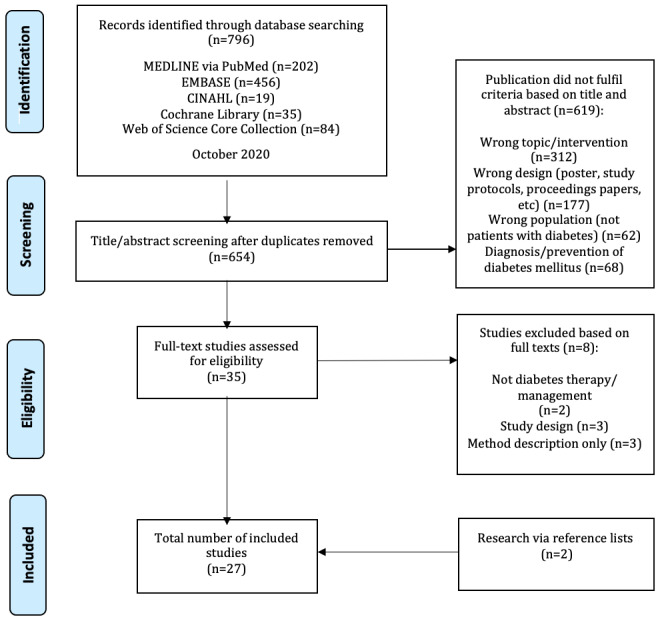
Methods: A scoping review was performed. A systematic literature search was conducted in MEDLINE (PubMed), Cochrane Library, EMBASE, CINAHL, and Web of Science Core Collection databases for studies published between January 2008 and October 2020. The studies were categorized by outcomes and type of DM. In addition, we carried out a meta-analysis to determine the impact of DM-specific mHealth apps on the management of glycated hemoglobin (HbA1c).
Results: In total, 27 studies comprising 2887 patients were included. We analyzed 19 randomized controlled trials, 1 randomized crossover trial, 1 exploratory study, 1 observational study, and 5 pre-post design studies. Overall, there was a clear improvement in HbA1c values in patients diagnosed with T1DM and T2DM. In addition, positive tendencies toward improved self-care and self-efficacy as a result of mHealth app use were found. The meta-analysis revealed an effect size, compared with usual care, of a mean difference of -0.54% (95% CI -0.8 to -0.28) for T2DM and -0.63% (95% CI -0.93 to -0.32) for T1DM.
Conclusions: DM-specific mHealth apps improved the glycemic control by significantly reducing HbA1c values in patients with T1DM and T2DM patients. In general, mHealth apps effectively enhanced DM management. However, further research in terms of clinical effectiveness needs to be done in greater detail.
Keywords: diabetes mellitus; mHealth apps; medical apps; mobile apps.
©Claudia Eberle, Maxine Löhnert, Stefanie Stichling. Originally published in JMIR mHealth and uHealth (http://mhealth.jmir.org), 15.02.2021.
Conflict of interest statement
Conflicts of Interest: None declared.
Figures
References
-
- Meister S. Das neue Gesundheits-Ich – souverän, selbstbestimmt und digital unterstützt? GGW. 2019;19(3):7–14. https://www.wido.de/fileadmin/Dateien/Dokumente/Publikationen_Produkte/G...
-
- Meister S, Becker S, Leppert F, Drop L. Pfannstiel MA, Da-Cruz P, Mehlich H. editors. Digitale Transformation von Dienstleistungen im Gesundheitswesen I. Wiesbaden: Springer Gabler; 2016. Digital Health, Mobile Health und Co. – Wertschöpfung durch Digitalisierung und Datenverarbeitung; pp. 185–212.
-
- Eberle C. Stupin J, Schäfer-Graf U, Hummel M. editors, Praxisorientiertes Wissen zu Gestationsdiabetes, Diabetes mellitus Typ 1 und 2, MODY. Berlin/Boston: Walter de Gruyter; 2020. Einsatz neuer Technologien in Diagnostik und Therapie: Diabetes-Smartphone-Apps.
-
- Hamidian K, Kraijo C. Keuper F. editor. Digitalisierung und Innovation: Planung, Entstehung, Entwicklungsperspektiven. Wiesbaden: Springer Gabler; 2013. DigITalisierung – Status quo; pp. 1–23.
-
- Bundesministerium für Wirtschaft und Energie Ökonomische Bestandsaufnahme und Potenzialanalyse der digitalen Gesundheitswirtschaft. 2016. [2021-01-28]. https://www.bmwi.de/Redaktion/DE/Publikationen/Studien/oekonomische-best....
Publication types
MeSH terms
Substances
LinkOut - more resources
Full Text Sources
Other Literature Sources
Medical
Miscellaneous
