


Artificial intelligence for good health: a scoping review of the ethics literature
- PMID: 33588803
- PMCID: PMC7885243
- DOI: 10.1186/s12910-021-00577-8
Artificial intelligence for good health: a scoping review of the ethics literature
Abstract
Background: Artificial intelligence (AI) has been described as the "fourth industrial revolution" with transformative and global implications, including in healthcare, public health, and global health. AI approaches hold promise for improving health systems worldwide, as well as individual and population health outcomes. While AI may have potential for advancing health equity within and between countries, we must consider the ethical implications of its deployment in order to mitigate its potential harms, particularly for the most vulnerable. This scoping review addresses the following question: What ethical issues have been identified in relation to AI in the field of health, including from a global health perspective?
Methods: Eight electronic databases were searched for peer reviewed and grey literature published before April 2018 using the concepts of health, ethics, and AI, and their related terms. Records were independently screened by two reviewers and were included if they reported on AI in relation to health and ethics and were written in the English language. Data was charted on a piloted data charting form, and a descriptive and thematic analysis was performed.
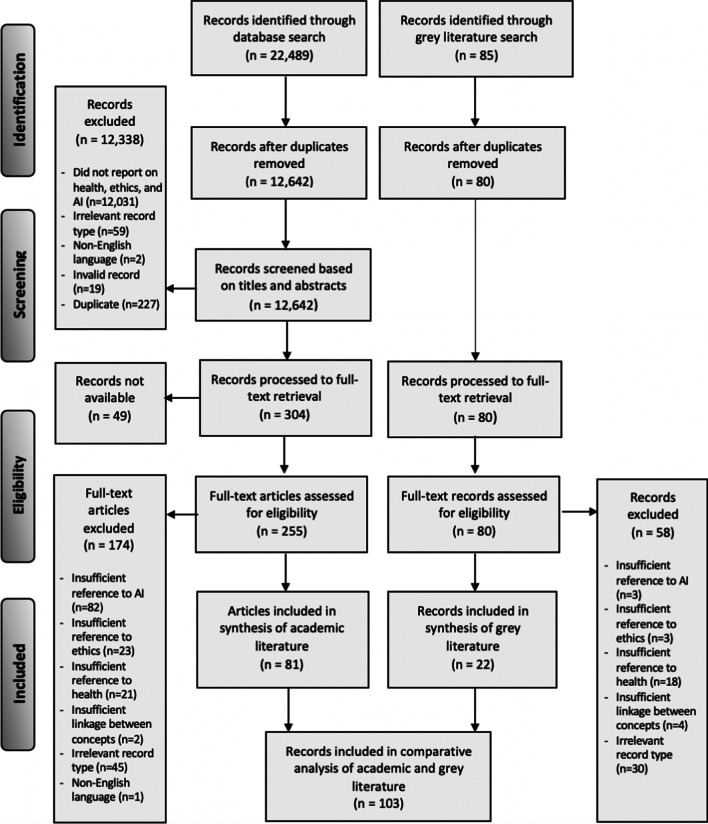
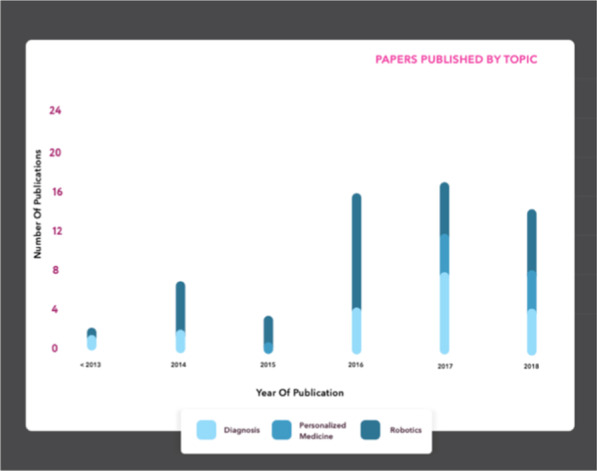
Results: Upon reviewing 12,722 articles, 103 met the predetermined inclusion criteria. The literature was primarily focused on the ethics of AI in health care, particularly on carer robots, diagnostics, and precision medicine, but was largely silent on ethics of AI in public and population health. The literature highlighted a number of common ethical concerns related to privacy, trust, accountability and responsibility, and bias. Largely missing from the literature was the ethics of AI in global health, particularly in the context of low- and middle-income countries (LMICs).
Conclusions: The ethical issues surrounding AI in the field of health are both vast and complex. While AI holds the potential to improve health and health systems, our analysis suggests that its introduction should be approached with cautious optimism. The dearth of literature on the ethics of AI within LMICs, as well as in public health, also points to a critical need for further research into the ethical implications of AI within both global and public health, to ensure that its development and implementation is ethical for everyone, everywhere.
Keywords: Artificial intelligence; Ethics; Global health; Health care; Public and population health.
Conflict of interest statement
The authors declare that they have no competing interests.
Figures
References
-
- Schwab K. The Fourth Industrial Revolution: what it means and how to respond. World Economic Forum. 2016 [cited 2020 Sep 23]. https://www.weforum.org/agenda/2016/01/the-fourth-industrial-revolution-....
-
- AI in the UK: ready, willing and able? United Kingdom: authority of the house of lords; 2018. (Intelligence SCoA, editor). https://publications.parliament.uk/pa/ld201719/ldselect/ldai/100/100.pdf.
-
- Future of Life Institute. National and international AI strategies. n.d. https://futureoflife.org/national-international-ai-strategies/.
Publication types
MeSH terms
LinkOut - more resources
Full Text Sources
Other Literature Sources
Medical
Miscellaneous
