


Latent brain state dynamics distinguish behavioral variability, impaired decision-making, and inattention
- PMID: 33589738
- PMCID: PMC8589642
- DOI: 10.1038/s41380-021-01022-3
Latent brain state dynamics distinguish behavioral variability, impaired decision-making, and inattention
Abstract
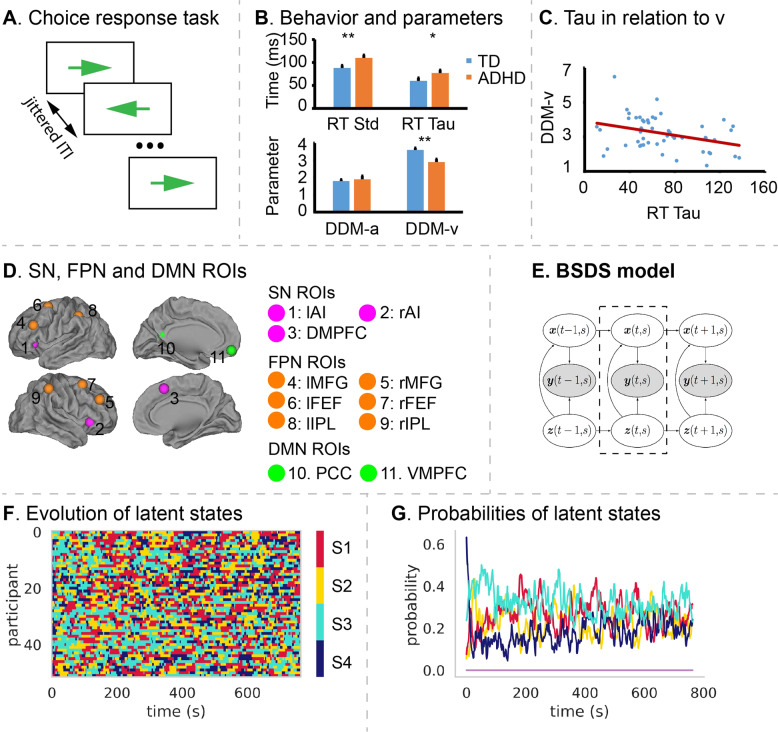
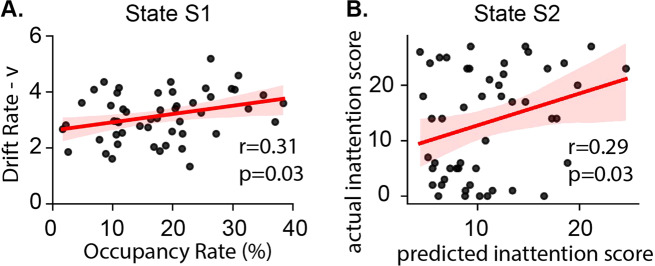
Children with Attention Deficit Hyperactivity Disorder (ADHD) have prominent deficits in sustained attention that manifest as elevated intra-individual response variability and poor decision-making. Influential neurocognitive models have linked attentional fluctuations to aberrant brain dynamics, but these models have not been tested with computationally rigorous procedures. Here we use a Research Domain Criteria approach, drift-diffusion modeling of behavior, and a novel Bayesian Switching Dynamic System unsupervised learning algorithm, with ultrafast temporal resolution (490 ms) whole-brain task-fMRI data, to investigate latent brain state dynamics of salience, frontoparietal, and default mode networks and their relation to response variability, latent decision-making processes, and inattention. Our analyses revealed that occurrence of a task-optimal latent brain state predicted decreased intra-individual response variability and increased evidence accumulation related to decision-making. In contrast, occurrence and dwell time of a non-optimal latent brain state predicted inattention symptoms and furthermore, in a categorical analysis, distinguished children with ADHD from controls. Importantly, functional connectivity between salience and frontoparietal networks predicted rate of evidence accumulation to a decision threshold, whereas functional connectivity between salience and default mode networks predicted inattention. Taken together, our computational modeling reveals dissociable latent brain state features underlying response variability, impaired decision-making, and inattentional symptoms common to ADHD. Our findings provide novel insights into the neurobiology of attention deficits in children.
© 2021. The Author(s).
Conflict of interest statement
The authors declare that they have no conflict of interest.
Figures



References
-
- Polanczyk G, de Lima MS, Horta BL, Biederman J, Rohde LA. The worldwide prevalence of ADHD: a systematic review and metaregression analysis. Am J Psychiatry. 2007;164:942–8. - PubMed
-
- Kofler MJ, Rapport MD, Sarver DE, Raiker JS, Orban SA, Friedman LM, et al. Reaction time variability in ADHD: a meta-analytic review of 319 studies. Clin Psychol Rev. 2013;33:795–811. - PubMed
-
- Lijffijt M, Kenemans JL, Verbaten MN, van Engeland H. A meta-analytic review of stopping performance in attention-deficit/hyperactivity disorder: deficient inhibitory motor control? J Abnorm Psychol. 2005;114:216–22. - PubMed
Publication types
MeSH terms
Grants and funding
LinkOut - more resources
Full Text Sources
Other Literature Sources
Medical
