. 2021 Jul;15(7):2131-2145.
doi: 10.1038/s41396-021-00910-4. Epub 2021 Feb 15.

Interspecies bacterial competition regulates community assembly in the C. elegans intestine

Affiliations

Interspecies bacterial competition regulates community assembly in the C. elegans intestine

Anthony Ortiz et al. ISME J. 2021 Jul.

Abstract

From insects to mammals, a large variety of animals hold in their intestines complex bacterial communities that play an important role in health and disease. To further our understanding of how intestinal bacterial communities assemble and function, we study the C. elegans microbiota with a bottom-up approach by feeding this nematode with bacterial monocultures as well as mixtures of two to eight bacterial species. We find that bacteria colonizing well in monoculture do not always do well in co-cultures due to interspecies bacterial interactions. Moreover, as community diversity increases, the ability to colonize the worm gut in monoculture becomes less important than interspecies interactions for determining community assembly. To explore the role of host-microbe adaptation, we compare bacteria isolated from C. elegans intestines and non-native isolates, and we find that the success of colonization is determined more by a species' taxonomy than by the isolation source. Lastly, by comparing the assembled microbiotas in two C. elegans mutants, we find that innate immunity via the p38 MAPK pathway decreases bacterial abundances yet has little influence on microbiota composition. These results highlight that bacterial interspecies interactions, more so than host-microbe adaptation or gut environmental filtering, play a dominant role in the assembly of the C. elegans microbiota.


Conflict of interest statement

The authors declare no competing interests.

Figures

Fig. 1
Fig. 1. Different bacterial species reach widely different population sizes in C. elegans gut.
A Diagram of the C. elegans microbiota assembly and the three biological forces (orange) that might influence this process and that we study in this article. To construct and measure simple microbiotas in C. elegans, a defined number of bacterial species are fed in liquid culture to a same-age adult population of C. elegans previously sterilized with antibiotics. The liquid feeding substrate is restored every day to maintain equal bacterial concentrations during the 4 days of colonization. Afterwards, worms are mechanically disrupted in batches of ~20, and counts of colony forming units (CFU) are used to determine bacterial population sizes in the worm gut. B Phylogenetic tree from full-length 16S rRNA gene sequences of the 11 non-native bacterial species used to colonize the gut of C. elegans. C Bacterial population sizes in monoculture colonization of immunocompromised C. elegans (AU37) span two orders of magnitude. These population sizes reflect the inherent abilities of bacteria to colonize the worm intestine environment. Points are the average of eight or more biological replicates, and error bars are the standard error of the mean (s.e.m.).
Fig. 2
Fig. 2. Monoculture colonization of the worm intestine often fails to predict composition of two-species microbiotas.
A LEFT panels: Fractional abundances of 55 co-culture experiments in C. elegans intestine (AU37); error bars are the s.e.m. of 2–8 biological replicates (Fig. S2). Bacterial species are ordered from left to right by their mean fraction across all co-cultures. RIGHT panels: Null expectation for the fractional abundances based on a noninteracting model where each bacterial species reaches its population size in monoculture; error bars are the s.e.m. from bootstrapping over the monoculture data. * and ** represent a statistically significant difference between the two panels at p values of 0.05 and 0.01, respectively (Welch’s T test). B Coexistence of two species is more common than competitive exclusion in the worm intestine. C Low yields in two species microbiotas—relative to monocultures—are indicative of competitive interactions (Fig. S2); error bars on X-axis are the s.e.m. and on Y-axis the s.e.m. from bootstrapping over monoculture and pairwise data simultaneously. D Competitive ability, defined as the mean fractional abundance in co-culture experiments, relates to monoculture population size, but there are significant deviations; error bars on Y-axis are the propagated error from the s.e.m. of the co-culture experiments.
Fig. 3
Fig. 3. Fractional abundances in three-species microbiotas are well predicted by pairwise outcomes.
A Outcome of trio Ea-Pf-Sm in C. elegans (AU37) intestine, together with predictions based on monoculture population sizes, two-species microbiotas, or pairwise outcomes in vitro liquid media (normalized arithmetic mean). B Simplex representation of trio outcome and predictions in (A), with the edges of the triangle depicting the two-species microbiotas in C. elegans. The error bars on measurement are the s.e.m. of four biological replicates, and the clouds of points around predictions are 400 bootstrap replicates (“N”s sampling the monoculture data, and “W”s and “M”s sampling the pairwise data in worm and media, respectively). C Twenty trio outcomes represented in one sixth of a simplex. D 3, 8, and 9 out of the 20 trios show full competitive exclusion, two- and three-species coexistence, respectively. E Assembly rules help the quantitative prediction of the trio outcomes based on pairwise outcomes when one of the pairs is competitive exclusion. F Cumulative distribution of error of predictions. Error calculated as the linear distance between prediction and measurement in the simplex. The distances are normalized by the maximal distance, √2. The dashed line is the mean distance between the measured mean and the four biological replicates of each trio, and serves as a lower bound for the error of the predictions.
Fig. 4
Fig. 4. Experimental colonization of C. elegans by a wide range of native and non-native bacteria reveals that phylogeny rather than isolation origin determines abundance in the gut microbiota.
A Phylogenetic classification of previously shown laboratory species (non-native) and bacterial strains isolated from C. elegans intestines (native; dark and light blue from MYb and CR collections, respectively; Methods). Phylogenetic tree built with maximum likelihood estimate utilizing alignment of full-length 16S gene sequences. The phylogenetic tree is sorted at each internal node to have the higher monoculture colonizers at the bottom. High level phylogenetic classification is given on the left side of the tree for ease of interpretation. Stars indicate bacteria used in follow-up two-species microbiotas. B Bacterial population sizes in monoculture colonization of wild-type C. elegans (N2); error bars are s.e.m. of two to three replicates. C Left panels: Fractional abundances in two-species microbiotas with native and non-native bacteria in C. elegans intestine (AU37). Right panels: Null expectation for the fractional abundances based on monoculture population sizes. “*” and “**” represent a statistically significant difference between measurement and null expectation at p values of 0.05 and 0.01, respectively (Welch’s T test). D Although two native strains can reach substantial colonization of the worm intestine in monoculture, these strains reach low fractional abundances in two-species microbiotas. E Differences in competitive ability correlate with phylogenetic distances regardless of the isolation origin of the bacteria. Phylogenetic distances are the horizontal distances in the phylogenetic tree. Differences in competitive ability are normalized by the maximum competitive ability of the pair (i.e., competitive abilities 0.8 and 0.4 are as different as 0.2 and 0.1).
Fig. 5
Fig. 5. Bacterial interspecies interactions are similar between the in vitro and in vivo environments, with some differences caused by the acidity of the worm gut.
A Black points are the mean fractional abundance in co-culture experiments in C. elegans intestine and liquid media (1% AXN); error bars are the propagated error from the s.e.m. of the underlying co-culture experiments. Blue points are the outcomes of individual co-culture experiments in worms and media. B S. marcescens and P. putida reach different fractional abundances in vivo worm gut and in vitro liquid media on a coupled experiment, where worms and liquid media from the same test tube are tested. C An acidic version of the media resembling the average pH of the worm intestine (4.5) shifts back the pairwise outcome to a worm-like state; error bars are the s.e.m. of at least four replicates.
Fig. 6
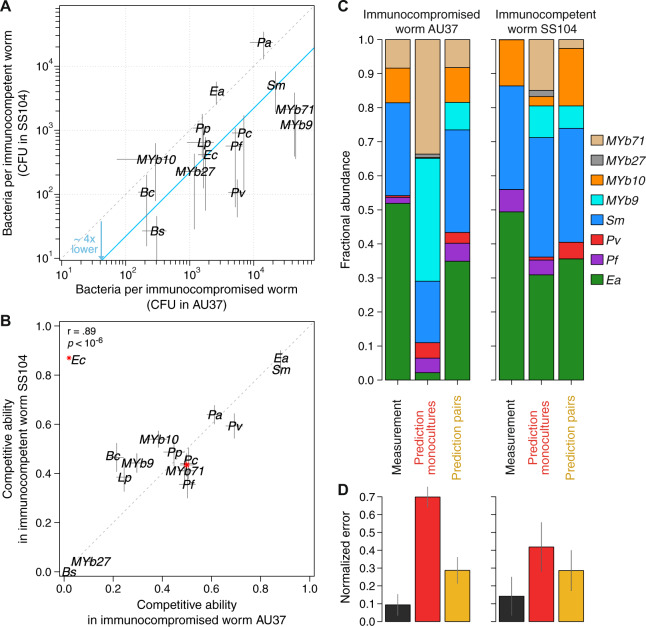
Fig. 6. Innate immunity of C. elegans via the p38 MAPK pathway reduces bacterial population sizes, but has little influence on the composition of the two- and eight-species microbiotas.
A Immune system of C. elegans reduces bacterial monoculture population sizes unevenly for different bacteria. Immunocompromised C. elegans (AU37) has larger bacterial population sizes in its intestine than immunocompetent C. elegans (GLP4). B The mean fractional abundances in co-cultures are similar between the two worm strains with different immune activity. C Composition of an intestinal microbiota in immunocompromised C. elegans AU37 and immunocompetent SS104, together with predictions based on monoculture colonization and pairwise outcomes in the same worm strains. Three or more batches of ~20 worms digested for each measurement. D Errors are the L1 norm (Manhattan distance) between measurement replicates and predictions. The variability across different batches of digested worms generates a measurement error of 9.3% and 14.2% for AU37 and SS104, respectively. The errors are normalized by 2, the maximum error. Confidence intervals of the prediction errors were calculated by bootstrapping over the corresponding data.

References

    1. Fierer N, Jackson RB. The diversity and biogeography of soil bacterial communities. Proc Natl Acad Sci USA. 2006;103:626–31. - PMC - PubMed
    1. Douglas AE. Multiorganismal insects: diversity and function of resident microorganisms. Annu Rev Entomol. 2015;60:17–34. - PMC - PubMed
    1. McFall-Ngai M, Hadfield MG, Bosch TCG, Carey HV, Domazet-Lošo T, Douglas AE, et al. Animals in a bacterial world, a new imperative for the life sciences. Proc Natl Acad Sci USA. 2013;110:3229–36. - PMC - PubMed
    1. Welch JLM, Rossetti BJ, Rieken CW, Dewhirst FE, Borisy GG. Biogeography of a human oral microbiome at the micron scale. Proc Natl Acad Sci USA. 2016;113:E791–800. - PMC - PubMed
    1. Nicholson JK, Holmes E, Kinross J, Burcelin R, Gibson G, Jia W, et al. Host-gut microbiota metabolic interactions. Science. 2012;336:1262–7. - PubMed

LinkOut - more resources