


Admixture mapping identifies African and Amerindigenous local ancestry loci associated with fetal growth
- PMID: 33590300
- PMCID: PMC8197736
- DOI: 10.1007/s00439-021-02265-4
Admixture mapping identifies African and Amerindigenous local ancestry loci associated with fetal growth
Abstract
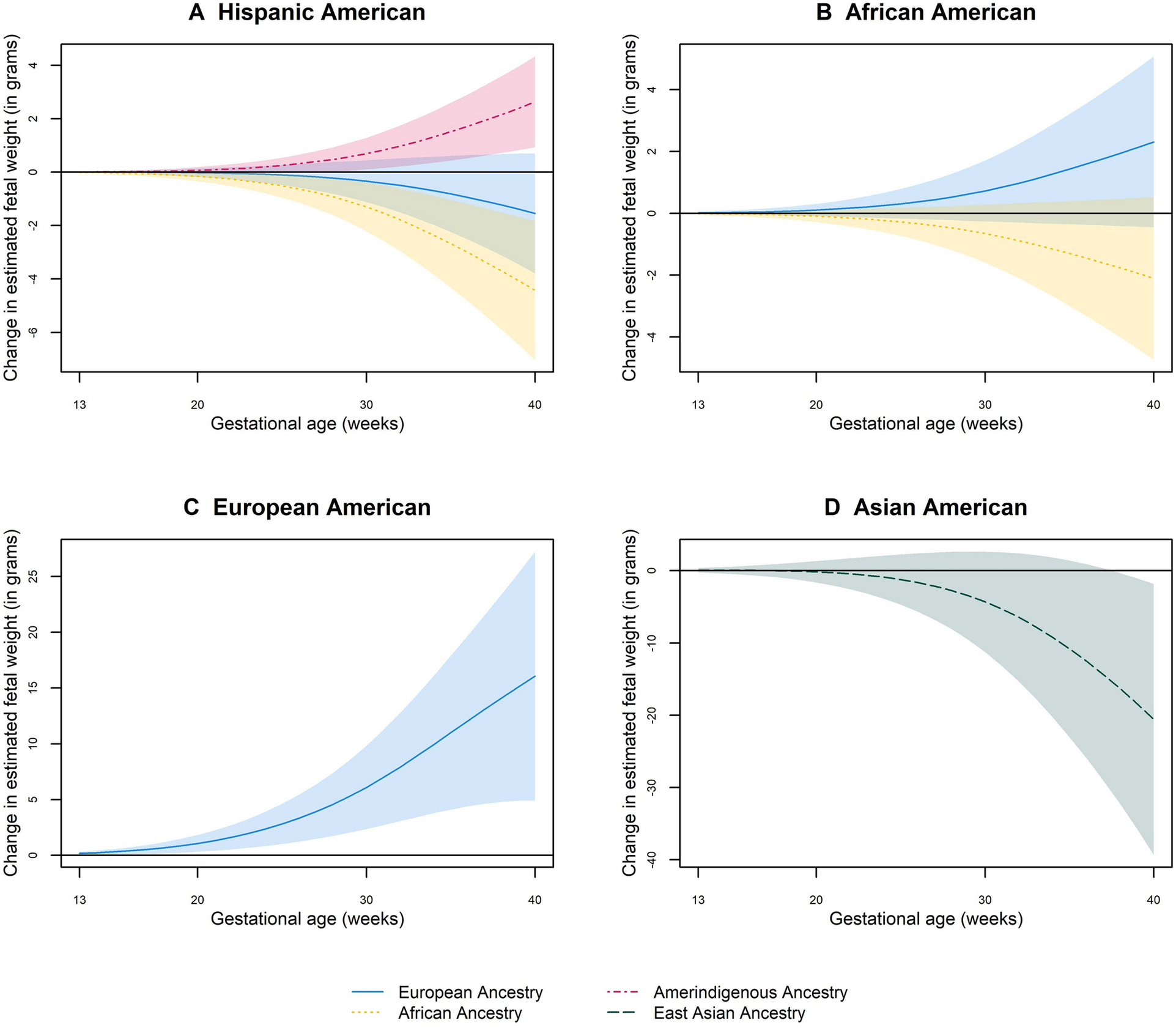
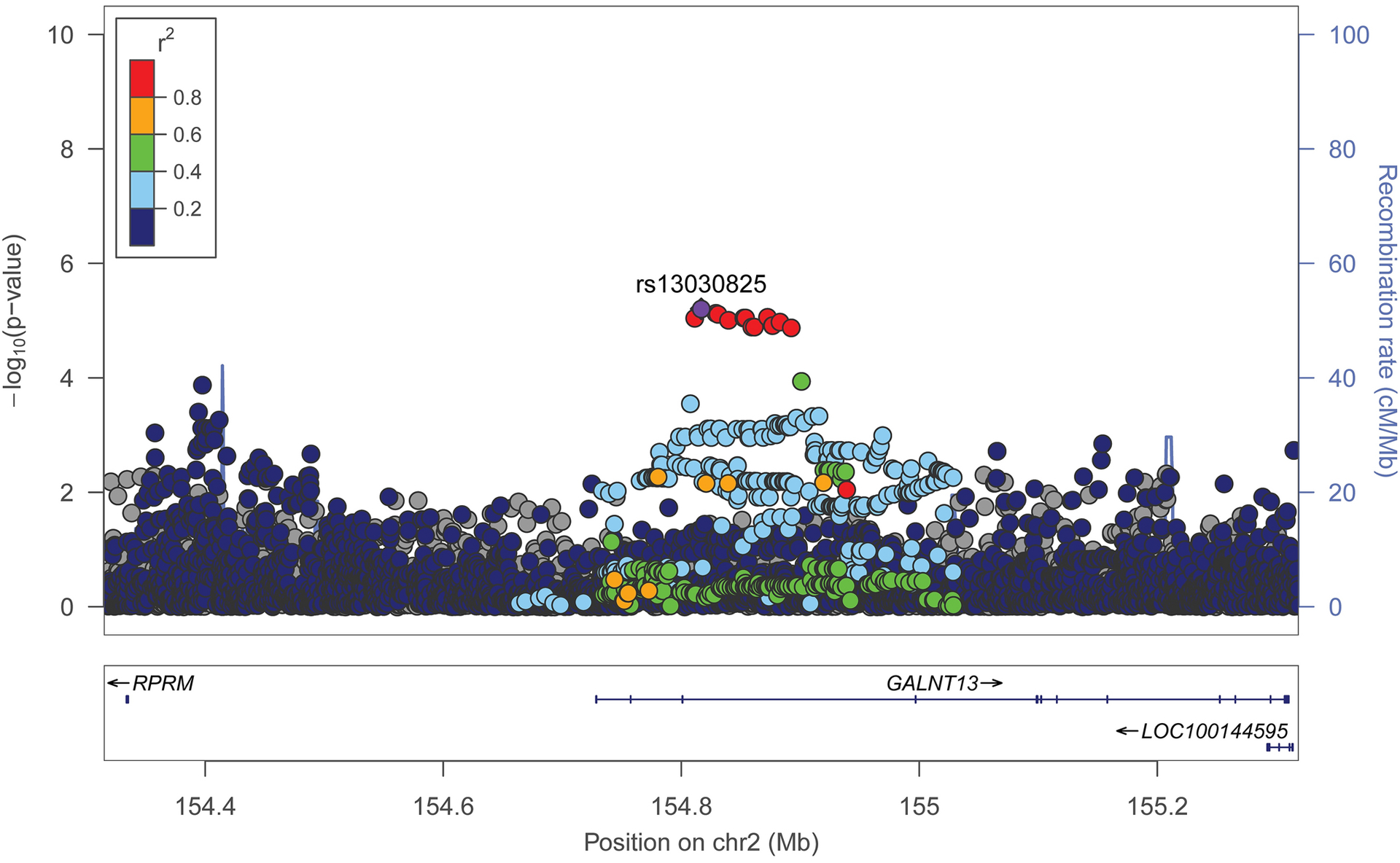
Fetal growth is an important determinant of cardiometabolic disease risk during childhood and adulthood. The genetic architecture of fetal growth remains largely understudied in ancestrally diverse populations. We conducted genome-wide admixture mapping scan and analysis of genetic ancestry among Hispanic American, African American, European American, and Asian American pregnant women to identify genetic loci associated with fetal growth measures across 13-40 weeks gestation. Fetal growth measures were associated with genome-wide average African, European, Amerindigenous and East Asian ancestry proportions (P ranged from10-3 to 4.8 × 10⁻²). Admixture mapping analysis identified ten African ancestry loci and three Amerindigenous ancestry loci significantly associated with fetal growth measures at Bonferroni-corrected levels of significance (P ranged from 2.18 × 10⁻⁸ to 3.71 × 10⁻⁶). At the chr2q23.3-24.2 locus in which higher African ancestry was associated with long bone (femur and humerus) lengths, the T allele of rs13030825 (GALNT13) was associated with longer humerus length in African Americans (β = 0.44, P = 6.25 × 10⁻⁶ at week 27; β = 0.39, P = 7.72 × 10⁻⁵ at week 40). The rs13030825 SNP accounted for most of the admixture association at the chr2q23.3-24.2 locus and has substantial allele frequency difference between African and European reference samples (FST = 0.55, P = 0.03). Regulatory annotation shows that rs13030825 overlaps with the serum response factor (SRF) transcription factor previously implicated in postnatal bone development of mice. Overall, we identified ancestry-related maternal genetic loci that influence fetal growth, shedding light on molecular pathways that regulate fetal growth and potential effects on health across the lifespan.Clinical trials registration ClinicalTrials.gov, NCT00912132.
Conflict of interest statement
Competing interests
The authors declare that the research was conducted in the absence of any commercial or financial relationships that could be construed as a potential conflict of interest.
Figures
References
-
- Asgari S, Luo Y, Akbari A, Belbin GM, Li X, Harris DN, Selig M, Bartell E, Calderon R, Slowikowski K, Contreras C, Yataco R, Galea JT, Jimenez J, Coit JM, Farronay C, Nazarian RM, O’Connor TD, Dietz HC, Hirschhorn JN, Guio H, Lecca L, Kenny EE, Freeman EE, Murray MB, Raychaudhuri S (2020) A positively selected FBN1 missense variant reduces height in Peruvian individuals. Nature 582: 234–239. doi: 10.1038/s41586-020-2302-0 - DOI - PMC - PubMed
Publication types
MeSH terms
Associated data
Grants and funding
- HHSN275200800014C/HD/NICHD NIH HHS/United States
- ZIA HD008967/ImNIH/Intramural NIH HHS/United States
- HHSN275200800002C/HD/NICHD NIH HHS/United States
- HHSN275200800013C/HD/NICHD NIH HHS/United States
- HHSN275200800003I/HD/NICHD NIH HHS/United States
- Intramural Program/NIH Office of the Director
- Intramural Program/MD/NIMHD NIH HHS/United States
- HHSN275200800003C/HD/NICHD NIH HHS/United States
- HHSN275201000009C/HD/NICHD NIH HHS/United States
- HHSN275200800002I/HD/NICHD NIH HHS/United States
- HHSN275200800028C/HD/NICHD NIH HHS/United States
- Intramural Program/Eunice Kennedy Shriver National Institute of Child Health and Human Development
- HHSN275200800012C/HD/NICHD NIH HHS/United States
LinkOut - more resources
Full Text Sources
Other Literature Sources
Medical
Miscellaneous
