


Exposure to Nicotine and Toxicants Among Dual Users of Tobacco Cigarettes and E-Cigarettes: Population Assessment of Tobacco and Health (PATH) Study, 2013-2014
- PMID: 33590857
- PMCID: PMC8095240
- DOI: 10.1093/ntr/ntaa252
Exposure to Nicotine and Toxicants Among Dual Users of Tobacco Cigarettes and E-Cigarettes: Population Assessment of Tobacco and Health (PATH) Study, 2013-2014
Erratum in
-
Correction to 20 papers to add an additional interest disclosure.Nicotine Tob Res. 2024 Dec 23;27(1):164. doi: 10.1093/ntr/ntae235. Nicotine Tob Res. 2024. PMID: 39405455 Free PMC article. No abstract available.
Abstract
Introduction: Concurrent use of tobacco cigarettes and e-cigarettes ("dual use") is common among tobacco users. Little is known about differences in demographics and toxicant exposure among subsets of dual users.
Aims and methods: We analyzed data from adult dual users (current every/some day users of tobacco cigarettes and e-cigarettes, n = 792) included in the PATH Study Wave 1 (2013-2014) and provided urine samples. Samples were analyzed for biomarkers of exposure to nicotine and selected toxicants (tobacco-specific nitrosamine NNK [NNAL], lead, cadmium, naphthalene [2-naphthol], pyrene [1-hydroxypyrene], acrylonitrile [CYMA], acrolein [CEMA], and acrylamide [AAMA]). Subsets of dual users were compared on demographic, behavioral, and biomarker measures to exclusive cigarette smokers (n = 2411) and exclusive e-cigarette users (n = 247).
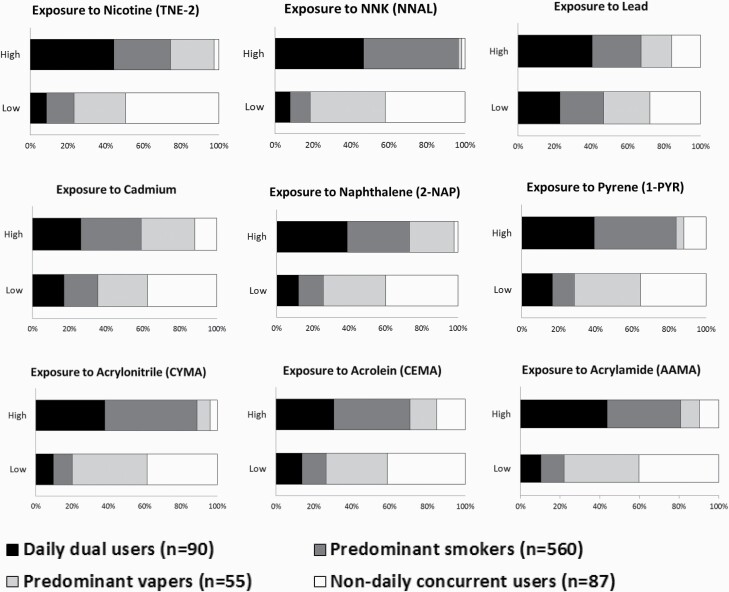
Results: Most dual users were predominant cigarette smokers (70%), followed by daily dual users (13%), non-daily concurrent dual users (10%), and predominant vapers (7%). Dual users who smoked daily showed significantly higher biomarker concentrations compared with those who did not smoke daily. Patterns of e-cigarette use had little effect on toxicant exposure. Dual users with high toxicant exposure were generally older, female, and smoked more cigarettes per day. Dual users who had low levels of biomarkers of exposure were generally younger, male, and smoked non-daily.
Conclusions: In 2013-2014, most dual users smoked cigarettes daily and used e-cigarettes occasionally. Cigarette smoking appears to be the primary driver of toxicant exposure among dual users, with little-to-no effect of e-cigarette use on biomarker levels. Results reinforce the need for dual users to stop smoking tobacco cigarettes to reduce toxicant exposure.
Implications: With considerable dual use of tobacco cigarettes and e-cigarettes in the United States, it is important to understand differences in toxicant exposure among subsets of dual users, and how these differences align with user demographics. Findings suggest most dual users smoke daily and use e-cigarettes intermittently. Low exposure to toxicants was most common among younger users, males, and intermittent smokers; high exposure to toxicants was most common among older users, females, and heavier cigarette smokers. Results underscore the heterogeneity occurring within dual users, and the need to quit smoking cigarettes completely in order to reduce toxicant exposure.
© The Author(s) 2021. Published by Oxford University Press on behalf of the Society for Research on Nicotine and Tobacco. All rights reserved. For permissions, please e-mail: journals.permissions@oup.com.
Figures
References
-
- National Academies of Sciences, Engineering, and Medicine. Public Health Consequences of E-Cigarettes. Washington, DC: National Academies Press; 2018. https://www.ncbi.nlm.nih.gov/books/NBK507187/. Accessed August 14, 2018. - PubMed
Publication types
MeSH terms
Substances
Grants and funding
LinkOut - more resources
Full Text Sources
Other Literature Sources
Medical
