. 2021 Apr;299(1):222-231.
doi: 10.1148/radiol.2021203531. Epub 2021 Feb 16.

Relationship between Emphysema Progression at CT and Mortality in Ever-Smokers: Results from the COPDGene and ECLIPSE Cohorts

Affiliations

Relationship between Emphysema Progression at CT and Mortality in Ever-Smokers: Results from the COPDGene and ECLIPSE Cohorts

Samuel Y Ash et al. Radiology. 2021 Apr.

Abstract

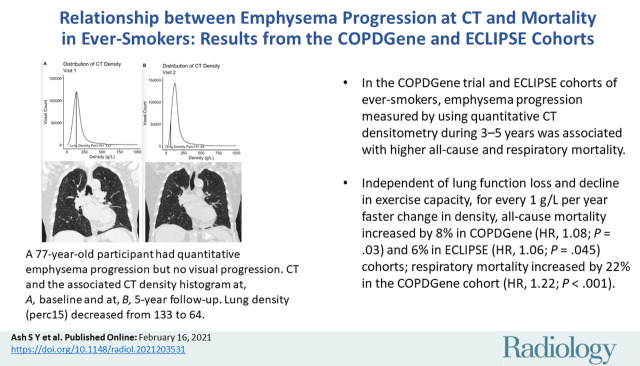
Background The relationship between emphysema progression and long-term outcomes is unclear. Purpose To determine the relationship between emphysema progression at CT and mortality among participants with emphysema. Materials and Methods In a secondary analysis of two prospective observational studies, COPDGene (clinicaltrials.gov, NCT00608764) and Evaluation of Chronic Obstructive Pulmonary Disease Longitudinally to Identify Predictive Surrogate End-points (ECLIPSE; clinicaltrials.gov, NCT00292552), emphysema was measured at CT at two points by using the volume-adjusted lung density at the 15th percentile of the lung density histogram (hereafter, lung density perc15) method. The association between emphysema progression rate and all-cause mortality was analyzed by using Cox regression adjusted for ethnicity, sex, baseline age, pack-years, and lung density, baseline and change in smoking status, forced expiratory volume in 1 second, and 6-minute walk distance. In COPDGene, respiratory mortality was analyzed by using the Fine and Gray method. Results A total of 5143 participants (2613 men [51%]; mean age, 60 years ± 9 [standard deviation]) in COPDGene and 1549 participants (973 men [63%]; mean age, 62 years ± 8) in ECLIPSE were evaluated, of which 2097 (40.8%) and 1179 (76.1%) had emphysema, respectively. Baseline imaging was performed between January 2008 and December 2010 for COPDGene and January 2006 and August 2007 for ECLIPSE. Follow-up imaging was performed after 5.5 years ± 0.6 in COPDGene and 3.0 years ± 0.2 in ECLIPSE, and mortality was assessed over the ensuing 5 years in both. For every 1 g/L per year faster rate of decline in lung density perc15, all-cause mortality increased by 8% in COPDGene (hazard ratio [HR], 1.08; 95% CI: 1.01, 1.16; P = .03) and 6% in ECLIPSE (HR, 1.06; 95% CI: 1.00, 1.13; P = .045). In COPDGene, respiratory mortality increased by 22% (HR, 1.22; 95% CI: 1.13, 1.31; P < .001) for the same increase in the rate of change in lung density perc15. Conclusion In ever-smokers with emphysema, emphysema progression at CT was associated with increased all-cause and respiratory mortality. © RSNA, 2021 Online supplemental material is available for this article. See also the editorial by Lee and Park in this issue.


Figures
None
Graphical abstract
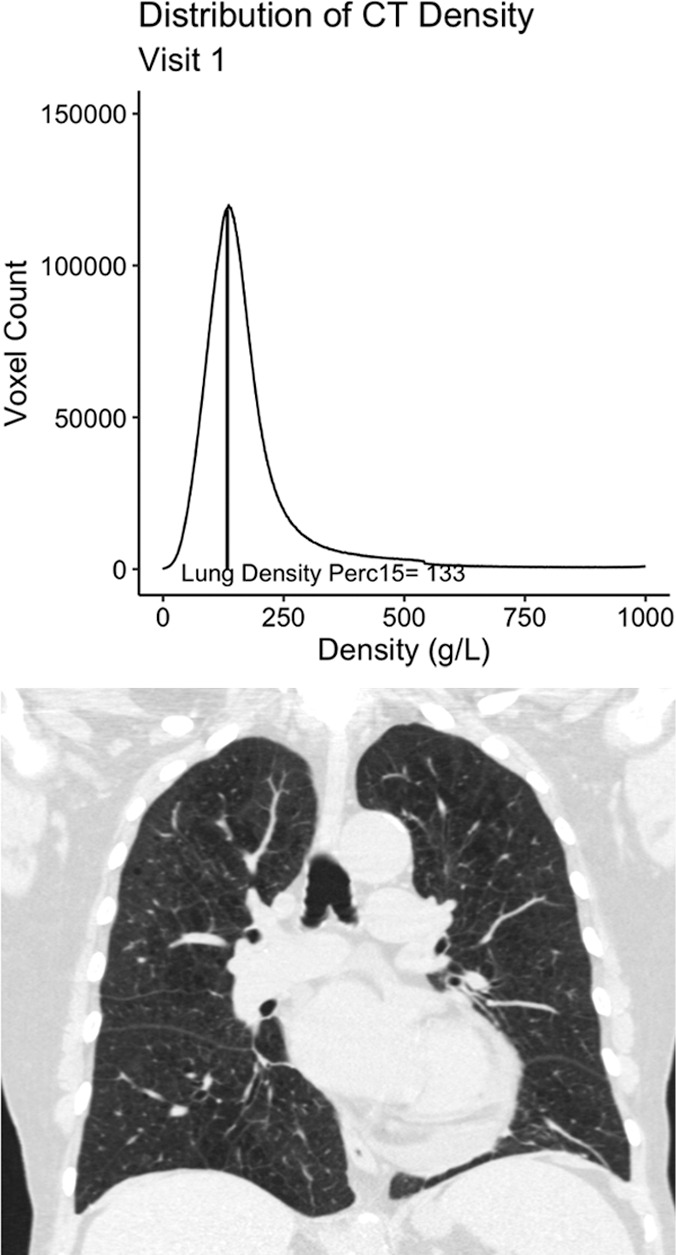
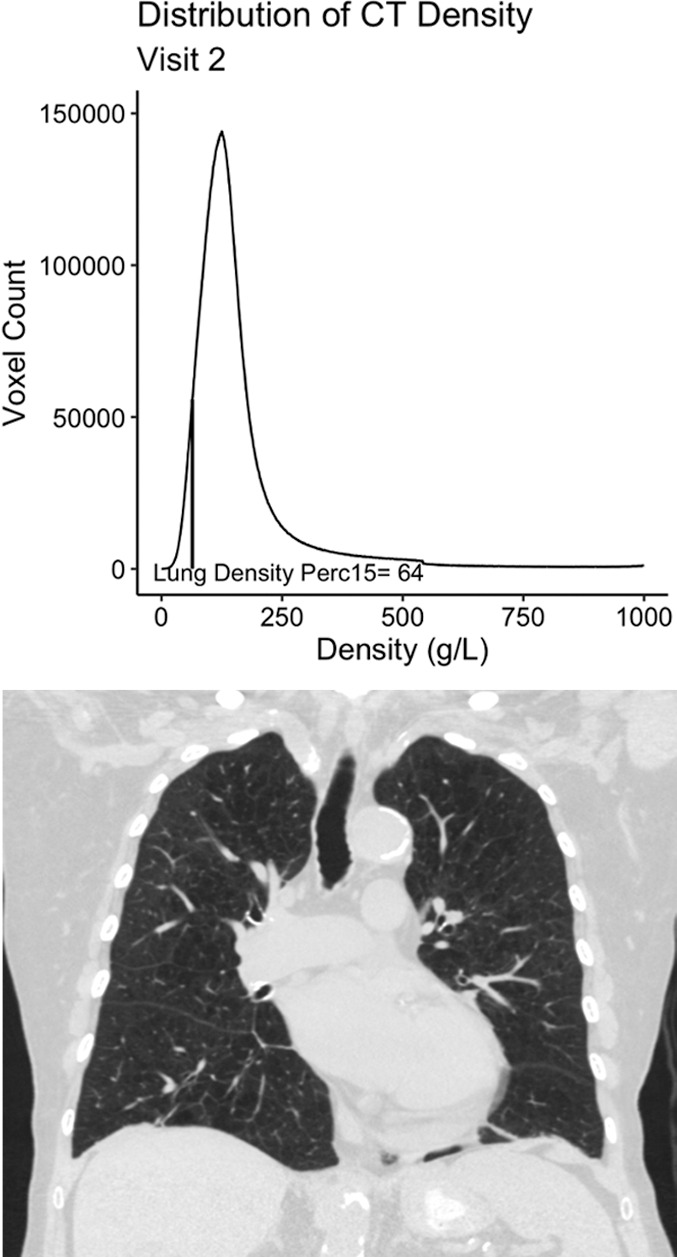
Example 77-year-old female participant from the chronic pulmonary obstructive disease (COPD) gene (COPDGene) cohort with evidence of quantitative emphysema progression but no clear visual progression of emphysema over 5 years who ultimately died during long term follow-up. (a) A representative coronal noncontrast CT image and the associated CT density histogram for the participant at baseline. (b) A representative noncontrast-enhanced coronal CT image and the associated CT density histogram for the participant at the 5-year follow-up visit. Lung density perc15 = volume-adjusted lung density measured at the 15th percentile of the CT lung density histogram.
Figure 1a:
Example 77-year-old female participant from the chronic pulmonary obstructive disease (COPD) gene (COPDGene) cohort with evidence of quantitative emphysema progression but no clear visual progression of emphysema over 5 years who ultimately died during long term follow-up. (a) A representative coronal noncontrast CT image and the associated CT density histogram for the participant at baseline. (b) A representative noncontrast-enhanced coronal CT image and the associated CT density histogram for the participant at the 5-year follow-up visit. Lung density perc15 = volume-adjusted lung density measured at the 15th percentile of the CT lung density histogram.
Figure 1b:
Example 77-year-old female participant from the chronic pulmonary obstructive disease (COPD) gene (COPDGene) cohort with evidence of quantitative emphysema progression but no clear visual progression of emphysema over 5 years who ultimately died during long term follow-up. (a) A representative coronal noncontrast CT image and the associated CT density histogram for the participant at baseline. (b) A representative noncontrast-enhanced coronal CT image and the associated CT density histogram for the participant at the 5-year follow-up visit. Lung density perc15 = volume-adjusted lung density measured at the 15th percentile of the CT lung density histogram.
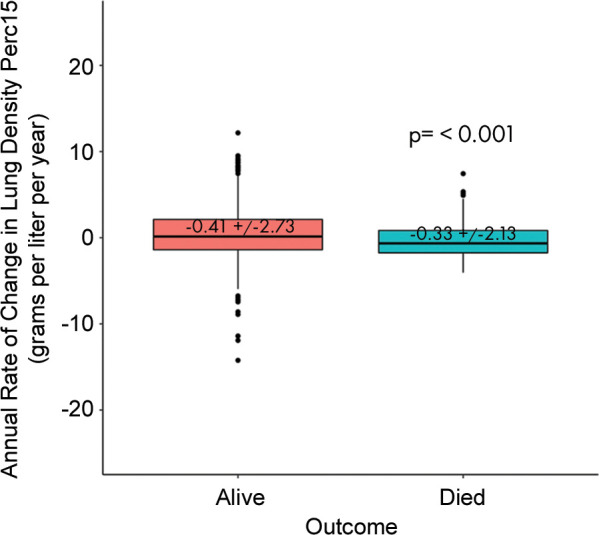
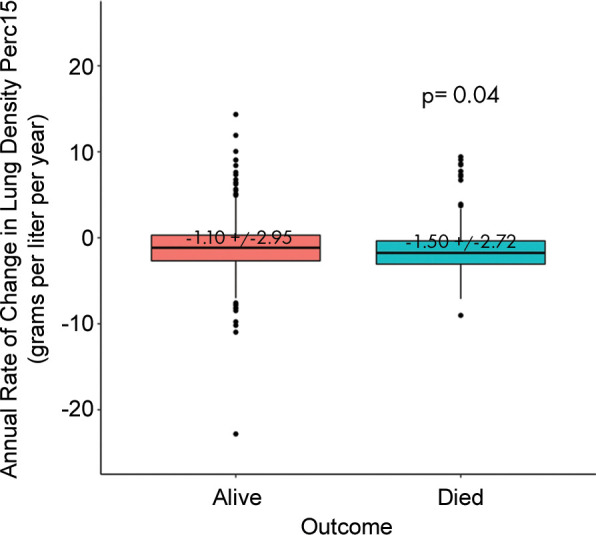
Differences in progression rate by outcome. Annualized rate of change in volume-adjusted lung density measured at the 15th percentile (referred to as lung density perc15) of the CT lung density histogram by mortality in the (a) COPDGene cohort (those with emphysema at baseline) and in the (b) Evaluation of Chronic Obstructive Pulmonary Diseaase Longitudinally to Identify Predictive Surrogate End-points (ECLIPSE) cohort (those with emphysema at baseline). Differences between rates by outcome assessed by using t tests.
Figure 2a:
Differences in progression rate by outcome. Annualized rate of change in volume-adjusted lung density measured at the 15th percentile (referred to as lung density perc15) of the CT lung density histogram by mortality in the (a) COPDGene cohort (those with emphysema at baseline) and in the (b) Evaluation of Chronic Obstructive Pulmonary Diseaase Longitudinally to Identify Predictive Surrogate End-points (ECLIPSE) cohort (those with emphysema at baseline). Differences between rates by outcome assessed by using t tests.
Figure 2b:
Differences in progression rate by outcome. Annualized rate of change in volume-adjusted lung density measured at the 15th percentile (referred to as lung density perc15) of the CT lung density histogram by mortality in the (a) COPDGene cohort (those with emphysema at baseline) and in the (b) Evaluation of Chronic Obstructive Pulmonary Diseaase Longitudinally to Identify Predictive Surrogate End-points (ECLIPSE) cohort (those with emphysema at baseline). Differences between rates by outcome assessed by using t tests.
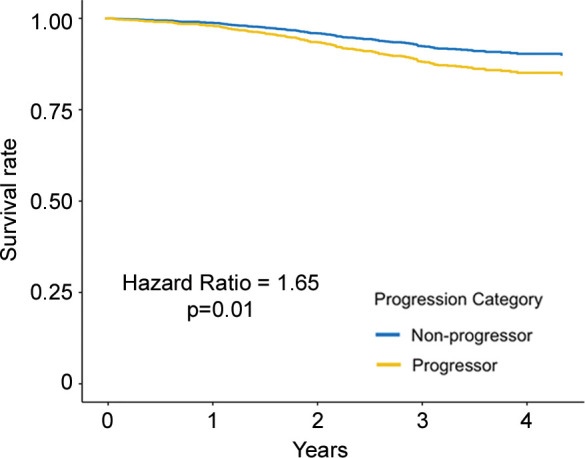
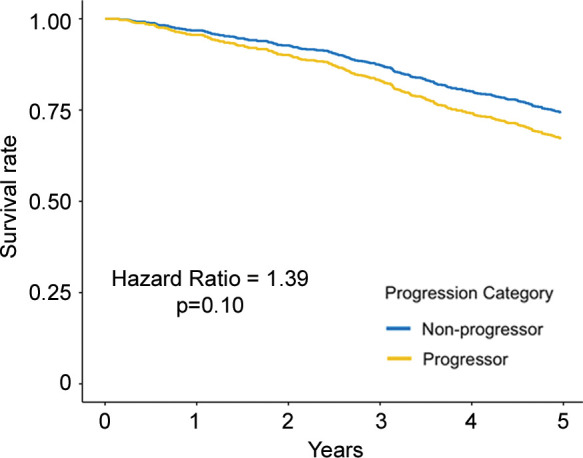
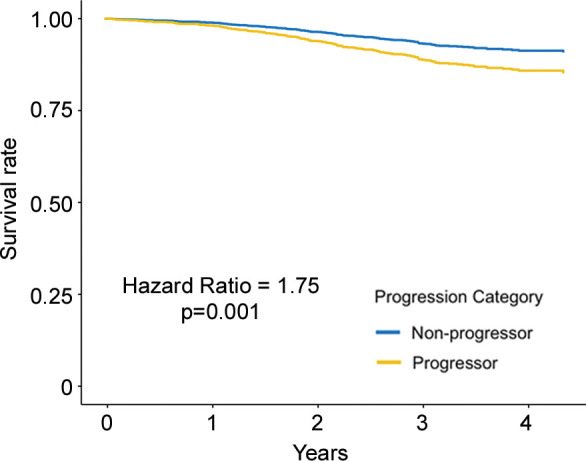
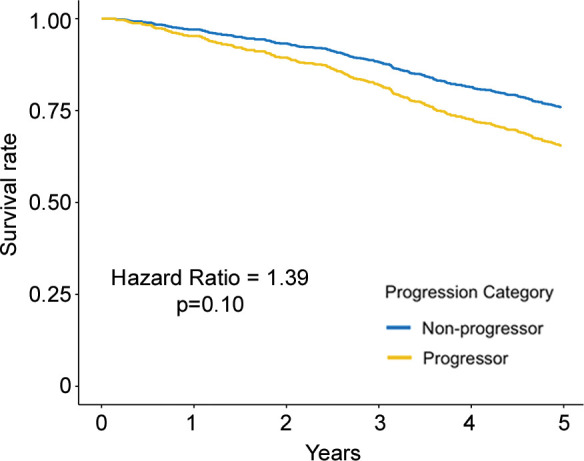
Adjusted survival curves created by using the corrected group prognosis method and by using multivariable Cox models adjusted for ethnicity; sex; baseline age; baseline pack-years of cigarette use; baseline percent predicted expiratory volume in 1 second; baseline volume-adjusted lung density measured at the 15th percentile of the CT lung density histogram (referred to as lung density perc15); and change in scanner model, body mass index, CT-measured lung volume, and smoking status. Survival curves of (a) COPDGene cohort (participants with emphysema at baseline) and (b) Evaluation of Chronic Pulmonary Obstructive Disease Longitudinally to Identify Predictive Surrogate End-points (ECLIPSE) cohort (participants with emphysema at baseline) show progressors who had a decrease of lung density perc15 more than the repeatability coefficient and nonprogressors who did not. Survival curves of (c) COPDGene cohort and (d) ECLIPSE cohort progressors in whom the rate of lung density perc15 decline was faster than the distribution-based minimum clinically important difference on the basis of the rate of change in never-smoking healthy participants.
Figure 3a:
Adjusted survival curves created by using the corrected group prognosis method and by using multivariable Cox models adjusted for ethnicity; sex; baseline age; baseline pack-years of cigarette use; baseline percent predicted expiratory volume in 1 second; baseline volume-adjusted lung density measured at the 15th percentile of the CT lung density histogram (referred to as lung density perc15); and change in scanner model, body mass index, CT-measured lung volume, and smoking status. Survival curves of (a) COPDGene cohort (participants with emphysema at baseline) and (b) Evaluation of Chronic Pulmonary Obstructive Disease Longitudinally to Identify Predictive Surrogate End-points (ECLIPSE) cohort (participants with emphysema at baseline) show progressors who had a decrease of lung density perc15 more than the repeatability coefficient and nonprogressors who did not. Survival curves of (c) COPDGene cohort and (d) ECLIPSE cohort progressors in whom the rate of lung density perc15 decline was faster than the distribution-based minimum clinically important difference on the basis of the rate of change in never-smoking healthy participants.
Figure 3b:
Adjusted survival curves created by using the corrected group prognosis method and by using multivariable Cox models adjusted for ethnicity; sex; baseline age; baseline pack-years of cigarette use; baseline percent predicted expiratory volume in 1 second; baseline volume-adjusted lung density measured at the 15th percentile of the CT lung density histogram (referred to as lung density perc15); and change in scanner model, body mass index, CT-measured lung volume, and smoking status. Survival curves of (a) COPDGene cohort (participants with emphysema at baseline) and (b) Evaluation of Chronic Pulmonary Obstructive Disease Longitudinally to Identify Predictive Surrogate End-points (ECLIPSE) cohort (participants with emphysema at baseline) show progressors who had a decrease of lung density perc15 more than the repeatability coefficient and nonprogressors who did not. Survival curves of (c) COPDGene cohort and (d) ECLIPSE cohort progressors in whom the rate of lung density perc15 decline was faster than the distribution-based minimum clinically important difference on the basis of the rate of change in never-smoking healthy participants.
Figure 3c:
Adjusted survival curves created by using the corrected group prognosis method and by using multivariable Cox models adjusted for ethnicity; sex; baseline age; baseline pack-years of cigarette use; baseline percent predicted expiratory volume in 1 second; baseline volume-adjusted lung density measured at the 15th percentile of the CT lung density histogram (referred to as lung density perc15); and change in scanner model, body mass index, CT-measured lung volume, and smoking status. Survival curves of (a) COPDGene cohort (participants with emphysema at baseline) and (b) Evaluation of Chronic Pulmonary Obstructive Disease Longitudinally to Identify Predictive Surrogate End-points (ECLIPSE) cohort (participants with emphysema at baseline) show progressors who had a decrease of lung density perc15 more than the repeatability coefficient and nonprogressors who did not. Survival curves of (c) COPDGene cohort and (d) ECLIPSE cohort progressors in whom the rate of lung density perc15 decline was faster than the distribution-based minimum clinically important difference on the basis of the rate of change in never-smoking healthy participants.
Figure 3d:
Adjusted survival curves created by using the corrected group prognosis method and by using multivariable Cox models adjusted for ethnicity; sex; baseline age; baseline pack-years of cigarette use; baseline percent predicted expiratory volume in 1 second; baseline volume-adjusted lung density measured at the 15th percentile of the CT lung density histogram (referred to as lung density perc15); and change in scanner model, body mass index, CT-measured lung volume, and smoking status. Survival curves of (a) COPDGene cohort (participants with emphysema at baseline) and (b) Evaluation of Chronic Pulmonary Obstructive Disease Longitudinally to Identify Predictive Surrogate End-points (ECLIPSE) cohort (participants with emphysema at baseline) show progressors who had a decrease of lung density perc15 more than the repeatability coefficient and nonprogressors who did not. Survival curves of (c) COPDGene cohort and (d) ECLIPSE cohort progressors in whom the rate of lung density perc15 decline was faster than the distribution-based minimum clinically important difference on the basis of the rate of change in never-smoking healthy participants.

Comment in

References

    1. Auerbach O, Hammond EC, Kirman D, Garfinkel L. Emphysema produced in dogs by cigarette smoking. JAMA 1967;199(4):241–246. - PubMed
    1. Goddard PR, Nicholson EM, Laszlo G, Watt I. Computed tomography in pulmonary emphysema. Clin Radiol 1982;33(4):379–387. - PubMed
    1. Müller NL, Staples CA, Miller RR, Abboud RT. “Density mask”. An objective method to quantitate emphysema using computed tomography. Chest 1988;94(4):782–787. - PubMed
    1. Jones PW, Beeh KM, Chapman KR, Decramer M, Mahler DA, Wedzicha JA. Minimal clinically important differences in pharmacological trials. Am J Respir Crit Care Med 2014;189(3):250–255. - PubMed
    1. National Lung Screening Trial Research Team ; Church TR, Black WC, et al. . Results of initial low-dose computed tomographic screening for lung cancer. N Engl J Med 2013;368(21):1980–1991. - PMC - PubMed

Publication types

Associated data