


The late Holocene demise of a sublittoral oyster bed in the North Sea
- PMID: 33591987
- PMCID: PMC7886217
- DOI: 10.1371/journal.pone.0242208
The late Holocene demise of a sublittoral oyster bed in the North Sea
Abstract
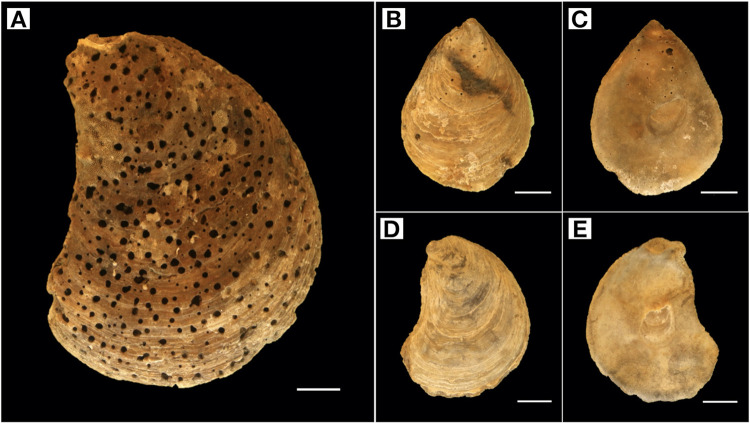
A fossil oyster bed (Ostrea edulis) was recently encountered offshore Helgoland (German Bight). Oysters are important filter feeders in marine environments and their habitat structure supports a large associated biodiversity. The European flat oyster Ostrea edulis has historically occurred in vast populations in the North Sea, but declined massively in the early 20th century. The ecological restoration of Ostrea habitats is a current focal point in the North Sea. To better understand the mechanisms that caused the local collapse of the oyster population, this study investigated the size structure, weight, and age of the shells, along with the spatial dimensions, seafloor properties, and environmental context of the oyster bed. The results show that the demise of the population occurred around 700 CE, ruling out excessive harvest as a driver of decline. Synchronicity of increased geomorphological activity of rivers and concurrent major land use changes in early medieval Europe suggest that increased sedimentation was a viable stressor that reduced the performance of the oysters. The shells provided no indication of a demographically poor state of the oyster bed prior to its demise, but manifested evidence of the wide-spread occurrence of the boring sponge Cliona sp. Our study challenges the assumption of a stable preindustrial state of the European flat oyster in the North Sea, and we conclude that the long-term variability of environmental conditions needs to be addressed to benchmark success criteria for the restoration of O. edulis.
Conflict of interest statement
The authors have declared that no competing interests exist.
Figures




References
-
- OSPAR. Background document for Ostrea edulis and Ostrea edulis beds. London: OSPAR Commission; 2009. 21 p.
-
- Bromley C, McGonigle C, Ashton EC, Roberts D. Bad moves: Pros and cons of moving oysters–A case study of global translocations of Ostrea edulis Linnaeus, 1758 (Mollusca: Bivalvia). Ocean Coast. Manage. 2016; 122:103–115.
-
- Hayer S, Bick A, Brandt A, Ewers-Saucedo C, Fiege D, Füting S, et al. Coming and going–Historical distributions of the European oyster Ostrea edulis Linnaeus, 1758 and the introduced slipper limpet Crepidula fornicata Linnaeus, 1758 in the North Sea. PLOS ONE. 2019;14(10): e0224249 10.1371/journal.pone.0224249 - DOI - PMC - PubMed
-
- Caspers H. Die Lebensgemeinschaft der Helgoländer Austernbank. Helgoland Wiss. Meer. 1950; 3(1):119.
Publication types
MeSH terms
LinkOut - more resources
Full Text Sources
Other Literature Sources
