


Kidney function and markers of renal damage after renal denervation. Does method of measurement matter? The Reshape CV-Risk Study
- PMID: 33592134
- PMCID: PMC8678667
- DOI: 10.1111/jch.14214
Kidney function and markers of renal damage after renal denervation. Does method of measurement matter? The Reshape CV-Risk Study
Abstract
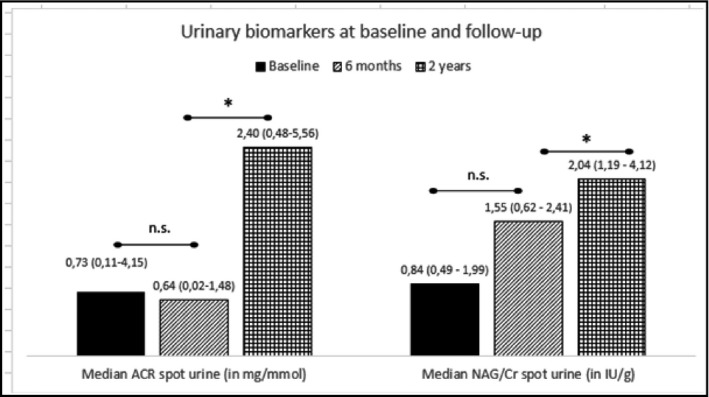
Data suggest that renal denervation (RDN) in treatment-resistant hypertension (TRHT) is safe in terms of renal function. However, most studies report kidney function as creatinine-based estimated glomerular filtration rate (eGFR), which may be biased by non-renal factors. Damage markers other than albuminuria have never been evaluated after RDN. In this non-randomized RDN trial, we studied changes in kidney function, assessed as measured GFR (mGFR) and various GFR estimates, six months and two years after RDN. We also examined changes in albuminuria and a biomarker of tubular dysfunction. Adult non-diabetic patients with TRHT and eGFR ≥45 ml/min/1.73 m2 were recruited from hypertension clinics. Before bilateral RDN, mGFR was measured by iohexol clearance. We estimated eGFR from serum creatinine and cystatin C (eGFRcrea , eGFRcys, and eGFRcreacys ), and albumin-creatinine ratio (ACR) and N-acetyl-β-D-glucosaminidase (NAG)-creatinine ratio (NAG-CR) were measured in spot urines. All measurements were repeated after six and twenty-four months. Twenty patients, mean age 54 (±9) years and baseline mGFR 83 (±20) ml/min/1.73 m2 underwent RDN. After six months, mGFR fell, eGFRcrea remained unchanged, whereas eGFRcys and eGFRcreacys increased. At 2 years' follow-up, eGFRcreacys was significantly lower than at baseline. mGFR was 78 (±28) ml/min/1.73 m2 . Change in ambulatory systolic BP predicted change in eGFRcrea . Urinary NAG-CR, but not ACR, increased during follow-up. Different GFR assessments gave diverging results after RDN. Therefore, care should be taken to method when evaluating kidney function after RDN. Increases in a tubular dysfunction biomarker suggest that kidney damage may occur. Long-term renal follow-up is needed after RDN.
Keywords: glomerular filtration rate; renal denervation; urinary biomarkers.
© 2021 The Authors. The Journal of Clinical Hypertension published by Wiley Periodicals LLC.
Conflict of interest statement
The authors has no conflicts of interest to declare.
Figures

References
-
- Collaborators GBDRF, Forouzanfar MH, Alexander L, et al. Global, regional, and national comparative risk assessment of 79 behavioural, environmental and occupational, and metabolic risks or clusters of risks in 188 countries, 1990–2013: A systematic analysis for the global burden of disease study. Lancet. 2015;386:2287‐2323. - PMC - PubMed
-
- Mancia G, Fagard R, Narkiewicz K, et al. 2013 esh/esc guidelines for the management of arterial hypertension: The task force for the management of arterial hypertension of the European Society of Hypertension (esh) and of the European Society of Cardiology (esc). Eur Heart J. 2013;34:2159‐2219. - PubMed
-
- Williams B, Mancia G, Spiering W, et al. Group ESCSD: 2018 esc/esh guidelines for the management of arterial hypertension. Eur Heart J. 2018;39:3021‐3104. - PubMed
-
- Voora R, Hinderliter AL. Modulation of sympathetic overactivity to treat resistant hypertension. Curr Hypertens Rep. 2018;20:92. - PubMed
Publication types
MeSH terms
Substances
LinkOut - more resources
Full Text Sources
Other Literature Sources
Medical
Research Materials
Miscellaneous
