


The Co-evolution of online social networks and syphilis incidence among young black men who have sex with men
- PMID: 33592396
- PMCID: PMC7939051
- DOI: 10.1016/j.socscimed.2021.113764
The Co-evolution of online social networks and syphilis incidence among young black men who have sex with men
Erratum in
-
Corrigendum to "The Co-evolution of Online Social Networks and Syphilis Incidence among Young Black Men Who have Sex with Men" [Soc. Sci. Med. 272 (2020) 113764].Soc Sci Med. 2021 Apr;274:113823. doi: 10.1016/j.socscimed.2021.113823. Epub 2021 Mar 11. Soc Sci Med. 2021. PMID: 33714642 No abstract available.
Abstract
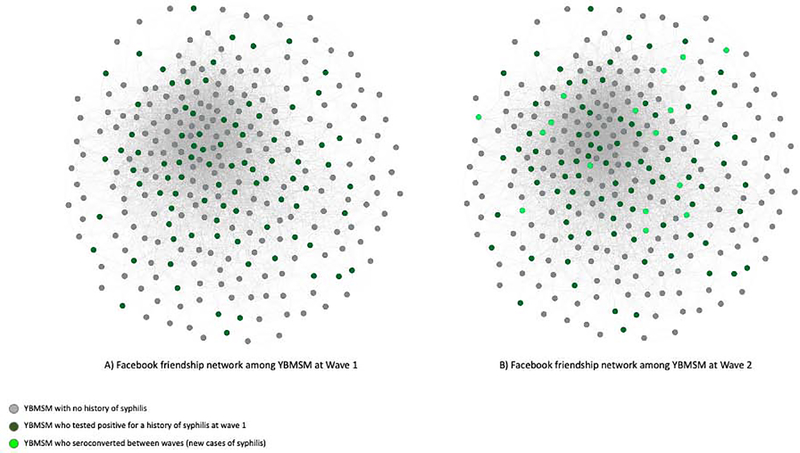
Network contexts have been implicated in the facilitation of syphilis transmission, however little is known about the relationship between online social networks, a proxy for physical networks, and rates of syphilis infection and how they co-evolve over time. To these ends, this study explored the interdependent relationship between Facebook friendship network dynamics and rates of syphilis incidence among young Black men who have sex with men (YBMSM). Specifically, we investigated the extent to which syphilis status, as a latent profile of network members, serves as a selection mechanism of Facebook tie formation and the degree to which Facebook friendships influenced dynamics of syphilis seroconversion. Sexual health, behavioral, and social network data were collected from a cohort of YBMSM (N = 286, Mean age = 22.8) at two time points between 2013 and 2015 in Chicago, IL, USA. The interdependencies between Facebook friendship networks and syphilis infection were assessed using stochastic actor-based models for social networks and behavior. Results showed that YBMSM tended to form Facebook friendships with other YBMSM who had similar syphilis and HIV status profiles, and the hazard of contracting syphilis was likewise influenced by their Facebook friendships, albeit subtly, by being connected to infectious network members. Meanwhile, intrinsic characteristics like condomless sex, HIV status, and online partner-seeking were not associated with dynamics in syphilis incidence. These findings show that there is a mutually dependent relationship between the online network dynamics of YBMSM and rates of syphilis incidence. Findings also direct attention to network-based strategies for intervention.
Keywords: Dynamic network models; Men who have sex with men; Online social networks; Stochastic actor-based models; Syphilis.
Copyright © 2021 Elsevier Ltd. All rights reserved.
Conflict of interest statement
Figures
References
-
- Beymer MR, Weiss RE, Bolan RK, Rudy ET, Bourque LB, Rodriguez JP, & Morisky DE (2014). Sex on demand: geosocial networking phone apps and risk of sexually transmitted infections among a cross-sectional sample of men who have sex with men in Los Angeles county. Sexually transmitted infections, sextrans-2013. - PMC - PubMed
-
- Centers for Disease Control and Prevention. (2004). Transmission of primary and secondary syphilis by oral sex--Chicago, Illinois, 1998–2002. MMWR. Morbidity and mortality weekly report, 53(41), 966. - PubMed
-
- Centers for Disease Control and Prevention. (2017a). Social Network Strategy for HIV Testing Recruitment. Retrieved from https://effectiveinterventions.cdc.gov/en/HighImpactPrevention/PublicHea...
Publication types
MeSH terms
Grants and funding
LinkOut - more resources
Full Text Sources
Other Literature Sources
Medical
Miscellaneous
